Cost Of Capital: Key Factors And Why It Matters & Calculation
Understanding the cost of capital is key to running a business. It’s the money a company needs to pay for loans or investments.
Cost of capital is the return a company needs to generate to meet the expectations of its investors, including both equity and debt holders. It reflects the company’s risk profile and influences investment decisions. A lower cost of capital indicates cheaper financing, promoting business growth.
Whether you’re a new startup or a large company, knowing the cost of capital is key to building success and staying strong in the market.
Key Takeaways
- Varies by Business Risk: Cost of capital reflects a company’s risk level, with higher risk leading to higher required returns by investors.
- Mix of Debt and Equity: Companies balance debt and equity to optimize their overall cost of capital, considering interest rates and investor expectations.
- Influenced by Market Conditions: Economic factors like interest rates and inflation directly impact businesses’ cost of capital.
- Critical for Investment Decisions: Understanding the cost of capital helps businesses evaluate potential investments and growth opportunities.
- Impacts Business Valuation: A company’s cost of capital influences its overall value and ability to attract funding.
What Is The Cost Of Capital?
The cost of capital is the price a business pays to raise money for its operations or growth. It includes both debt and equity. When a company borrows money or sells shares, it needs to offer returns to investors. These returns are the cost of capital.
Debt usually comes with interest, while equity involves sharing profits. Companies look at their cost of capital to decide how to fund their projects. By understanding this, businesses make smarter choices on where to invest or grow.
Knowing the cost of capital helps businesses plan their finances better. It ensures they don’t overpay when raising funds, allowing them to keep growing without risking too much.
Types Of Cost Of Capital
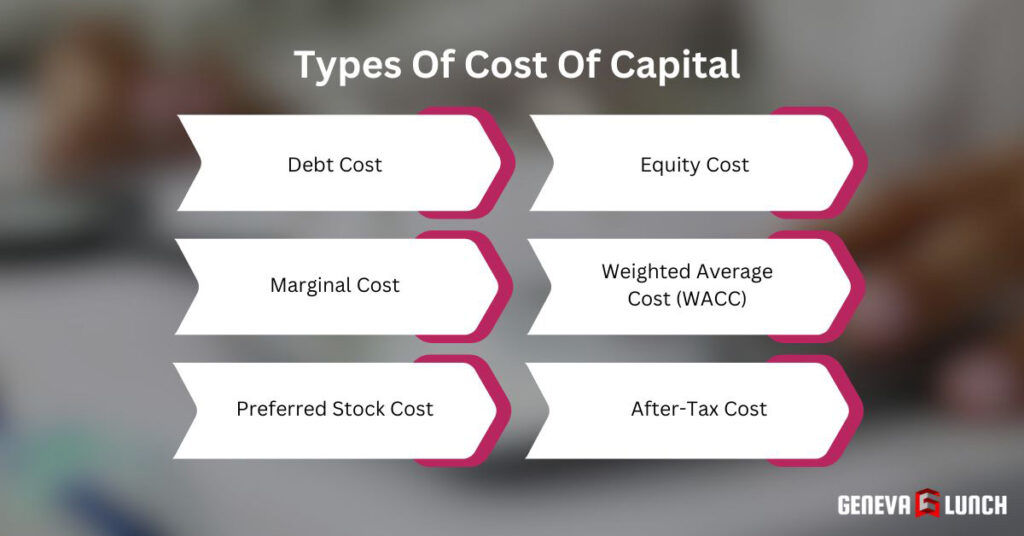
The cost of capital comes from different sources. Each source has its own cost and impact on a business. Companies raise money through borrowing (debt) or getting investors (equity). Understanding these types helps businesses decide how to fund their projects. Below are the main types of cost of capital.
Debt Cost
Debt cost is the interest a company pays when it borrows money. Businesses often take loans or issue bonds to raise money, and the debt cost includes the loan’s interest rate. Companies with good credit scores usually get lower interest rates. Lower debt costs make borrowing cheaper, and help businesses grow without giving up ownership.
Equity Cost
Equity cost is the return investors expect when buying company shares. It is higher than debt because investors take on more risk and don’t receive regular payments like lenders.
When the business does well, the value of the shares rises. If not, investors may lose money. The equity cost pushes businesses to perform well to meet investor expectations.
Marginal Cost
The marginal cost of capital refers to raising one more dollar of capital. This type focuses on how much it costs to get extra money as a company grows. The marginal cost increases as a company raises more money because investors and lenders demand higher returns due to the growing risk.
Weighted Average Cost (WACC)
The Weighted Average Cost of Capital (WACC) combines the cost of debt, equity, and other funding sources. Each source is weighted based on its contribution to the company’s total capital.
WACC gives the overall cost of capital, helping companies make investment decisions. A lower WACC means cheaper capital, which can lead to better profits.
Preferred Stock Cost
Preferred stock cost is the return a company pays to preferred shareholders. Preferred stockholders get fixed payments, similar to debt, but they have more security than regular shareholders. The cost of preferred stock is usually lower than equity but higher than debt. It provides a balance between the two.
After-Tax Cost
The after-tax cost of capital applies mainly to debt. Companies can deduct interest payments on debt from their taxes, lowering the actual cost of borrowing. The after-tax cost is the interest rate on debt minus the tax savings. Lower after-tax costs make debt a more attractive option for funding.
How To Calculate Cost Of Capital?
Calculating the cost of capital helps businesses understand how much it costs them to raise money. It shows the expected return for both equity and debt investors. Depending on how the business gets its money, there are several ways to calculate the cost of capital. Below are some common methods.
Capital Asset Pricing Model (CAPM)
The Capital Asset Pricing Model (CAPM) calculates the cost of equity. It uses the risk-free rate, market risk premium, and beta (a measure of how risky a stock is compared to the market). The formula is:
Cost of Equity (Re) = Risk-Free Rate + Beta × (Market Return – Risk-Free Rate)
This method helps figure out how much return investors expect for taking on extra risk.
Dividend Discount Model (DDM)
The Dividend Discount Model (DDM) focuses on the company’s dividends to shareholders. It assumes the value of the stock equals the sum of all future dividends. The formula is:
Cost of Equity (Re) = (Next Year’s Dividend / Current Stock Price) + Growth Rate of Dividends
This method works well for companies that pay regular dividends and have predictable growth.
Bond Yield Plus Risk Premium
The Bond Yield Plus Risk Premium approach calculates the cost of equity by adding a risk premium to the company’s bond yield. The risk premium reflects the extra return investors want for owning stocks instead of bonds. The formula is:
Cost of Equity (Re) = Bond Yield + Risk Premium
This method is easy to use and works best for companies with traded bonds.
Marginal Cost Of Capital
The marginal cost of capital considers debt and equity and reflects the current costs of raising new funds. It is calculated by calculating the cost of one additional dollar of capital.
The formula combines the cost of debt and equity based on their proportion in the company’s capital structure. The overall formula is:
WACC = (E/V) × Re + (D/V) × Rd × (1 – Tax Rate)
Here, E is equity, D is debt, V is the total value (E + D), Re is the cost of equity, Rd is the cost of debt, and WACC is the weighted average cost of capital.
What Factors Influence The Cost Of Capital?
The cost of capital depends on many factors that can change over time. Knowing these factors helps businesses make better financial choices. They also impact the way a company raises money and invests. Let’s explore key factors that influence the cost of capital.
Market Conditions
Market conditions play a big role in the cost of capital. Interest rates tend to be lower when the economy is strong, making borrowing cheaper. On the other hand, in times of economic uncertainty, lenders demand higher returns due to increased risk. Changes in stock prices and demand for bonds also impact the cost of raising funds for a company.
Company-Specific Factors
Each company faces different costs based on its unique situation. For example, a company with a strong reputation and steady cash flow will likely pay less to raise capital. On the other hand, securing funding for newer companies or those facing challenges may be more complex and expensive.
Inflation
Inflation affects the cost of capital because it decreases the value of money over time. When inflation rises, lenders want to ensure they don’t lose out. They raise interest rates to cover the loss in value, making it more expensive for businesses to borrow money.
Credit Rating
A company’s credit rating shows how likely it is to repay its debts. A higher credit rating means the company can borrow at lower rates. Lower-rated companies face higher borrowing costs because lenders see them as risky. Investors expect more returns from these companies, increasing their cost of capital.
Capital Structure
How a company mixes debt and equity in its capital structure impacts its cost of capital. A company with more debt may face lower initial costs, as interest on debt is often cheaper than equity. However, too much debt can raise the risk of default, increasing the cost of capital in the long term.
Financial Leverage
Financial leverage refers to how much debt a company uses to finance its assets. While leveraging can help a company grow faster using borrowed funds, it also raises risk. When the business generates enough profit, it can repay its debt, leading to a higher cost of capital.
Importance Of Cost Of Capital
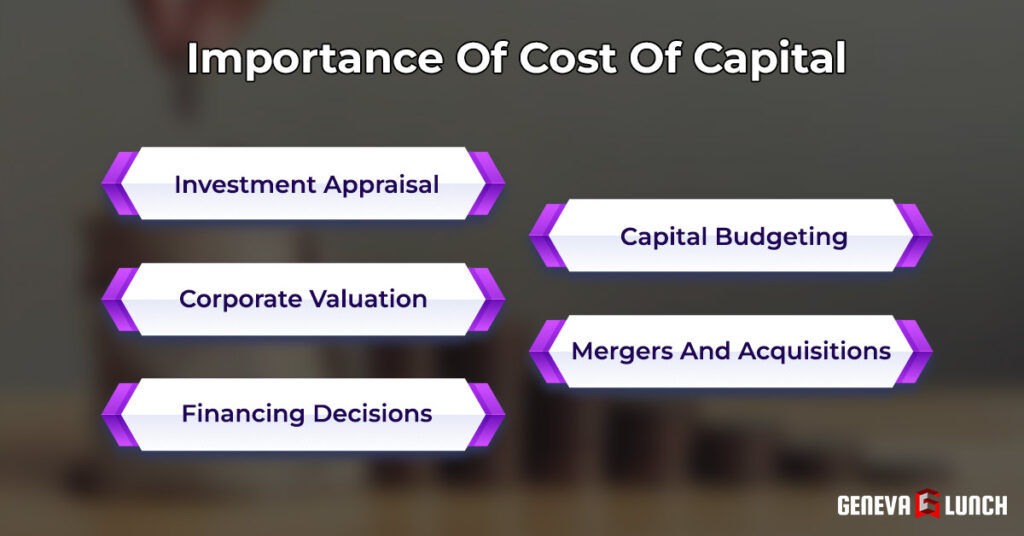
The cost of capital is key to a company’s growth and operation. It is the price a business pays to raise money, whether through debt or equity. Knowing the cost of capital helps businesses make smart decisions. A lower cost of capital means the company can grow more easily, while a higher cost makes things tougher.
Investment Appraisal
Investment appraisal helps businesses decide if a project or investment is worth the cost. The cost of capital acts as the benchmark.
When the expected return from the project is higher than the cost of capital, the company moves forward with the investment. When it’s lower, the company rejects the project. This process helps the business avoid risky or unprofitable investments.
Capital Budgeting
Capital budgeting is the process businesses use to plan for major expenses such as new buildings, equipment, or technology. The cost of capital checks if big expenses yield enough return to cover the cost of the money spent. When a business knows its cost of capital, it can prioritize projects that promise better returns, ensuring the best use of its resources.
Corporate Valuation
Corporate valuation is the process of determining a company’s worth. The cost of capital directly affects this value.
When businesses calculate their worth, they factor in future profits and the risk involved. A higher cost of capital means more risk. It lowers the company’s value. A lower cost boosts the company’s value.
Mergers And Acquisitions
In mergers and acquisitions, businesses must assess if a merger will be worth more than its cost. The cost of capital helps companies decide if a merger or acquisition will be profitable. It measures if the returns will exceed the financing costs. It ensures that businesses only pursue deals that add real value.
Financing Decisions
Financing decisions involve choosing between raising money through debt or equity. The cost of capital guides this choice. Businesses consider how much borrowing money (debt) costs versus selling shares (equity). By comparing these costs, they can pick the most affordable option. This helps companies stay profitable and reduce unnecessary expenses.
Challenges In Calculating The Cost Of Capital
Calculating the cost of capital can be challenging. Many factors can affect the final number, and small mistakes can lead to poor financial decisions. Companies need to understand debt and equity costs to get an accurate cost of capital. Estimating beta, a vital part of the calculation, can be tricky.
Estimating Beta
Beta measures how a company’s stock moves compared to the market. It shows investors’ risk level. A higher beta means more risk, while a lower beta means less. Estimating beta involves studying the stock’s past performance.
Beta Calculation Challenges
The stock market changes daily, making it difficult to calculate an accurate beta. A stock’s past performance does not always predict future results. The time period chosen for analysis can also affect beta. Using too short or too long a time can give false results.
Adjusting Beta For Leveraging
Leverage refers to how much debt a company uses. High leverage increases risk, which affects beta. Adjusting beta for leveraging is another challenge. The more debt a company has, the higher the beta, making the company riskier for investors.
Forecasting Market Returns
When a business tries to forecast market returns, it faces challenges. Markets change often, and predicting how they will perform is hard. Even small mistakes can affect the calculation of the cost of capital.
Market Risk Premium Uncertainty
The market risk premium is the extra return investors expect for taking on risk. Estimating this can be tricky because it depends on current market conditions. If a business guesses wrong, it may miscalculate its cost of capital.
Historical Vs. Expected Returns
Some businesses use past market returns to estimate future performance. But markets do not always behave the same. Using historical data can be risky if it doesn’t match future trends. Expected returns are often more accurate but harder to predict.
Impact Of Tax Rates
Tax rates directly affect a company’s cost of capital. When a company uses debt financing, it can deduct interest payments from its taxable income, lowering the cost of borrowing. However, taxes vary, making it tricky to plan properly.
Variability In Tax Impact
Tax rates change over time due to new laws or economic conditions. A company can face different tax rates from one year to the next.
This variability can complicate the calculation of the cost of capital. A higher tax rate increases the cost, while a lower rate can reduce it.
International Tax Considerations
International tax rules make it harder for companies operating in multiple countries to calculate the cost of capital. Different countries have unique tax laws, leading to complex decisions on where to invest or raise money. This affects the overall cost of capital, especially for global businesses.
Handling Non-Traditional Financing
Non-traditional financing involves sources of capital beyond standard loans or stock issuance. These types often come with special terms, making it harder to figure out the real cost. Let’s explore two common forms of non-traditional financing.
Hybrid Securities
Hybrid securities combine features of debt and equity. They may have fixed interest payments like bonds but also offer the potential to convert into company shares. Since hybrid securities aren’t purely debt or equity, calculating their cost can be tough.
Convertible Debt
Convertible debt starts as a loan but allows the lender to convert it into company stock later. This flexibility adds complexity to the cost of capital. The business must consider the interest payments and the potential stock value, making calculations harder.
Preferred Stock Complications
Preferred stock pays dividends before common stockholders but has no voting rights. The fixed dividends can complicate calculations, especially when interest rates or company performance shift, making it hard to decide the true cost.
Global Considerations
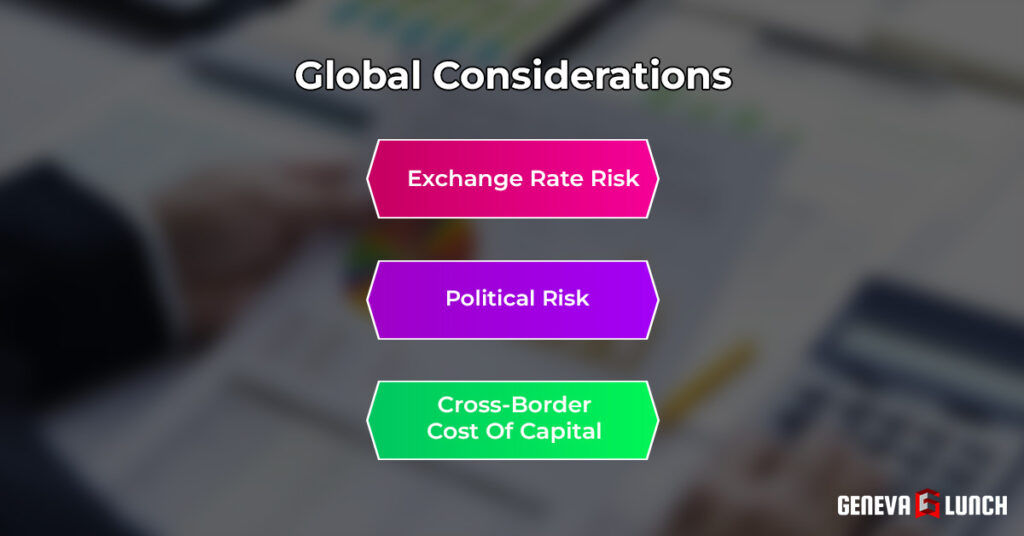
When companies work across borders, they face extra challenges. They deal with different currencies, political climates, and costs that can affect their overall cost of capital.
Exchange Rate Risk
One big challenge is exchange rate risk. This happens when a company deals with foreign currencies. The value of these currencies can change quickly, causing big gains or losses. Foreign exchange rates can make it hard to predict the cost of borrowing money or earning returns.
Political Risk
Political changes in a country can affect a business. New laws, taxes, or government changes can create instability. This uncertainty makes it harder to calculate the true cost of capital. Companies must watch these risks closely when making investment decisions.
Cross-Border Cost Of Capital
Cross-border operations add complexity to calculating the cost of capital. Different countries have their own interest rates and economic conditions, and companies must factor in the cost of doing business in each country. This leads to a higher cost of capital for many global businesses.
Strategies For Managing The Cost Of Capital
Managing capital costs is vital for any business that wants to grow while keeping expenses low. Companies use different strategies to ensure they don’t pay too much when raising money. Here are key strategies for managing the cost of capital:
Diversification Of Funding Sources
A business can lower its capital cost by using different funding sources. Relying on more than just one type of funding, like loans or selling shares, can become expensive or risky.
Companies spread their risk by using a mix of debt, equity, and other options like grants or bonds. If one source becomes costly, the business can turn to another. This approach also gives companies more flexibility in raising and using funds.
Capital Structure Optimization
Capital structure refers to the balance between debt and equity. A company must find the right mix to keep costs low while attracting investors. Excess debt can cause high interest payments, and too much equity can dilute ownership.
By optimizing the capital structure, a business can lower its overall cost of capital. The right balance depends on the company’s risk tolerance, growth stage, and market conditions.
Risk Management
Risk management plays a big role in controlling the cost of capital. Investors want higher returns when they face more risk. By reducing risks, like fluctuating interest rates, companies can lower their cost of capital. They can manage these risks using tools like hedging, insurance, or long-term contracts. A lower risk profile makes the business more attractive to investors, leading to lower costs.
Cost Of Capital Benchmarking
Benchmarking helps companies compare their cost of capital with industry standards. This process involves analyzing what similar companies pay for their capital.
When a business’s cost of capital is too high compared to competitors, it signals a need for change. By knowing their status, companies can act to improve their finances and cut their cost of capital.
What Are Common Mistakes In Cost Of Capital Calculation?
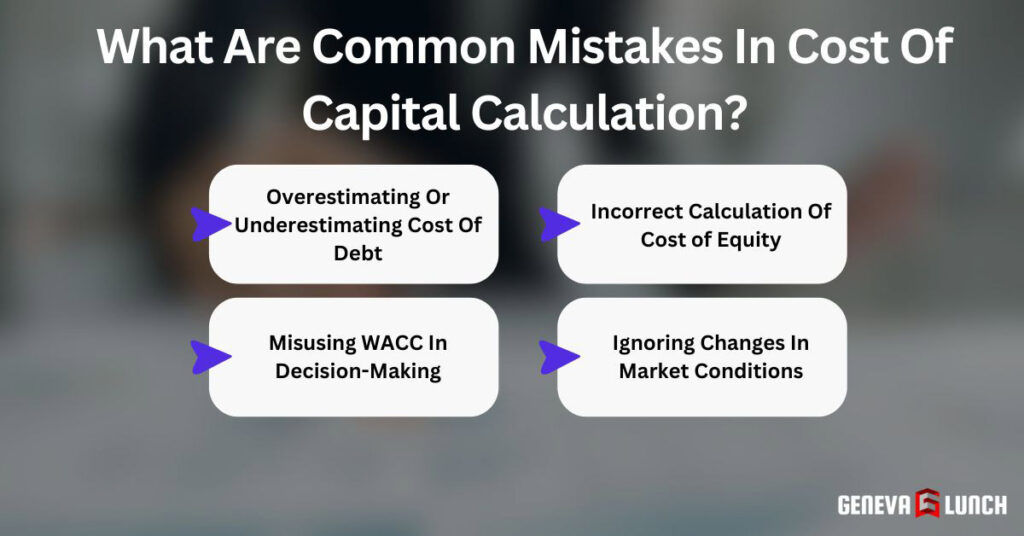
Calculating the cost of capital is important for making smart business decisions. However, many businesses make mistakes that can lead to poor choices. Knowing these common errors helps companies avoid costly problems. Let’s explore these mistakes in more detail.
Overestimating Or Underestimating Cost Of Debt
Many businesses misjudge the cost of debt. They either overestimate or underestimate how much they need to pay on loans. This mistake happens when companies focus only on interest rates but forget other costs like fees.
Overestimating can cause a company to avoid good opportunities, while underestimating can lead to poor budgeting, causing financial stress.
Incorrect Calculation Of Cost of Equity
The cost of equity is harder to measure, and companies often get it wrong. This mistake happens when businesses don’t account for all the risks investors face.
If they calculate too low, investors may feel unhappy with returns. If they calculate too high, the business can reject projects that could have been good for growth.
Misusing WACC In Decision-Making
The Weighted Average Cost of Capital (WACC) is useful, but companies often misuse it. Some businesses apply the same WACC to all projects, even though different projects carry different risks. This can lead to bad investment choices. Each project should have a WACC that matches its risk level.
Ignoring Changes In Market Conditions
Market conditions change over time, and so does the cost of capital. Businesses that ignore these changes make big mistakes. Interest rates, inflation, and investor expectations can shift, impacting debt and equity costs. Failing to adjust the cost of capital leads to bad decisions that hurt the business in the long run.
FAQ
What Role Does The Risk-Free Rate Play In The Cost Of Capital?
The risk-free rate plays a key role in the cost of capital by serving as a baseline for the minimum return investors expect. It’s used in models like the Capital Asset Pricing Model (CAPM) to calculate equity costs, reflecting the risk of default-free investments, such as government bonds.
How Often Should Companies Reassess Their Cost Of Capital?
Companies should reassess their cost of capital annually to ensure it reflects current market conditions, risk factors, and capital structure. Regular reviews help businesses make informed investment decisions and optimize financing strategies based on the latest economic environment.
What Are The Risks Of Underestimating The Cost Of Capital?
Underestimating the cost of capital can lead to poor investment decisions, inadequate risk assessment, and misallocation of resources. It may result in projects that fail to generate expected returns, increasing the risk of financial instability and reducing overall shareholder value.
What Is The Relationship Between Cost Of Capital And Financial Risk?
The relationship between the cost of capital and financial risk is direct. Higher financial risk often leads to a higher cost of capital, as investors demand greater returns to compensate for increased uncertainty. Conversely, lower financial risk can reduce the cost of capital for a company.
Can Startups And Growth Companies Have A Different Cost Of Capital?
Startups and growth companies can have a different capital cost than established businesses. Due to higher risk and uncertainty, investors typically demand higher returns, raising the equity cost. Additionally, access to debt financing could be limited or come with higher interest rates.
Final Word
The cost of capital helps businesses understand how much it costs to fund their growth. By knowing this, companies can make better decisions about where to get money and how to use it wisely. It keeps them from paying too much and helps them plan for success.
Every business, big or small, needs to know its cost of capital to stay competitive and profitable. This key number helps firms pick the right investments and balance debt and equity.
When a business manages its cost of capital well, it sets itself up for long-term growth and stability. Understanding the cost of capital isn’t just smart; it’s necessary for success.