Debt-To-Equity Ratio: Impact On Financial Health And Stability

Companies use different ways to finance their operations. Some use their own money, while others borrow funds to grow. Investors and lenders want to know how much debt a company uses compared to its own money. One way to find this out is by looking at the debt-to-equity ratio. So, what is the debt-to-equity ratio?
The debt-to-equity ratio shows how much debt a company has compared to its equity. It is calculated by dividing total debt by total equity. This ratio helps investors see if a company relies more on borrowed money or its own funds. A higher ratio means more debt, while a lower ratio means more equity.
In this guide, we’ll explore what the debt-to-equity ratio means, how it’s calculated, and why it’s important for understanding a company’s financial position. We’ll also discuss how different industries and companies use this ratio to make financial decisions.
Key Takeaways
- Understanding the Ratio: The debt-to-equity ratio compares a company’s total debt to its equity, showing its financial leverage.
- Low Ratio Implication: A lower ratio suggests the company relies more on its own funds, indicating lower financial risk.
- High Ratio Implication: A higher ratio means the company is using more debt, which could signal higher financial risk.
What Is The Debt-To-Equity Ratio?
The debt-to-equity ratio is a number that shows how much debt a company has compared to its equity. Debt is money the company owes. Equity is the money the company owns. It helps people see how a company is paying for its business. The ratio is calculated by dividing the total debt by total equity.
For example, if a company has $200,000 in debt and $400,000 in equity, the debt-to-equity ratio is 0.5. This means the company has 50% debt compared to its equity. A lower debt-to-equity ratio is generally better. It shows the company is using less borrowed money. A higher ratio means the company is using more debt. This can be risky for the company.
Types Of Debt-To-Equity Ratios
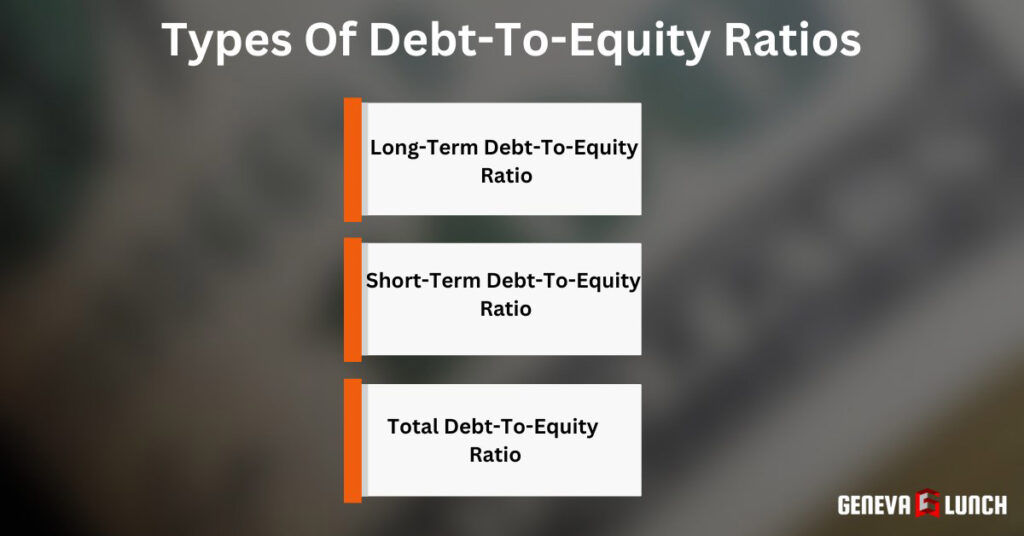
There are three main types of debt-to-equity ratios. These are the long-term debt-to-equity ratio, short-term debt-to-equity ratio, and total debt-to-equity ratio. Each one looks at different kinds of debt. They help investors understand how much debt a company uses compared to its equity. These ratios show whether a company uses more of its own money or borrows money.
Long-Term Debt-To-Equity Ratio
The long-term debt-to-equity ratio shows how much long-term debt a company has compared to its equity. Long-term debt is money that needs to be paid back in more than one year. This ratio is important because it shows if a company depends on debt that it must pay back over a long time.
For example, if a company has $300,000 in long-term debt and $600,000 in equity, the ratio is 0.5. This means the company has 50 cents of long-term debt for every dollar of equity.
Short-Term Debt-To-Equity Ratio
The short-term debt-to-equity ratio shows how much short-term debt a company has compared to its equity. Short-term debt is money that needs to be paid back within one year. This ratio is important because it shows if a company might have trouble paying its debt soon.
For example, if a company has $100,000 in short-term debt and $500,000 in equity, the ratio is 0.2. This means the company has 20 cents of short-term debt for every dollar of equity.
Total Debt-To-Equity Ratio
The total debt-to-equity ratio shows how much total debt a company has compared to its equity. Total debt includes both short-term and long-term debt. This ratio gives a full picture of how much debt a company has.
For example, if a company has $400,000 in total debt (both short-term and long-term) and $800,000 in equity, the ratio is 0.5. This means the company has 50 cents of debt for every dollar of equity.
How Is The Debt-To-Equity Ratio Calculated?
The debt-to-equity ratio is calculated by dividing a company’s total debt by its total equity. The formula is simple:
Debt-to-Equity Ratio = Total Debt ÷ Total Equity
Total debt includes both short-term and long-term debt. Equity is the money the company owns, like investments and profits.
For example, if a company has $500,000 in total debt and $1,000,000 in equity, the debt-to-equity ratio is 0.5.
This means the company has 50 cents of debt for every dollar of equity. A lower ratio means the company uses less debt. A higher ratio means the company depends more on borrowed money.
Significance Of The Debt-To-Equity Ratio
The debt-to-equity ratio is an important tool. It helps people understand how a company uses debt compared to its own money, or equity. This ratio can give a lot of information about the company’s financial health. It shows if the company borrows too much or uses its own money wisely. Investors and lenders often look at this ratio before making decisions about a company.
Indicator Of Financial Leverage
The debt-to-equity ratio shows how much financial leverage a company has. Leverage means how much money a company borrows to run its business. For example, if a company has $600,000 in debt and $300,000 in equity, its ratio is 2.0. This means the company has twice as much debt as equity.
A high ratio like this shows the company uses a lot of borrowed money. A low ratio, like 0.5, means the company relies more on its own funds. Companies with high leverage may have higher financial risks.
Measure Of Company’s Risk
The debt-to-equity ratio helps measure the risk level of a company. A higher ratio means more risk because the company has more debt to repay. For instance, if a company has a ratio of 3.0, this means it has three times more debt than equity. The company may face trouble paying its debt if business conditions change.
A lower ratio, like 0.4, means the company uses less debt and is considered less risky. This makes it easier for the company to manage its finances, even if times get tough, making it a key factor in effective risk management.
Tool For Assessing Capital Structure
The debt-to-equity ratio is useful for analyzing a company’s capital structure. Capital structure refers to how a company finances itself, using either debt or equity. A company with more debt will have higher costs because it has to pay interest.
For example, if a company has a ratio of 1.5, it means the company uses more debt than equity to fund its operations. Companies with more equity, such as a ratio of 0.3, depend less on debt, which can mean fewer costs. This makes it easier to understand how the company runs its business.
Insight Into Financial Stability
The debt-to-equity ratio offers insight into a company’s financial stability. A low ratio, like 0.4, shows the company relies more on its own money. This can be a sign of a stable and safe company. On the other hand, a high ratio, such as 2.0, may signal that the company depends too much on debt.
When the company struggles to make enough money, it could face problems paying back its debt. Companies with lower debt are often in better positions during difficult times because they don’t owe as much.
How Do You Interpret The Debt-To-Equity Ratio?
The debt-to-equity ratio helps you understand how much debt a company uses compared to its own money. A high ratio means the company uses a lot of debt, while a low ratio means the company uses less debt. You can compare this ratio to other companies in the same industry.
High Debt-To-Equity Ratio Implications
A high debt-to-equity ratio means a company is using a lot of debt. This can be risky. For example, if a company has a ratio of 2.5, it means the company has $2.50 in debt for every $1 of equity.
This shows that the company relies heavily on borrowed money. A high ratio can lead to financial problems if the company cannot pay its debt. It may also have to pay high interest costs. Investors may see this as a warning sign.
Low Debt-To-Equity Ratio Implications
A low debt-to-equity ratio means the company is using less debt and more of its own money. This is often seen as a safer option. For example, if a company has a ratio of 0.3, it means the company has 30 cents of debt for every $1 of equity.
A low ratio shows that the company is not heavily dependent on borrowing. This can make it easier for the company to manage its money and grow its business. Investors often prefer companies with lower ratios because they have less risk.
Industry-Specific Benchmarks
The debt-to-equity ratio can vary by industry. Some industries, like manufacturing or utilities, may have higher average debt-to-equity ratios. This is because they often need to borrow more money to buy equipment or build infrastructure. In other industries, like technology or software, companies may have lower ratios because they don’t need to borrow as much.
For example, a utility company may have a ratio of 1.8, while a software company might have a ratio of 0.4. It is important to compare a company’s ratio to others in the same industry.
Comparing Ratios Within Industries
When looking at the debt-to-equity ratio, it’s useful to compare companies in the same industry. This gives a better idea of how a company is doing compared to its competitors.
For example, if two companies in the retail industry have debt-to-equity ratios of 1.2 and 0.8, the company with the lower ratio is using less debt. This might mean it has less financial risk. Comparing ratios helps you understand if a company is borrowing more or less than others in the same business.
Historical Trends In Debt-To-Equity Ratio
Looking at the debt-to-equity ratio over time can show important trends. When a company’s ratio is rising, it means the company is taking on more debt. This could be a sign of financial trouble or growth. For example, if a company’s ratio increased from 0.5 to 1.5 over five years, it means the company is borrowing more money.
When the ratio is going down, the company may be paying off debt or using more of its own money. Investors watch these trends to see if a company is managing its debt well.
What Factors Influence The Debt-To-Equity Ratio?

Several factors can affect a company’s debt-to-equity ratio. These include the company’s capital structure, economic conditions, interest rates, market sentiment, and how profitable the company is. These factors can change how much debt a company takes on compared to its equity. Understanding these factors helps investors see why a company’s ratio might change over time.
Company’s Capital Structure
A company’s capital structure is how it is financed, using a mix of debt and equity. Some companies choose to use more debt because it can be cheaper than equity. For example, if a company wants to expand, it might borrow $1 million instead of using its own $1 million.
This will increase the debt-to-equity ratio. Other companies prefer to rely more on their own funds, which lowers the ratio. The balance between debt and equity is a key factor in a company’s debt-to-equity ratio.
Economic Conditions
Economic conditions play a big role in a company’s debt-to-equity ratio. In a strong economy, companies may borrow more because they expect to grow and make more money. For example, a company might increase its debt-to-equity ratio from 0.6 to 1.0 during a boom period.
However, in a weak economy, companies may avoid taking on debt because it becomes harder to pay back. In such times, companies might work to reduce their ratio by paying off debt or using more of their own money.
Interest Rate Changes
Changes in interest rates can influence the debt-to-equity ratio. When interest rates are low, borrowing money is cheaper, so companies might take on more debt. For example, if interest rates drop from 5% to 3%, a company may borrow more and increase its ratio from 0.7 to 1.2.
When interest rates are high, borrowing becomes more expensive. Companies may borrow less and rely more on their own equity, lowering their debt-to-equity ratio. Investors watch interest rates to see how they affect companies’ borrowing.
Market Sentiment
Market sentiment refers to how confident investors and companies feel about the economy and their market value. When investors feel confident, companies may borrow more to grow. This can raise their debt-to-equity ratio.
For example, if the market is strong, a company might increase its debt-to-equity ratio from 1.0 to 1.5. On the other hand, if investors are uncertain or worried about the market, companies may avoid borrowing and focus on using equity. This can lower their ratio, as companies try to reduce risk during uncertain times.
Company’s Profitability And Earnings Quality
A company’s profitability affects its debt-to-equity ratio. If a company is making a lot of profit, it may not need to borrow much money, so its ratio stays low. For example, a profitable company with strong earnings might have a ratio of 0.4.
When a company’s profits are low or unstable, it may need to borrow more, raising its ratio. For example, if a company’s earnings drop, it may need to borrow more money to cover costs, which could increase the ratio from 0.8 to 1.2.
What Are The Limitations Of The Debt-To-Equity Ratio?
The debt-to-equity ratio is useful, but it has limitations. It doesn’t always give a complete picture of a company’s financial health. This ratio focuses only on debt and equity, but other factors can also affect a company’s situation. Investors need to be aware of these limitations when using this ratio to make decisions.
Impact Of Varying Capital Structures
The debt-to-equity ratio can be affected by different capital structures. Some companies use more debt in their capital structure, while others rely more on equity. For example, a company with a debt-to-equity ratio of 2.0 may not necessarily be in worse financial health than a company with a ratio of 1.0.
It depends on how the company is structured. Investors need to look at the whole picture and not just the ratio when analyzing a company’s finances.
Differences Across Industries
Debt-to-equity ratios can vary widely across different industries. For example, companies in industries like utilities or real estate often have higher debt-to-equity ratios because they need to borrow money to buy expensive equipment or property.
A utility company may have a ratio of 2.5, while a tech company may have a ratio of 0.5. Comparing companies across different industries can lead to misleading conclusions. It’s important to compare the ratio within the same industry to get accurate insights.
Potential For Misleading Results
The debt-to-equity ratio can sometimes give misleading results. A company with a high ratio might appear risky, but it could still be in good financial shape if it manages its debt well. Similarly, a company with a low ratio might not be as safe as it seems. It may have hidden problems like poor cash flow.
For example, a company with a ratio of 0.4 may have cash flow issues that don’t show up in the ratio. Investors should use other financial metrics along with the debt-to-equity ratio to get a clearer picture.
Lack Of Consideration For Growth Potential
The debt-to-equity ratio does not consider a company’s growth potential. A company might have a high ratio because it is borrowing to expand its business. For example, a company with a ratio of 1.8 might be investing in new projects that will increase profits in the future.
This can make the company stronger in the long run. The ratio doesn’t show how this debt might help the company grow, so investors should also consider the company’s growth plans when evaluating the ratio.
Impact Of Non-Recurring Expenses
Non-recurring expenses can affect the debt-to-equity ratio, but the ratio doesn’t account for them. Non-recurring expenses are one-time costs that don’t happen regularly, like a large legal settlement or a major purchase.
For example, if a company has a large one-time expense, it might need to borrow more money, which could temporarily raise its debt-to-equity ratio from 0.6 to 1.2. This increase might make the company look riskier than it actually is. Investors should look at whether the debt is due to normal business operations or one-time events.
Practical Applications Of The Debt-To-Equity Ratio

The debt-to-equity ratio is a useful tool for many purposes. It helps investors, lenders, and business owners understand a company’s financial health. This ratio can be used to assess how much debt a company uses compared to its own funds. It also helps in making investment decisions, evaluating the company’s risk, and comparing it to other companies in the same industry.
Assessing Financial Health
The debt-to-equity ratio is often used to assess a company’s financial health. A low ratio means the company uses more of its own money and is less dependent on borrowing.
For example, if a company has a ratio of 0.4, it means it is using only 40 cents of debt for every dollar of equity, which is generally a sign of good financial health. A high ratio, like 2.0, means the company has twice as much debt as equity, which can be a warning sign that the company might have trouble managing its debt.
Making Investment Decisions
Investors use the debt-to-equity ratio to help make smart investment decisions. A company with a lower ratio is usually seen as a safer investment because it does not rely too much on debt. For example, an investor might choose to invest in a company with a ratio of 0.6 over a company with a ratio of 1.8.
The lower ratio means the company is less risky. However, some investors may take the risk if they believe a company with a higher ratio has strong growth potential.
Evaluating Company Risk
The debt-to-equity ratio helps people evaluate the risk of a company. A higher ratio means more risk because the company is relying more on borrowed money. For example, a company with a debt-to-equity ratio of 2.5 is using a lot of debt, which could be risky if the company struggles to pay it back.
On the other hand, a company with a lower ratio, like 0.5, has less debt and is considered less risky. Investors and lenders use this ratio to decide if they want to take the risk of working with a company.
Benchmarking Against Industry Peers
The debt-to-equity ratio is also helpful for comparing a company to others in the same industry. This is called benchmarking. Different industries have different average debt-to-equity ratios. For example, a manufacturing company might have a ratio of 1.5, while a retail company might have a ratio of 0.8.
When one company has a much higher ratio than its industry peers, it might be a sign that the company is taking on too much debt. Benchmarking helps investors see how a company’s debt levels compare to others in its field.
What Strategies Can You Use With The Debt-To-Equity Ratio?
The debt-to-equity ratio can be used in different strategies to make smart financial decisions. Investors use this ratio to see how much debt a company has compared to its own funds. The ratio helps in value investing, growth investing, comparing companies, and choosing sectors to invest in. Companies can also use the ratio to find ways to reduce their debt.
Value Investing
Value investing focuses on finding companies that are undervalued in the market. The debt-to-equity ratio helps value investors find companies with low debt. For example, a company with a ratio of 0.4 might be seen as a good investment because it doesn’t rely too much on borrowing.
Value investors look for companies that are stable and have strong financial health. A low ratio means the company is less risky, which is important for value investors who want steady returns over time.
Growth Investing
Growth investors look for companies that are expanding quickly. These companies might have higher debt-to-equity ratios because they borrow money to grow. For example, a company with a ratio of 1.5 might be borrowing to open new locations or launch new products.
Growth investors are willing to take more risk if they believe the company will grow and make more money in the future. A higher debt-to-equity ratio is acceptable in growth investing as long as the company’s growth potential is strong.
Comparative Analysis
Comparative analysis means comparing a company’s debt-to-equity ratio to other companies. This helps investors see how much debt a company is using compared to its competitors. For example, if two companies in the same industry have ratios of 0.7 and 1.3, the company with the lower ratio might be seen as less risky.
Investors use this strategy to compare companies before making decisions. This helps them choose companies with better financial health and lower risk.
Sector Rotation Strategies
Sector rotation is a strategy where investors move their money between different industries or sectors. The debt-to-equity ratio can help investors choose which sectors to invest in. Some sectors, like technology, may have lower debt-to-equity ratios because they don’t need as much debt.
Other sectors, like utilities or manufacturing, may have higher ratios. Investors might rotate their investments based on how well certain sectors are doing. For example, they might move into sectors with lower debt ratios during uncertain economic times.
Debt Reduction Strategies
Companies can use debt reduction strategies to lower their debt-to-equity ratio. When a company has a high ratio, it might work on paying off its debt to reduce risk. For example, if a company’s ratio is 2.0, it may aim to bring it down to 1.0 by paying off loans or using profits to reduce debt.
This helps the company become more financially stable. Lowering the debt-to-equity ratio can make the company more attractive to investors and lenders because it shows better financial health. Seeking help from a financial advisor for debt management can be a good idea.
Debt-To-Equity Ratio In Different Business Scenarios

The debt-to-equity ratio changes depending on the type of company or industry. Some companies rely more on borrowing, while others use their own funds. The ratio helps investors understand how a company manages its finances. Different types of businesses, like startups, mature companies, and industries with high or low debt, all have different debt-to-equity ratios.
Startups Companies
Startups often have a higher debt-to-equity ratio. These companies are new and usually don’t have a lot of money saved, so they borrow more. For example, a startup might have a ratio of 3.0, meaning it has three times more debt than equity.
Startups need to borrow to grow quickly, but this also makes them riskier. They have to make sure they can repay their debt even if profits are low.
Mature Companies
Mature companies usually have a lower debt-to-equity ratio. These companies have been in business for a long time and have built up profits and savings. For example, a mature company might have a ratio of 0.8, which means it uses more of its own money than borrowed money.
This makes mature companies less risky because they don’t rely as much on debt to run their business. They are more stable and better able to manage their finances.
Capital-Intensive Industries
Capital-intensive industries, like manufacturing and construction, often have a higher debt-to-equity ratio. These companies need a lot of expensive equipment and facilities, so they borrow more money. For example, a company in this industry might have a ratio of 2.0, meaning it has twice as much debt as equity.
While these businesses may have higher debt, it is normal for their industry, as they need to invest in costly infrastructure to operate.
Service-Based Businesses
Service-based businesses tend to have a lower debt-to-equity ratio. These companies, like consulting or software businesses, don’t need a lot of physical equipment. They rely more on people and skills rather than heavy investments.
For example, a service-based company might have a ratio of 0.5, meaning it uses more of its own money than borrowed funds. These businesses are often considered less risky because they don’t need to borrow as much.
Low-Debt Industries
Some industries naturally have low debt. These industries don’t need to borrow much because their operating costs are lower. For example, a technology company might have a debt-to-equity ratio of 0.4.
This shows that the company is using mostly its own money. Investors may see companies in low-debt industries as safer because they are not heavily reliant on borrowed funds.
High-Debt Industries
High-debt industries, like utilities or real estate, often have a higher debt-to-equity ratio. These industries require large upfront investments to build infrastructure or properties. For example, a real estate company might have a ratio of 3.5, meaning it has more debt than equity.
While this can seem risky, it’s common for these industries because they need to borrow to finance large projects that take time to complete.
FAQs
How Does The Debt-To-Equity Ratio Affect A Company’s Stock Price?
The debt-to-equity ratio can affect a company’s stock price because it shows how much debt the company is using. A high ratio shows the company has a lot of debt, which may make investors worry about financial risk. A low ratio shows the company is using less debt, which can make investors feel safer.
Can A Company Have A Negative Debt-To-Equity Ratio?
Yes, a company can have a negative debt-to-equity ratio. This happens when the company’s total liabilities are higher than its total equity. This usually means the company owes more than it owns. This also shows that the company may be in financial trouble and can struggle to pay its debts.
How Does The Debt-To-Equity Ratio Affect Credit Ratings?
The debt-to-equity ratio affects a company’s credit ratings. A high ratio may lead to a lower credit rating because it shows the company has a lot of debt. Credit agencies see this as risky. A low ratio shows the company is less dependent on debt, which can result in a higher credit rating.
What Happens If A Company’s Debt-To-Equity Ratio Is Too Low?
When a company’s debt-to-equity ratio is too low, it means the company is not using much debt. While this may seem safe, it can also mean the company is missing out on growth opportunities. When the company avoids debt completely, it may grow slower compared to competitors who use debt wisely.
What Are Common Mistakes In Calculating The Debt-To-Equity Ratio?
One common mistake in calculating the debt-to-equity ratio is not using the correct numbers. Some people may forget to include all liabilities, like short-term debt. Another mistake is comparing the ratios across industries without considering that different industries have different average ratios.
Final Words
The debt-to-equity ratio is an important tool for understanding a company’s financial health. It helps show how much debt a company uses compared to its equity. A lower ratio usually means the company is less risky, while a higher ratio indicates more financial risk. Understanding this ratio can help investors and businesses make better decisions about their finances.