Financial Advisor Vs Financial Consultant (10 Key Differences)

Managing money wisely is important for both individuals and businesses. With so many financial options and decisions to make, it can be hard to know where to start. This is why people often seek professional advice to help them make the right financial choices. So, what is the difference between Financial Advisor vs. Financial Consultant?
A financial advisor helps individuals plan for personal goals like retirement, savings, and investments. A financial consultant, on the other hand, often works with businesses, providing advice on improving profits, managing budgets. Both serve different types of clients and offer different services.
In this guide, we’ll explain the key differences between financial advisors and financial consultants. We’ll explore their services, qualifications, and how to choose the right one for your needs.
Key Takeaways
- Personal Financial Expertise: Financial advisors focus on helping individuals with retirement planning, investments, savings, and tax strategies.
- Business-Focused Financial Solutions: Financial consultants work primarily with businesses to improve financial operations, reduce costs, and manage risks.
- Ongoing Financial Management: Financial advisors provide continuous support for long-term personal goals such as retirement and wealth building.
- Project-Specific Financial Guidance: Financial consultants offer targeted advice for short-term business projects like cost-cutting or growth planning.
- Choosing the Right Professional: Opt for a financial advisor for personal finances, and a consultant for specialized business-related advice.
What Does A Financial Advisor Do?

A financial advisor helps people manage their money wisely. They offer guidance on saving, investing, and planning for the future. Duties of a financial advisor include working with clients to create clear plans for their financial goals. These goals might include buying a house, saving for retirement, or paying for education.
Financial Planning
Financial planning involves creating a detailed plan for managing money. A financial advisor reviews a client’s income, expenses, savings, and investments. They set goals and develop a plan to achieve them.
For example, if someone wants to save $40,000 for a car in four years, the advisor will calculate how much to save each month to reach that target. Financial planning covers both short-term and long-term goals. Advisors regularly review these plans to ensure clients stay on track.
Education Planning
Education planning focuses on saving for future education costs, like college. A financial advisor helps families choose the best savings options, such as a 529 plan, which offers tax benefits.
For example, if parents want to save $60,000 for their child’s college by the time they turn 18, the advisor calculates how much they need to set aside each month. Advisors also help clients understand financial aid, student loans, and other ways to pay for education. They make sure clients have a solid plan in place.
Investment Management
Investment management involves growing a client’s wealth through smart investments. A financial advisor helps clients choose where to invest their money, such as stocks, bonds, or mutual funds.
For example, if someone wants to invest $20,000 with the goal of earning a 7% return annually, the advisor will guide them on the best investment choices to meet that goal. Advisors also track these investments over time, making adjustments to ensure the client’s money grows steadily and securely.
Tax Planning
Tax planning helps clients reduce the amount they pay in taxes. A financial advisor suggests ways to save on taxes, such as contributing to retirement accounts like a 401(k) or IRA.
For example, if a person earns $80,000 a year, putting $5,000 into a retirement account could lower their taxable income, reducing their tax bill. Advisors also help clients navigate tax laws, making sure they take advantage of deductions, credits, and tax-efficient investments that save money.
Risk Management
Risk management protects clients from financial losses. A financial advisor recommends different types of insurance to safeguard a client’s income and savings.
For example, they might suggest life insurance to a family breadwinner who earns $70,000 a year, providing $500,000 in coverage if something happens. Advisors also recommend health, disability, and long-term care insurance to protect against unexpected events. This way, clients are prepared for life’s uncertainties, and their financial plans stay on course.
Retirement Planning
Retirement planning ensures that clients save enough money to live comfortably when they stop working. A financial advisor helps clients set up retirement accounts like a 401(k) or IRA. For example, if someone wants to retire with $800,000 in 25 years, the advisor will determine how much they need to save each year to reach that goal.
They also help manage these accounts and make adjustments as needed. Retirement planning ensures clients can maintain their lifestyle without worrying about running out of money.
Estate Planning
Estate planning ensures that a client’s assets are passed on according to their wishes. A financial advisor helps clients create wills, trusts, and other documents that detail who will receive their money and property. For example, if someone has $400,000 in assets, the advisor will help them decide how to distribute those funds to their heirs. Seeking help from a financial advisor for estate planning can also be valuable.
Advisors also help clients minimize taxes on their estate, ensuring that their loved ones receive the maximum benefit. Estate planning also includes decisions about healthcare and legal matters if the client becomes unable to make those decisions on their own.
What Does A Financial Consultant Do?
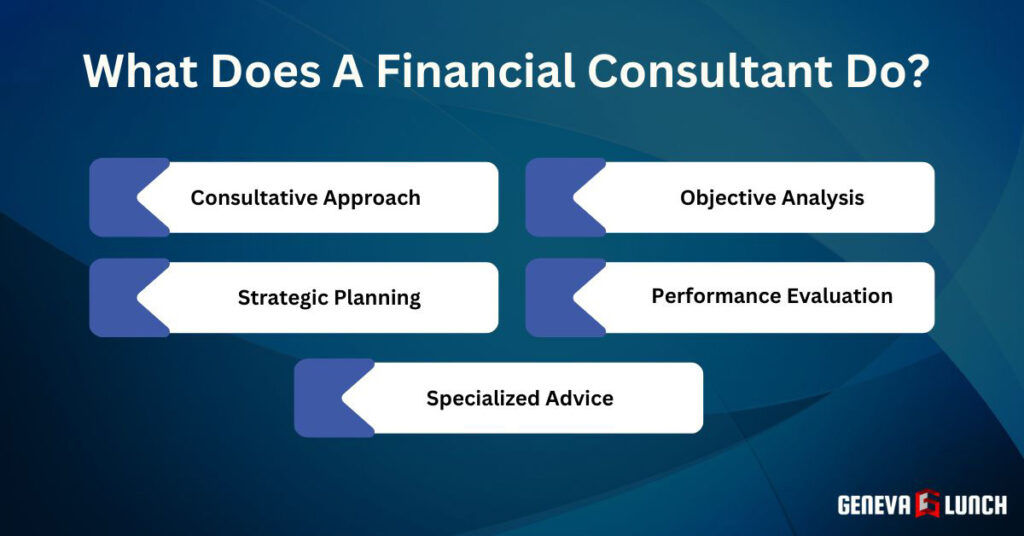
A financial consultant provides expert financial advice to businesses or individuals. They help clients improve their financial strategies and make better decisions. They provide advice on how to manage budgets, cut costs, and increase profits. Financial consultants also work on specific financial projects or solve particular financial problems.
Consultative Approach
A financial consultant uses a consultative approach. This means they spend time understanding the client’s needs before giving advice. For example, a company might want to improve its cash flow. The consultant will first gather all necessary financial data, review current practices, and then provide recommendations.
They listen carefully to the client’s concerns and goals. This approach helps the consultant tailor their advice to the specific situation, ensuring the client receives the best possible financial solutions.
Objective Analysis
Financial consultants provide an objective analysis of a client’s financial situation. They review financial statements, budgets, and market trends. This helps them give unbiased advice based on facts. For example, if a business wants to expand, the consultant will analyze the company’s financial health to see if it’s a good idea.
They will examine profits, cash flow, and risks. This analysis helps the client make informed decisions without emotional influence. The consultant focuses only on the financial data to guide the client.
Strategic Planning
Strategic planning is one of the key services a financial consultant offers. They create detailed financial plans to help clients achieve long-term goals. For example, a business may need a 5-year plan to grow its market share by 10%. The financial consultant will design a plan, showing step-by-step how to reach that goal.
This plan may include managing costs, increasing investments, or improving cash flow. Strategic planning helps clients stay focused on their financial objectives and ensures they are prepared for future growth.
Performance Evaluation
A financial consultant also evaluates the performance of financial plans or investments. They review if the strategies in place are working as expected. For example, after implementing a new cost-saving plan, the consultant will check whether expenses have actually gone down.
When not, they will suggest changes to improve results. Performance evaluation is important because it helps clients stay on track with their goals. Regular reviews help identify what is working and what needs to be adjusted for better results.
Specialized Advice
Financial consultants provide specialized advice based on their client’s specific needs. They may specialize in areas like risk management, mergers and acquisitions, or debt restructuring. For example, if a company is considering a merger, the consultant will offer advice on the financial impact and help with negotiations.
Their specialized knowledge makes them valuable for clients with unique financial challenges. This tailored advice ensures that the client gets solutions that are designed for their exact financial situation.
Financial Advisor Vs. Financial Consultant: Key Differences
When comparing a financial advisor and a financial consultant, it’s important to understand that while both help manage and improve finances, they serve different types of clients and offer distinct services. Financial advisors typically work with individuals or families, focusing on personal financial goals, while financial consultants often work with businesses or high-net-worth clients to solve more complex financial challenges. Here is a detailed comparison table that breaks down the key differences between a financial advisor and a financial consultant:
| Key Difference | Financial Advisor | Financial Consultant |
| Scope of Services | Works with individuals on personal finance, taxes, and retirement planning. | Focuses on businesses, solving financial problems, and improving company finances. |
| Client Relationships | Builds long-term relationships with individuals to manage personal financial goals. | Works on specific projects, often short-term, with businesses or high-net-worth clients. |
| Compensation Structure | Usually charges a fee or percentage of assets managed. | Often paid hourly, by project, or a consulting fee. |
| Regulatory Oversight | Regulated by bodies like the SEC and FINRA. Must follow strict rules. | Less regulated but may follow industry standards. |
| Decision-Making Authority | Helps clients make decisions but does not make decisions for them. | Provides advice and analysis but does not manage money directly. |
| Educational Requirements | May require certifications like CFP or licenses. | Often has advanced degrees like an MBA. |
| Investment Strategy | Focuses on long-term investment growth for personal wealth. | Focuses on financial efficiency, cost-saving, and business growth. |
| Ongoing Support | Provides ongoing financial support, including regular check-ins. | Provides short-term support, mainly project-based. |
| Customization | Creates personalized plans for individuals based on their financial needs. | Offers tailored solutions for businesses or specific financial challenges. |
| Fiduciary Responsibility | Must act in the best interest of their clients. | May or may not have a fiduciary duty, depending on the project. |
Scope Of Services
A financial advisor works mainly with individuals to help them plan for personal goals like retirement, education, or saving for a home. For example, a financial advisor might help a client save $200,000 for retirement by suggesting investment strategies.
On the other hand, a financial consultant works with businesses or wealthy clients. They focus on improving business financial performance, cutting costs, or expanding a business. For instance, a consultant may help a company increase profits by 15% over two years.
Client Relationships
Financial advisors build long-term relationships with individual clients. They work with families or individuals over many years to help meet their financial goals. For example, an advisor might meet with a client every six months to review their retirement plan.
Financial consultants often have shorter relationships. They may work with a company on a single project, such as cutting costs or restructuring debt, and then move on once the project is complete.
Compensation Structure
Financial advisors and financial consultants have different ways of charging for their services. Financial advisors often charge a flat fee or take a percentage of the assets they manage, like 1% of a $500,000 investment account.
Financial consultants usually charge by the hour or for specific projects. For example, a consultant might charge $150 per hour or $10,000 for a business strategy project. The pay structure depends on the type of services being offered.
Regulatory Oversight
Financial advisors are usually required to register with regulatory bodies like the SEC (Securities and Exchange Commission) or FINRA (Financial Industry Regulatory Authority). They need to follow strict rules to protect clients.
Financial consultants may not need to register, depending on the services they offer. For example, a consultant advising on business strategy might not need to be registered. However, if they give investment advice, they might have to follow similar regulations as financial advisors.
Decision-Making Authority
Financial advisors provide advice, but clients make the final decisions. For example, an advisor might recommend investing in a stock, but the client chooses whether to buy it. Financial consultants can sometimes have more decision-making power, especially if they work closely with a business.
For example, a consultant might help a company decide to open a new location or invest in new technology. However, in most cases, the final decision is still up to the business.
Educational Requirements
Financial advisors often have certifications like CFP (Certified Financial Planner) or CFA (Chartered Financial Analyst). These credentials require years of study and exams. Financial consultants may have different qualifications, such as an MBA (Master of Business Administration) or specialized training in business finance. Both roles require strong financial skills, but the focus of their education can vary depending on whether they work with personal or business finances
Investment Strategy
Financial advisors focus on personal investment strategies. For example, they may suggest mutual funds, stocks, or bonds for a client’s retirement plan. They aim to grow wealth over time.
Financial consultants, however, focus on business investments and growth strategies. For example, they might help a company invest in new technology or expand into a new market. Their goal is often to increase profits or improve business operations rather than personal wealth growth.
Ongoing Support
Financial advisors provide ongoing support. They meet with clients regularly, adjust financial plans, and monitor investments. For example, an advisor might review a client’s investment portfolio every year to make sure it is still performing well.
Financial consultants offer support during specific projects. Once the project is complete, their role may end. For example, after helping a company cut costs, the consultant might not work with the company again unless another project arises.
Customization
Financial advisors customize their plans to each client’s personal goals. For example, an advisor may create a savings plan for a couple looking to buy a home in five years. Financial consultants also provide tailored advice but focus on the needs of businesses.
For example, they may design a financial plan for a company looking to increase its market share by 10%. Both roles require personalized strategies, but the focus of the advice is different.
Fiduciary Responsibility
Many financial advisors act as fiduciaries, which means they are legally required to act in the best interest of their clients. For example, if an advisor recommends an investment, it must be what’s best for the client, not what earns the advisor more money.
Financial consultants are not always held to the same standard. They provide advice but may not have a fiduciary duty unless they are offering specific investment advice.
Financial Advisor Vs. Financial Consultant: Similarities
While financial advisors and financial consultants have different focuses, they also share some key similarities. Both are professionals who help clients make better financial decisions. Their services are centered on the needs of the client, and they work to provide valuable advice. They also follow certain regulations and ethical standards to protect their clients.
Client-Centered Services
Both financial advisors and financial consultants focus on the needs of their clients. They work to understand what the client wants to achieve. Whether the goal is to save for retirement or improve business profits, these professionals create a plan to meet that goal.
For example, a financial advisor might help a client save $50,000 for college tuition, while a consultant could help a company reduce costs by 10%. In both cases, the client’s best interest is the top priority.
Regulatory Compliance
Financial advisors and financial consultants must follow laws and regulations. These rules are in place to protect clients. For example, financial advisors often have to register with regulatory bodies like the SEC or FINRA.
Financial consultants may also need to follow rules, especially if they offer investment advice. Compliance ensures that both types of professionals act in a legal and fair way. This protects clients from fraud and ensures they receive accurate advice.
Ethical Standards
Both financial advisors and financial consultants are expected to follow high ethical standards. They must act honestly and put the client’s needs first. For example, they should not recommend financial products just to earn a higher commission.
Many financial advisors are also fiduciaries, meaning they are legally required to act in the client’s best interest. Consultants are expected to provide fair and honest advice to help businesses grow. Ethical standards build trust between the client and the professional.
Investment Guidance
Both financial advisors and financial consultants provide advice on investments. Advisors help individuals choose investments like stocks or bonds that align with their personal financial goals. Consultants, on the other hand, may help businesses decide where to invest for growth.
For example, a consultant might help a company invest in new technology to improve productivity. While the type of investment advice differs, both professionals offer guidance to grow their client’s money in a smart and strategic way.
Holistic Planning
Both financial advisors and financial consultants take a broad approach to planning. They look at the whole financial picture to help their clients make the best decisions. Financial advisors consider all aspects of a person’s finances, like income, expenses, and future goals.
Financial consultants do the same for businesses, examining profits, expenses, and long-term growth. This holistic planning ensures that all parts of the financial plan work together to help the client succeed.
When To Choose A Financial Advisor?

A financial advisor is a good choice when you need help managing your personal finances. They work with individuals and families to create a plan for their money. Advisors help with things like saving for retirement, paying off debt, or making smart investments. When you are not sure how to reach your financial goals, a financial advisor can guide you. Here are some situations where choosing a financial advisor might be the best option for you.
Complex Financial Situations
When you have a complex financial situation, a financial advisor can help. This includes having multiple sources of income, a large amount of debt, or complicated investments.
For example, if you own a business, have rental properties, and investments, an advisor will create a plan to manage all of these. They help you stay organized and make sure your financial choices fit together. Advisors give clear advice when your financial situation is not simple.
Debt Management
A financial advisor can help you manage and reduce debt. They will look at how much you owe and create a plan to pay it off. For example, if you have $50,000 in student loans and credit card debt, they will help you figure out how much to pay each month to ensure better debt management.
They may also give advice on ways to lower your interest rates. Debt can be stressful, but a financial advisor helps you tackle it step by step.
Wealth Management
Wealth management involves handling a large amount of money. When you have built up significant savings, a financial advisor can help you protect and grow that wealth. For example, if you have $1,000,000 in investments, the advisor will suggest ways to invest it wisely.
They look for safe ways to grow your money while managing risks. Wealth management also includes planning for things like taxes and retirement, ensuring your money lasts for the long term.
Education Funding
Saving for education, especially college, can be expensive. A financial advisor helps you plan for these costs. For example, if you want to save $100,000 for your child’s college tuition, the advisor will show you how much to save each month.
They may suggest using a 529 plan, which offers tax benefits for education savings. Education funding is a big goal for many families, and a financial advisor can make sure you reach it.
Investment Planning
A financial advisor provides expert advice on how to invest your money. They help you choose the right financial investment based on your goals and how much risk you are comfortable with.
For example, if you want to invest $20,000 and earn a 6% return, the advisor will suggest options like stocks or bonds. They also monitor your investments over time to make sure they continue to grow. Investment planning helps you build wealth for the future.
When To Choose A Financial Consultant?

A financial consultant is a good choice when you need expert advice for a specific financial problem or project. Consultants often work with businesses or high-net-worth individuals. They provide advice on how to improve financial strategies or handle special financial tasks. Here are some situations where hiring a financial consultant might be the right decision.
Specific Financial Needs
When you have a specific financial need, a consultant can help. For example, if your company needs advice on how to cut costs, a financial consultant will create a plan to do that. They might suggest ways to reduce expenses by 10% over the next year.
A consultant’s role is to solve a particular problem, whether it’s managing cash flow, increasing profits, or restructuring debt. Once the task is done, the consultant’s job is usually complete.
Short-Term Financial Goals
A financial consultant is a good option if you have short-term financial goals. For example, if a company wants to increase revenue by 20% over the next year, a consultant can help plan the steps to reach that goal.
They provide detailed strategies to meet financial goals in a shorter timeframe. These goals might include things like launching a new product, expanding into new markets, or improving profit margins. Consultants offer focused help for these shorter-term objectives.
Project-Based Advice
Financial consultants often work on specific projects. For example, if a company wants to improve its budgeting process, a consultant will step in, review the current system, and recommend changes.
The project may last a few months, and once it’s finished, the consultant moves on. This is different from a financial advisor, who often works with clients for many years. Consultants are brought in for specific projects, giving advice only when needed.
Business Financial Planning
A financial consultant is often hired for business financial planning. This includes creating budgets, managing cash flow, and planning for growth. For example, if a company wants to open a new location, the consultant helps calculate costs and potential profits.
They plan how to fund the expansion and minimize risks. Consultants have expertise in business finance, making them the right choice for companies that need financial strategies to grow and succeed.
Periodic Financial Reviews
Sometimes businesses need a financial expert to review their financial health. A financial consultant can provide a periodic financial review. For example, if a business wants to check its performance every year, a consultant can review the finances and suggest improvements.
This includes reviewing profits, expenses, and investments. A periodic review helps businesses stay on track and make sure their financial strategies are working as planned.
Can You Use Both?

Yes, you can use both a financial advisor and a financial consultant. They have different roles but can work together to help you manage your money. A financial advisor helps with personal finances, like saving for retirement or investing. A financial consultant focuses more on business or project-based financial needs.
Complementary Roles
Financial advisors and financial consultants have different but complementary roles. For example, a financial advisor might help you manage your personal investments, while a consultant helps your business reduce costs.
Both experts provide advice, but they focus on different areas. Using both gives you a well-rounded approach to managing both personal and business finances. This ensures that all parts of your financial life are covered.
Layered Protection
Having both a financial advisor and a financial consultant adds layers of protection. A financial advisor protects your personal wealth by helping you make smart investment choices. Meanwhile, a financial consultant protects your business by offering advice on improving profits or managing risks.
For example, while your advisor is helping you save for retirement, your consultant could be helping your business plan for growth. This layered protection helps ensure your finances are secure in both areas.
Diverse Expertise
Financial advisors and financial consultants bring different types of expertise. A financial advisor knows a lot about personal investments, taxes, and retirement planning. A financial consultant has deep knowledge of business finances and project-based planning.
For example, while your advisor helps you invest in a 401(k), your consultant can help your business reduce operating costs. Using both allows you to take advantage of a wider range of financial skills and knowledge.
Enhanced Trust And Confidence
Working with both a financial advisor and a financial consultant can increase your trust and confidence in your financial plans. You get more detailed advice for both your personal and business needs.
For example, you can trust your financial advisor to handle your personal savings while your financial consultant focuses on improving your business’s bottom line. Having two experts working together can give you peace of mind knowing that your finances are being managed carefully in all areas.
FAQs
1. Is A Financial Advisor Better Than A Financial Consultant?
A financial advisor is not better than a financial consultant. They serve different purposes. A financial advisor focuses on personal financial goals like saving for retirement or investing. A financial consultant often helps businesses or works on specific projects. The best choice depends on your needs.
2. What Should I Consider When Choosing Between A Financial Advisor And A Financial Consultant?
When choosing between a financial advisor and a financial consultant consider your specific needs. When you need help with personal financial goals like saving or investing, a financial advisor is the best choice. When you need help with business planning or reducing costs, a financial consultant is better.
3. How Do I Know If A Financial Advisor Or Consultant Is Right For Me?
You can decide if a financial advisor or consultant is right for you by considering your goals. When you need help managing personal money, a financial advisor is a good fit. When you need help with improving your company’s finances a financial consultant is a better option. Choose based on your needs.
4. Can A Financial Advisor Also Be A Financial Consultant?
Yes, a financial advisor can also be a financial consultant. Some professionals offer both services, especially if they have experience with both personal and business finances. However, not all advisors or consultants do both, so you should ask them what specific services they offer.
5. How Do Financial Advisors And Financial Consultants Charge For Their Services?
Financial advisors often charge a flat fee or take a percentage of the money they manage, like 1% of a $200,000 investment. Financial consultants usually charge by the hour or per project. For example, a consultant might charge $150 per hour or $5,000 for specific business projects or financial plans.
Final Words
In conclusion, both financial advisors and financial consultants play important roles in managing finances. A financial advisor is best for individuals seeking help with personal finances like retirement and investments. A financial consultant is better suited for businesses or those needing project-specific advice. Understanding your financial needs will help you decide which professional is right for you.