Net Present Value (NPV): Guide To Project Profitability

Net Present Value (NPV) is a key financial concept used to assess whether an investment will make or lose money. It helps investors compare the value of money today to its value in the future.
Net Present Value (NPV) is a financial metric used to assess the profitability of an investment. It calculates the difference between the present value of cash inflows and outflows over a project’s lifetime. A positive NPV indicates a profitable investment, guiding financial decision-making.
Whether you’re deciding on a business project or investing in real estate, understanding NPV is essential for making smart financial decisions. With NPV, you can ensure that your investments work for you, not against you.
Key Takeaways
- Valuation Metric: NPV calculates the current value of future cash flows minus initial investment, assessing profitability.
- Investment Guide: Higher NPV indicates more profitable investments, guiding capital allocation decisions.
- Risk Assessment: Incorporates risk by discounting future cash flows, providing a realistic project value.
- Time Sensitive: NPV emphasizes the time value of money, which is important for long-term investment evaluations.
- Scenario Analysis: Useful in comparing different investment scenarios, aiding in strategic financial planning.
What Is Net Present Value (NPV)?
Net Present Value (NPV) measures the profit an investment will bring in today’s terms. It compares the current value of cash inflows with the investment’s initial cost.
A positive NPV means the investment will likely make money, while a negative NPV signals a loss. Businesses and investors use NPV to decide if a project is worth the cost.
How To Calculate Net Present Value (NPV)?
To calculate NPV, follow these steps:
- Estimate all future cash inflows and outflows from the investment.
- Choose a discount rate that reflects the investment’s risk and the return you expect.
- Apply this formula:
NPV = (Cash Flow / (1 + discount rate)^time period) – initial investment
Repeat the formula for each time period, add the results, then subtract the initial investment. A positive result shows a profitable investment, while a negative result indicates a loss.
Components Of Net Present Value (NPV)
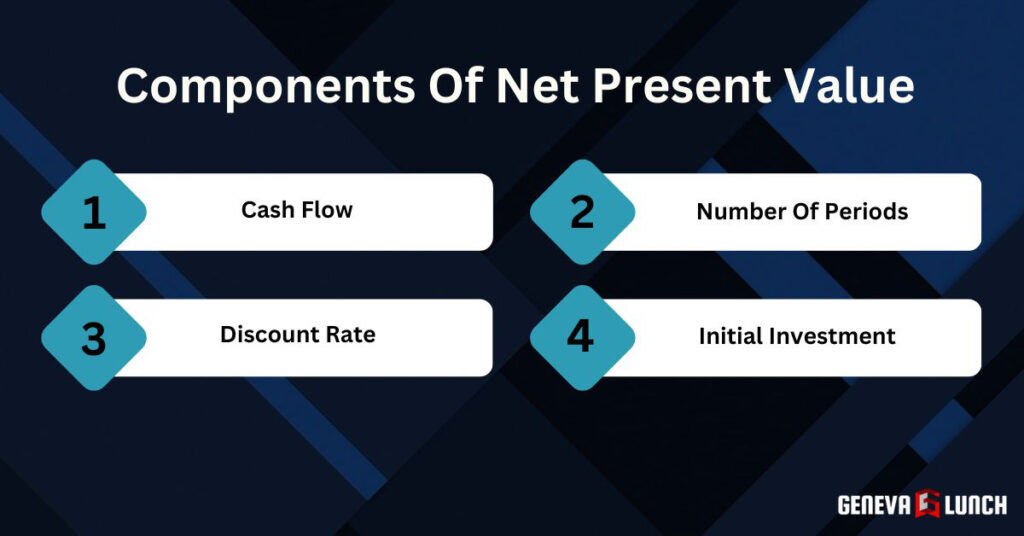
Net Present Value (NPV) is a way to see if your investment will make money. It helps you know how much more money an investment will bring compared to its cost. Let’s look at what makes up NPV.
Cash Flow
Cash flow is the money that comes in and goes out from an investment. For NPV, you look at all the money you expect to make from the project each year. You add up all these future cash amounts to see the total expected cash flow. This helps you understand if you will gain more money than you spend.
Number Of Periods
The number of periods refers to how long you will get money from your investment. This could be years or months.
NPV needs this time to calculate how long it will take to get all your cash back. Knowing the periods helps calculate whether the waiting is worth the money you expect to earn.
Discount Rate
The discount rate is a tricky part. It shows the value of future money compared to today’s money.
A dollar today is worth more than a dollar you get next year because you can use today’s dollar right away. The discount rate helps you see how much future cash flows are worth right now.
Initial Investment
The initial investment is the total money you spend at the start of a project. This could be money spent on buying property, machines, or any other costs to start the project.
NPV subtracts this amount from the present value of future cash flows to see if the total result is positive, meaning the investment is worth it.
Applications Of Net Present Value (NPV)
Net Present Value (NPV) is a key tool in finance. It helps people decide if an investment is good by comparing the money invested today to the money it will make in the future. Let’s look at how NPV is used in different areas.
Capital Budgeting
Capital budgeting is when a company decides whether to start a big project. Using NPV, the company can determine whether the project will make more money than it costs.
They choose projects with a positive NPV. This means the project should earn more money than it costs, making it a good choice.
Real Estate Investments
People who invest in real estate use NPV to pick the best properties to buy. They look at the future money they will get from renting or selling the property and subtract the money they need to spend now.
A property with a high NPV is a great investment because it will make more money over time.
Stock Valuation
Investors use NPV to decide which stocks to buy. They estimate how much money the company will make in the future and compare it to the stock’s price today. Stocks with a high NPV are usually a better buy because they are expected to grow in value.
Mergers And Acquisitions (M&A)
When companies consider merging with or buying another company, they use NPV to make the decision. They calculate whether the combined company will make more money than the two companies separately. A positive NPV means the merger or purchase is likely to be profitable.
Private Equity And Venture Capital
Private equity and venture capital firms invest in companies and want to make a profit. They use NPV to pick companies that look like they will grow and make more money. Choosing companies with a high NPV helps them make good investment decisions.
Factors That Affect Net Present Value (NPV)
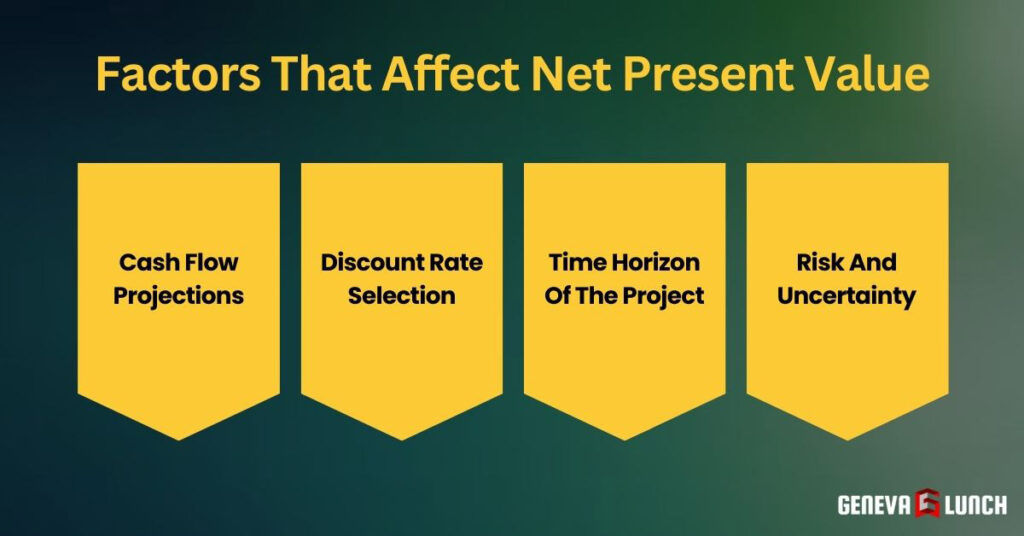
Net Present Value (NPV) is a way to see if an investment will make more money than it costs. Many things can change the NPV, making it go up or down. Here are 4 important factors:
Cash Flow Projections
Cash flow projections estimate how much a project will bring in or spend over time. Getting these numbers right is key. Once you expect more money to come in, the NPV will look better than it is.
Making accurate money flow guesses helps ensure that NPV tells the truth about an investment’s worth.
Discount Rate Selection
The discount rate is the interest rate used to determine the value of future cash. Picking the right rate is crucial because it affects how we perceive the value of future money.
A high rate makes future money seem less valuable, which can reduce the NPV. A low rate does the opposite.
Time Horizon Of The Project
The time horizon is how long the project will last. Longer projects have more uncertainty because it’s hard to guess what will happen soon. This can lower the NPV, as longer times make money received in the far future worth less today.
Risk And Uncertainty
Risk and uncertainty involve not knowing what will happen. They can significantly change NPV. More risk can lower NPV because it makes people want more rewards for the chance they are taking. We often use a higher discount rate to show more risk, which lowers NPV.
Advantages Of Using Net Present Value (NPV)
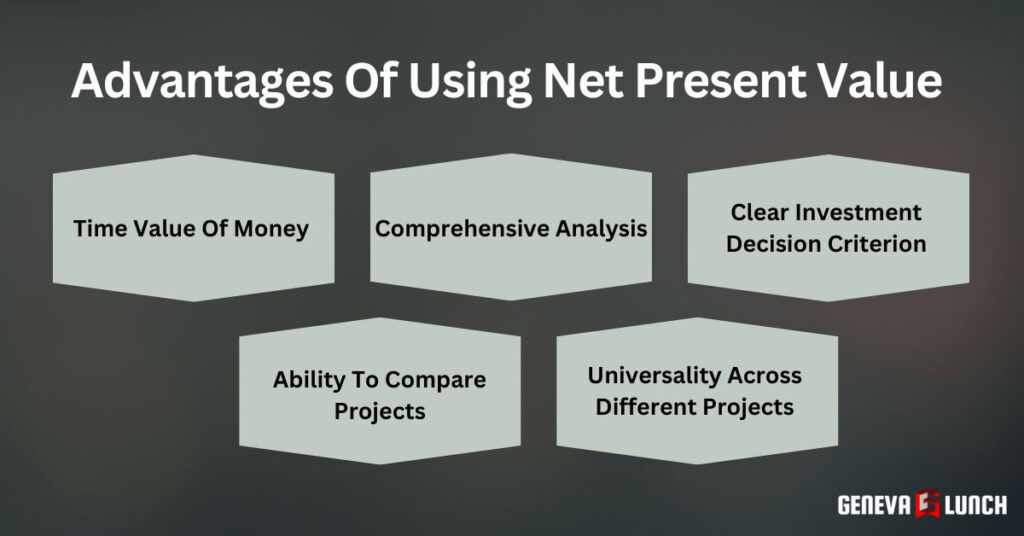
Net Present Value (NPV) is a method businesses use to determine whether their investments will make more money than they cost. This approach has many benefits, especially when choosing the best investment projects.
Time Value Of Money
The time value of money is a key part of NPV. This idea means that the money you have right now is worth more than the same amount in the future because of its potential earning capacity.
NPV helps you see how much future money is worth today. This helps you decide if an investment is worth it based on today’s dollars.
Comprehensive Analysis
NPV provides a thorough look at an investment project’s potential profitability. It considers all expected cash flows over the project’s life and discounts them back to their present value.
This complete analysis helps investors see the big picture of their investment’s potential earnings, including all incoming and outgoing cash flows.
Clear Investment Decision Criterion
One major benefit of NPV is that it gives a simple rule: if NPV is positive, the investment is likely worth it. This makes decision-making easier because it turns complex financial details into a straightforward yes or no choice based on whether the number is above zero.
Ability To Compare Projects
NPV is great for comparing different projects. It turns all options into a single number, the NPV, representing the value each project could add to the company. This makes it simple to compare different types and sizes of investments, as higher NPVs point to more valuable projects.
Universality Across Different Projects
NPV works for all kinds of investments, regardless of industry or type of cash flow involved. This universality makes it a valuable tool for any business looking at various projects, from new products to infrastructure upgrades.
It provides a consistent method to evaluate investment opportunities using the same criteria.
Limitations Of Net Present Value (NPV)
Net Present Value (NPV) is a widely used tool to evaluate investment profitability. However, certain limitations affect its accuracy and reliability. Below are key challenges when using NPV.
Sensitivity To Discount Rate
NPV relies heavily on the discount rate, which calculates the present value of future cash flows. A small change in the discount rate can significantly impact the NPV, making the project seem more or less profitable.
Choosing the right discount rate is critical, but it can be difficult to estimate accurately, especially in uncertain market conditions.
Difficulty In Cash Flow Estimation
One of the biggest challenges in using NPV is accurately forecasting future cash flows. Businesses may need help to predict how much revenue a project will generate, especially over long periods. When cash flow estimates are correct, the NPV result becomes reliable, leading to better investment decisions.
Assumes Reinvestment At Discount Rate
NPV assumes that future cash flows will be reinvested at the same discount rate used in the calculation. In reality, this is not always possible, as actual reinvestment rates may differ.
This assumption can cause NPV to either overestimate or underestimate a project’s true value, depending on actual market conditions.
Ignores Project Size
NPV does not consider a project’s scale or size. A small project with a high NPV might appear more attractive than a larger project with a lower NPV, even though the larger project could generate more profit overall. This limitation can lead businesses to favor smaller projects when larger ones offer better long-term returns.
Limited Use For Short-Term Projects
NPV may need to provide more insight to make the best decision for short-term projects. Since it focuses on long-term cash flows, NPV can overlook the immediate benefits of short-term investments.
Other methods, such as a payback period or internal rate of return (IRR), may be more suitable for evaluating short-term projects.
Common Mistakes In Net Present Value (NPV) Calculation
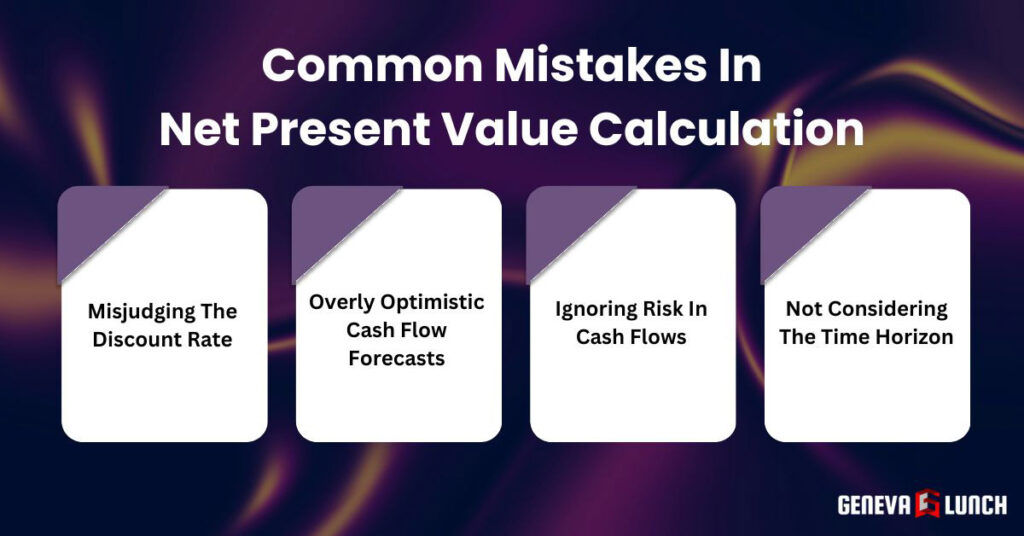
Calculating Net Present Value (NPV) helps investors decide if an investment is worth pursuing. However, mistakes can lead to inaccurate results, affecting financial decisions. Below are some common errors to watch for when calculating NPV.
Misjudging The Discount Rate
The discount rate plays a crucial role in NPV calculations. Choosing the right rate can lead to accurate results. If the rate is higher, the NPV may show higher returns than realistic ones.
On the other hand, a high discount rate can undervalue future cash flows, making good projects seem unattractive. Choosing a rate that reflects the cost of capital and the risk involved in the investment is essential.
Overly Optimistic Cash Flow Forecasts
One of the biggest things that could be improved in NPV calculations is overestimating future cash flows. Investors may assume that their project will perform better than it realistically will, leading to inflated NPVs and poor investment decisions.
Accurate, conservative forecasts provide a better picture of potential returns and help avoid risky investments.
Ignoring Risk In Cash Flows
Investments carry different levels of risk, which directly affect future cash flows as outlined in the cash flow statement. Ignoring these risks can lead to inaccurate NPV calculations.
For instance, market fluctuations or uncertain economic conditions may lower future cash flows. Factoring in these risks during the NPV calculation provides a clearer and more accurate evaluation of an investment’s true value.
Not Considering The Time Horizon
Many investors need to pay more attention to the importance of the time horizon when calculating NPV. Longer projects with extended cash flows require more careful analysis, as the value of money changes over time.
Failing to account for the project’s length can result in an inaccurate NPV. Always consider the project’s duration and adjust the calculation accordingly.
FAQs
1. What Does A Positive NPV Mean?
A positive Net Present Value (NPV) indicates that the projected earnings from an investment, discounted to their present value, exceed the initial costs. This suggests the investment should yield profits, making it financially worthwhile. A positive NPV is typically a green light for investment.
2. Can NPV Be Negative, And What Does That Mean?
Yes, Net Present Value (NPV) can be negative. This indicates that the total costs of an investment exceed the total returns, adjusted for the time value of money. A negative NPV suggests that the investment may not be financially viable or worth pursuing, as it likely leads to a net loss.
3. Is NPV Useful For Short-Term Projects?
NPV is useful for short-term projects as it evaluates immediate financial benefits by discounting cash flows to present value. It accurately assesses profitability and helps in making informed decisions by comparing initial investment costs against the returns generated over the project’s duration.
4. How Often Should NPV Be Recalculated For Long-Term Projects?
NPV should be recalculated annually for long-term projects to reflect changes in cash flows, discount rates, and market conditions. Regular updates ensure accurate project valuation and facilitate timely decisions on continuation, adjustment, or termination based on updated financial forecasts.
Final Word
Net Present Value (NPV) is a powerful tool for evaluating investments. It shows us how much more we could earn compared to what we spent initially.
By using NPV, we make better choices with our finances, picking projects that offer real benefits. It’s like a financial friend that guides us to smarter, more profitable decisions. When we manage our finances wisely with NPV, we can grow our money and achieve our financial goals more effectively.