Internal Rate Of Return (IRR): Maximizing Investment Value

The Internal Rate of Return, or IRR, is like a tool that helps people understand how well an investment is doing.
Internal Rate of Return (IRR): maximizing investment value focuses on calculating the rate that makes cash flows’ net present value (NPV) zero. A higher IRR means greater returns, helping investors evaluate project profitability and prioritize those with better long-term value potential.
Using IRR, you can also compare it to other ways to spend your money, like buying a new bike or a video game, to see which is best. It’s a great way to make smart choices with your money!
Key Takeaways
- Predictive Tool: IRR helps forecast the profitability of potential investments, providing a clear percentage return.
- Comparison Metric: Use IRR to compare the efficiency of multiple investment opportunities against each other.
- Time Value of Money: IRR incorporates the time value of money, emphasizing the impact of time on cash flows.
- Limitations: IRR may not accurately reflect returns if cash flows fluctuate or reinvestment rates differ.
- Supplementary Analysis: Best used alongside other financial metrics like NPV to offer a complete investment appraisal.
What Is The Internal Rate Of Return (IRR)?
The Internal Rate of Return (IRR) is a metric. It estimates an investment’s profitability. The discount rate makes the net present value (NPV) of all cash flows from the investment equal to zero.
In simpler terms, it’s the rate of return that an investment is expected to generate. Here’s how it works –
- Cash Flows: This determines the expected cash inflows and outflows associated with the investment.
- Discount Rate: The IRR is the discount rate that makes cash inflows’ present value equal to cash outflows’ present value.
- Decision: If the IRR is greater than the required rate of return (or hurdle rate), the investment is considered profitable and worth pursuing.
Key Points To Remember:
- Higher IRR, Better Investment: A higher IRR indicates a more profitable investment.
- Limitations: IRR can be misleading in certain scenarios, such as when multiple sign changes in cash flows (e.g., negative, positive, negative).
- Complementary to NPV: IRR is often used with Net Present Value (NPV) for a more comprehensive analysis.
How To Calculate Internal Rate Of Return (IRR)

The Internal Rate of Return (IRR) is a financial metric that measures an investment’s profitability. The discount rate makes the net present value (NPV) of all cash flows from the investment equal to zero. In simpler terms, it is the rate of return that an investment is expected to generate.
IRR Formula
The formula to find IRR is complex, such as adding or subtracting. It tries to set the net present value (NPV) of all cash flows from an investment equal to zero. Here’s how the formula looks:
NPV = 0 = ∑ [CFt / (1 + IRR)^t]
Where:
- NPV = Net Present Value
- CFt = Cash Flow at time t
- IRR = Internal Rate of Return
- t = Time period
Manual Calculation Of IRR
While there are financial calculators and software that can calculate IRR automatically, understanding the manual methods can provide deeper insight into the concept.
Trial And Error Method
To calculate IRR by trial and error, you guess different IRR values until the NPV formula equals zero. This method can take a lot of time because you must guess many times.
Approximation Techniques
Approximation techniques make guessing faster. One common method is the interpolation technique, which uses two IRR guesses to estimate a more accurate IRR. This method helps you get closer to the actual IRR quicker than random guessing.
Using Financial Tools For IRR Calculation
Calculating IRR by hand can be tricky. Luckily, some tools make it easier to figure out. Here are some you can use:
Excel’s IRR And XIRR Functions
Excel is great for calculating IRR, especially when your cash flows (money in and out) happen regularly. You use the IRR function for this. If your cash flows aren’t timed regularly, like getting money back at random times, you use the XIRR function. Here’s how:
- List your cash flows in one column, including your initial investment as a negative number.
- Type “=IRR(range)” or “=XIRR(range, dates),” where “range” is your cash flow cells and “dates” are the specific times you got or will get the money.
Financial Calculators
Financial calculators are handy if you don’t want to use a computer. Many calculators have an IRR function. You enter your cash flows individually, and it tells you the IRR. This is useful for quick checks or when you’re away from your desk.
Online IRR Calculators
Online IRR calculators are a good choice if you don’t have Excel or a financial calculator. You just find a website that offers this tool, enter your cash flows and the times they happen, and it calculates the IRR for you. This is a fast way to get your IRR without special software or equipment.
IRR In Complex Cash Flows
Calculating IRR becomes trickier when cash flows are complex or irregular. Sometimes, these unusual patterns result in more than one IRR or none.
Handling Irregular Cash Flows
With irregular cash flows, the timing of the payments can vary. Some cash flows happen earlier, others later. This inconsistency can make finding the exact IRR challenging. In these cases, financial software is needed to ensure accuracy.
Dealing With Multiple IRRs In Unconventional Cash Flow Patterns
Once a project’s cash flows change, multiple IRRs can appear. This can happen with big upfront investments followed by periods of negative and positive cash flows. This means there’s more than one interest rate where NPV equals zero.
To avoid confusion, use other metrics like NPV or Modified IRR (MIRR) alongside IRR. These tools provide a clearer picture of whether the investment is good or bad.
Significance Of The Internal Rate Of Return

The Internal Rate of Return (IRR) is a key tool used in financial investment. It helps investors see how much money a project can make. Think of IRR as a way to measure how quickly and effectively your money can grow in an investment. The higher the IRR, the better the investment looks.
Indicator Of Project Viability
IRR tells us if a project is worth the money and effort. When the IRR is higher than the cost to borrow money for the project, it means the project is likely a good choice. It acts like a green light for investors that a project can pay off well.
Insight Into Growth Potential
IRR gives a glimpse into a project’s growth potential. A high IRR value shows that a project can grow your money faster. This is really useful when comparing two projects. The one with the higher IRR is usually the better one to help your money grow more.
Assessing Project Risk
Looking at IRR also helps us see the risks in a project. While a high IRR can be good, it often comes with higher risks.
Investors use IRR to determine whether a project’s possible rewards are worth the risks. This helps them make more intelligent choices and avoid losing money.
How Do You Interpret The IRR?
The Internal Rate of Return (IRR) measures the percentage of money an investment can make over time. It shows the annual growth rate of the invested money. When you understand the IRR, you can tell if an investment is good by comparing it to what you expect or other investments.
High IRR Implications
A high IRR means an investment is expected to yield a strong return. It suggests that the project or investment grows your money fast. Businesses often prefer projects with a high IRR because they aim to maximize profits.
For example, if a new product has a high IRR, the company will likely invest in its development and marketing.
Low IRR Implications
On the other hand, a low IRR indicates that the investment returns are less attractive. This means the investment may grow slowly. It might not be the best use of funds, especially if other projects promise better returns.
Companies often pass on these investments. They do so unless the investments serve other strategic purposes, like maintaining market presence or meeting regulations.
Benchmarks For Acceptable IRR
What counts as a good IRR depends on the company’s needs and the economic environment. Each industry has its own benchmark IRR, which reflects the minimum return an investment must offer to be considered.
Generally, it is acceptable if the IRR is above the cost of capital (what it costs to fund the project).
Comparing IRR Across Industries
Comparing IRRs across industries can take time and effort. Each has different risks and returns. For instance, tech startups have a higher IRR due to rapid growth.
In contrast, utility companies have lower IRRs because they grow slowly but steadily. Investors use IRR to compare potential returns in the context of industry-specific risks and opportunities.
Factors That Influence IRR
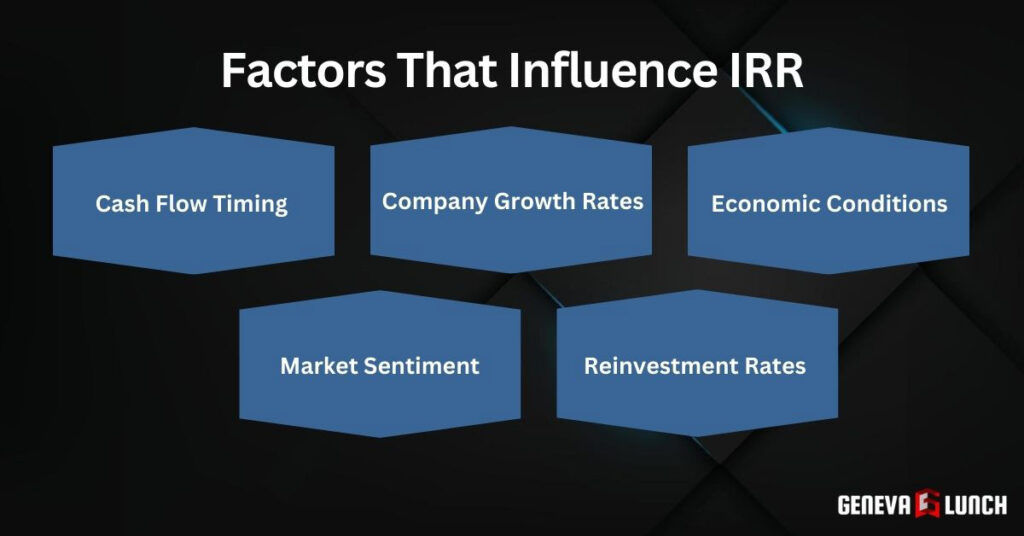
The Internal Rate of Return (IRR) is a key number that tells us how well an investment is performing. It shows a project’s profit as a percentage, helping businesses decide where to put their money.
Cash Flow Timing
The timing of cash flow is crucial for calculating IRR. The cash flow statement is key to financial analysis. It clearly shows a company’s inflows and outflows.
When a company receives cash earlier, it can reinvest it to generate additional returns, leading to a higher IRR. Delayed cash inflows can reduce the IRR. The money can only earn returns if we wait.
Company Growth Rates
How fast a company grows also impacts the IRR. A company that grows quickly usually sees more and faster cash returns, boosting the IRR.
However, slow growth can lead to lower and slower returns, lowering the IRR. Investors often look at growth rates to guess future cash flows from their investments.
Economic Conditions
The economy plays a big role in shaping the IRR. In a strong economy, businesses earn more, and investments perform better, raising the IRR. On the other hand, during tough economic times, lower earnings and harder business conditions can reduce the IRR.
Market Sentiment
Market sentiment refers to how people feel about the market’s future. If investors are positive and believe the market will do well, they are more likely to invest.
This can drive up the IRR as more money flows into investments. If the sentiment is negative, the IRR might fall because fewer people are investing.
Reinvestment Rates
The reinvestment rate is the rate at which an investor can reinvest cash flows from an investment. A high reinvestment rate can lead to a higher IRR, as the returns on reinvested funds add to the overall profitability.
When the reinvestment rates are low, it can be harder to keep a high IRR because the returns from the reinvested cash are less.
What Are The Limitations Of The IRR?
Many people use the internal rate of Return (IRR) to decide whether to invest in a project. It shows what percent of their money they might get back. However, the IRR isn’t perfect and has some limits that we need to understand.
Multiple IRRs In Non-Conventional Cash Flows
Sometimes, an investment’s cash flow could be more steady. For instance, you might spend money at the start and get returns later but then need to spend more again, leading to more than one IRR value.
When this happens, it can be confusing and hard to tell which IRR to examine. It can also be difficult to decide whether the investment is good or not.
Reinvestment Assumptions
IRR assumes that all the cash you get from an investment can be returned to the same project at the same return rate. This is only sometimes true in real life. Often, the return rate for reinvested cash is different and usually lower. This can make the IRR seem better than it is.
Lack Of Scale Consideration
IRR does not consider the size of an investment. A small and big project might have the same IRR, but the more significant project will likely need more money and bring more total cash back.
Looking at IRR might make small and big projects seem equally good, but they are only sometimes.
Sensitivity To Cash Flow Timing
The timing of cash flows in and out can significantly affect the IRR. Small changes in timing can lead to big changes in the IRR.
When cash arrives a bit earlier or later than expected, the IRR can look much better or worse than it really should.
IRR For Long-Term Projects
Using IRR for long-term projects can take time and effort. Over many years, many things can change, like costs and the amount of money you make from the project.
IRR only sometimes handles these changes well, so long-term projects may give you a vague picture of what to expect.
Strategies That Use The IRR

The Internal Rate of Return (IRR) is a key financial metric. It is used across sectors to assess the viability and profitability of investments. Here’s how different strategies utilize IRR:
Capital Budgeting
Capital budgeting helps businesses decide on long-term investments, such as buying equipment or launching a new product line. The IRR helps assess whether a project will yield returns above the cost of capital.
By comparing a project’s IRR to the company’s required rate of return, decision-makers can pick projects that will maximize profits. The higher the IRR, the more attractive the project becomes.
Private Equity Investment
Private equity firms often use IRR to evaluate potential investments in companies. When investing in a private company, IRR estimates future returns based on expected profits and growth.
A higher IRR suggests a better investment opportunity. Private equity investments usually have long holding periods. So, IRR helps investors assess potential growth and exit strategies and ensures they make the right investment choice.
Real Estate Investment
In real estate, investors use IRR to gauge whether a property will provide good returns. When buying a property, they project future cash flows, considering rent, property appreciation, and sale value.
The IRR gives an overall view of whether these returns justify the initial investment. Investors often pick properties with higher IRRs to meet their profit goals.
Sector-Specific Analysis
Some sectors require a closer look at IRR to determine investment value. For example, IRR helps measure the potential returns of investing in new projects in fast-growing, innovative industries like tech and healthcare.
Investors can compare the IRRs of different sectors, which helps them determine where to invest for the best returns.
FAQs
1. Why Might IRR Not Be Sufficient Alone For Investment Decisions?
IRR alone may not suffice for investment decisions. It assumes reinvestment at the same rate, which is unrealistic. IRR also fails to consider project scale and timing of cash flows. Therefore, combining IRR with metrics like NPV and payback period ensures a more comprehensive investment analysis.
2. Can IRR Be Used To Evaluate Short-Term Projects?
Yes, IRR (Internal Rate of Return) can be used to evaluate short-term projects. It helps determine the project’s profitability by calculating expected returns as a percentage. But, IRR assumes all cash flows are reinvested at the same rate, which may not always be realistic for shorter durations.
3. What Happens When A Project Has Multiple IRRs?
A project with multiple IRRs indicates differing cash flows over time that cross the x-axis more than once. This scenario typically occurs in projects with alternating negative and positive cash flow periods. Understanding each IRR helps evaluate the project’s viability at various stages.
4. How Does Inflation Affect The IRR Calculation?
Inflation affects the Internal Rate of Return (IRR) by reducing the real value of future cash flows. As inflation rises, the nominal IRR may overstate investments’ real profitability. Adjusting cash flows for expected inflation provides a more accurate assessment of an investment’s potential.
5. How Does IRR Compare To The Payback Period?
IRR and payback period are distinct metrics for evaluating investments. IRR calculates expected returns as a percentage rate, reflecting profitability. Conversely, the payback period shows how quickly an investment recovers its initial cost, focusing on risk reduction rather than profitability.
Final Word
The Internal Rate of Return (IRR) is a useful tool. It helps people see how much money they can make from their investments. The IRR shows profit as a percentage, making it easy to compare opportunities.
IRR gives a clear view of an investment’s potential. It avoids complex details. However, remember that IRR isn’t perfect.
It works best with other methods, like NPV, which gives a fuller picture of an investment’s worth. By using IRR, investors make smarter choices, ensuring their money works hard for them.