Do I Need A Financial Advisor? (When? When Not?)

Managing your finances effectively is crucial for achieving financial stability and reaching your long-term goals. It requires specific strategies and careful planning. But a common question is: Do I need a financial advisor for that?
Whether you need a financial advisor depends on your financial knowledge, the complexity of your financial situation, and how comfortable you are managing your own finances. When you find it challenging to create financial plans or manage investments, a financial advisor can provide valuable support.
In this article, we’ll discuss whether you need a financial advisor. We’ll cover the various scenarios in which a financial advisor may be beneficial, potential drawbacks, and alternatives if you decide going solo is the right path for you.
Key Takeaways
- Assess Your Skills: Evaluate your financial knowledge and investment management skills.
- Analyze Complexity: Consider the complexity of your financial situation and goals.
- Independence Evaluation: Assess your comfort with handling major financial decisions independently.
- Financial Goals: Determine if professional help is needed to achieve specific financial objectives.
- Cost-Benefit Analysis: Consider if the advisor’s cost outweighs the financial benefit provided.
What Is A Financial Advisor?
According to the financial advisor definition, they are professionals who help people manage their money. They offer advice on how to save, invest, and grow funds. Financial advisors also help their clients with planning for retirement, paying off debts, and planning for big expenses.
Who Can Benefit From A Financial Advisor?

Many people find that hiring a financial advisor can greatly enhance their financial health and planning. Here are some groups who might benefit most from professional financial advice:
- Young Professionals: Starting early with financial planning can set a foundation for future wealth.
- Families: Advisors help plan for children’s education costs and manage household budgets.
- Retirees: Managing retirement savings effectively to ensure a comfortable lifestyle.
- High Net Worth Individuals: Complex financial portfolios require sophisticated management and strategy.
- Business Owners: Strategic financial planning is crucial for both business growth and personal finances.
When You Might Need A Financial Advisor
Financial advisors are invaluable during significant changes in life, complex financial situations, or when you have specific financial goals. They provide expert advice tailored to individual needs. They ensure you make sound financial decisions.
Major Life Events
Major life events often bring financial challenges and opportunities. Whether you’re starting a family, changing your marital status, or planning for retirement, a financial advisor can guide you through these crucial times. They can ensure financial security and growth.
Marriage
Combining finances in marriage requires careful planning. A financial advisor can help create a joint budget, suggest strategies for saving towards future goals like buying a home, and advise on managing any existing debts. They can help create a financial plan that suits both partners.
For example, if a couple earns a combined income of $100,000, an advisor might suggest saving 15% each year towards retirement and major purchases.
Birth Of A Child
The birth of a child significantly increases financial responsibilities. A financial advisor can guide parents on budget adjustments to accommodate childcare, medical, and educational expenses.
The average cost to raise a child in the U.S. is about $233,000. So, starting an education fund early, like a 529 plan, is a strategic move advised by financial experts.
Divorce
Navigating finances during a divorce can be complex and emotionally taxing. A financial advisor helps individuals understand asset division, manage alimony or child support, and reevaluate their financial goals independently.
They ensure that one’s financial future remains secure, even when personal circumstances change dramatically.
Inheritance
Receiving an inheritance can alter a financial situation significantly. Advisors help beneficiaries manage large sums effectively, advising on investment options and tax implications.
For example, if someone inherits $100,000, a financial advisor might recommend ways to invest that will ensure long-term growth and tax efficiency.
Retirement
Effective retirement planning is essential to ensure a comfortable life later on. Financial advisors assess current savings, future needs, and the best investment strategies to meet retirement goals.
For example, they may calculate that saving $500 monthly from age 30 will adequately fund a comfortable retirement at 65.
Complex Financial Situations
Navigating complex financial situations requires professional insight. Especially when your finances involve high net worth, multiple income sources, or business ownership. A financial advisor can simplify these complexities, providing clarity and strategic direction.
High Net Worth Individuals
Individuals with substantial assets often face unique financial challenges. A financial advisor provides expertise in estate planning, investment management, and tax strategies to safeguard and grow wealth.
They tailor strategies to individual needs, ensuring that high net worth clients maintain their lifestyle and pass on wealth according to their wishes.
Multiple Income Sources
For those with various income streams such as salary, rental income, and freelance earnings, managing finances can be challenging. A financial advisor helps optimize tax returns and ensures that all sources of income are efficiently managed to avoid financial strain.
They provide strategic advice on how to allocate funds from different sources for maximum financial benefit.
Business Owners
Business owners deal with unique challenges such as fluctuating cash flows and complex tax regulations. A financial advisor offers crucial guidance on financial planning, investment decisions, and cash management strategies tailored to business needs.
This support is vital for sustaining operations and facilitating growth in competitive markets.
Specific Financial Goals
People can have specific financial goals. For example, buying a home, funding education, or planning for vacations. A financial advisor can help with that. They can ensure your financial strategies are effective and tailored to your objectives.
Home Purchase
Planning to buy a home involves more than just saving for a down payment. A financial advisor can outline a saving strategy, help choose the right mortgage type, and plan for other purchasing costs like closing fees.
For a home priced at $300,000, they might suggest strategies for accumulating the $60,000 down payment while maintaining a balanced budget.
Education Funding
As the cost of education continues to rise, planning for this significant expense becomes critical. A financial advisor helps set up dedicated savings accounts like 529 plans and advises on the amount needed to cover tuition and related expenses.
This proactive approach ensures funds are available when children reach college age.
Travel And Leisure Planning
For individuals who value travel and leisure, financial planning helps ensure that these activities do not compromise their overall financial health.
Advisors suggest setting up a separate savings account dedicated to travel and determining an affordable amount to contribute monthly. This method helps clients enjoy their leisure activities without financial stress.
When You Might Not Need A Financial Advisor
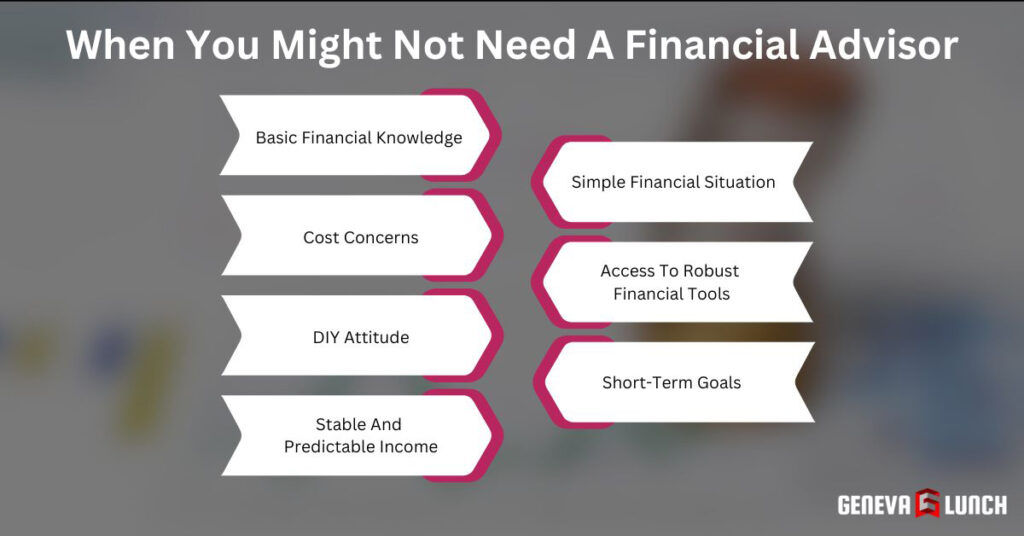
Not everyone requires the services of a financial advisor. There are several circumstances where you might decide to handle your finances independently. Here are some of the possible situations where a financial advisor might not be necessary:
Basic Financial Knowledge
When you understand the basics of financial management, such as how to budget, save, and make simple investments, you may not need a financial advisor. For example, if you already know how to allocate your monthly income effectively, such as saving 20% of a $3,000 paycheck for emergencies and investing 10% in a retirement plan, you can manage these tasks on your own.
Understanding interest rates, credit scores, and the importance of an emergency fund also indicates that you may handle your finances without professional help.
Simple Financial Situation
Those with straightforward financial situations, like having a single, steady source of income, few debts, and limited family obligations, might not see the value in hiring a financial advisor.
When your financial life involves little more than managing monthly bills, saving a portion of your paycheck, and perhaps contributing to a retirement account, the simplicity of your finances makes self-management a viable option.
Cost Concerns
The cost of hiring a financial advisor can sometimes outweigh the benefits, especially if your investment returns are minimal. When an advisor’s annual fee is $1,200, but your investment gains are only $1,000, then financially, it doesn’t make sense to hire one.
Individuals who find the costs prohibitive might prefer to rely on free or low-cost financial resources and tools available online or through community workshops.
Access To Robust Financial Tools
Today’s market offers a variety of sophisticated financial tools that provide guidance on everything from budgeting to investing. Many of these tools are equipped with user-friendly interfaces and provide as much functionality as a basic financial advisor would.
When you are comfortable using these tools and they meet all your financial planning needs, you may not need to pay for a financial advisor.
DIY Attitude
When you are the type of person who enjoys deep diving into financial literature, exploring various investment strategies, and actively managing your budget, you might prefer to handle your finances yourself.
People who enjoy the challenge of managing their own money and have the time to commit to learning about financial markets and strategies may not need a financial advisor.
Short-Term Goals
For goals that are short-term like saving for a holiday in the next year or buying a new car in six months, you might manage fine without a financial advisor.
Short-term goals typically require straightforward savings plans and budget adjustments. It can be handled without professional help, as long as you remain disciplined and focused.
Stable And Predictable Income
When your income is stable and your financial needs do not fluctuate much from month to month, the services of a financial advisor might not be necessary.
For instance, if you earn a predictable $4,000 each month, and your expenses only amount to $3,000, you can likely manage your budgeting and saving without needing external advice.
This stability allows you to plan ahead confidently, knowing how much you can afford to spend or save each month.
Types Of Financial Advice You Might Need
Financial advice can be essential in various aspects of your financial life. It can help you whether you’re looking to grow your wealth, plan for retirement, or manage risks. Here are some common types of financial advice that might benefit you:
Investment Management
Investment management involves choosing where to put your money to grow over time. A financial advisor can help you select stocks, bonds, or mutual funds based on your risk tolerance and financial goals.
For example, if you invest $10,000, an advisor may help you divide it among different assets to balance potential gains with risk.
Retirement Planning
Retirement planning involves calculating how much money you’ll need to live comfortably after you stop working. A financial advisor can help you set up plans like a 401(k) or IRA.
For instance, if you start saving $300 a month at age 30 in a retirement account with a 5% annual return, you could have over $300,000 by age 65.
Tax Planning
Tax planning helps you minimize your tax liability through deductions, savings, and investments. A financial advisor can guide you on strategies like tax-loss harvesting or choosing tax-efficient investments.
When you earn $50,000 a year, proper tax planning may reduce your taxable income, lowering your tax bill significantly.
Estate Planning
Estate planning ensures your assets are distributed according to your wishes after you pass away. This can involve setting up wills, trusts, and healthcare directives.
For example, an advisor can help you set up a trust to manage your assets and ensure they are passed on smoothly without legal hassles.
Insurance And Risk Management
This type of advice involves evaluating potential financial risks and finding ways to mitigate them through insurance. Financial advisors can recommend types of insurance like life, disability, or property insurance depending on your needs.
For instance, if you have a family, life insurance worth $500,000 can secure their financial future in case of any mishaps.
Debt Management
Debt management advice can help you handle or reduce debts more efficiently. An advisor might suggest strategies like consolidating various debts into one with a lower interest rate or paying off high-interest debt first.
When you have $15,000 in credit card debt, an advisor might help set up a plan to pay it off in 3 years, saving you money on interest.
Budgeting And Saving
Budgeting and saving advice is essential for managing daily finances and preparing for future expenses. A financial advisor can help you create a budget that tracks your income and expenses, helping you save for goals like a vacation or emergency fund.
For example, by saving $200 a month, you can build a $1,200 emergency fund in just 6 months.
Benefits Of Hiring A Financial Advisor

Hiring a financial advisor can provide you with several advantages. These advantages can range from accessing professional expertise to reducing financial stress. Here are some of the ways they can help:
Professional Expertise
Financial advisors bring deep knowledge about money management, investments, and financial planning. They stay updated on market trends and legal changes that could impact your finances. They can tailor financial strategy for your specific needs.
For example, an advisor can help you adjust your investment portfolio in response to economic changes. It ensures that your investments are well-positioned for growth despite market fluctuations.
Time Savings
Managing finances can be time-consuming, especially if you need to research investments, keep up with financial news, and track expenses. A financial advisor can take care of these tasks for you. This means you can spend more time on your career, family, or hobbies.
For instance, instead of spending 10 hours a month reviewing financial statements, an advisor handles this, giving you that time back.
Personalized Financial Strategy
Every individual has unique financial goals and situations. A financial advisor crafts a personalized financial plan tailored to your specific needs and objectives. Whether you’re saving for a child’s education, planning for retirement, or buying a home, they can set a strategy that aligns with your financial capacity and goals.
For example, if your goal is to buy a home in five years, an advisor might develop a saving and investment plan to accumulate the needed down payment of $40,000.
Objective Perspective
Financial decisions are often influenced by emotions, which can lead to costly mistakes. Financial advisors provide an objective viewpoint, helping you make decisions based on facts and sound judgment rather than emotion.
This is particularly helpful in volatile markets or big life changes. For example, during a market downturn, an advisor might recommend holding your investments steady instead of selling in panic, which can preserve your wealth in the long term.
Stress Reduction
Managing money can be stressful, especially when dealing with complex issues like debt management, investment decisions, and long-term financial planning. Having a financial advisor can reduce this stress by ensuring that your financial affairs are in order, providing peace of mind.
They handle the complexities of financial management, so you don’t have to worry about making every decision alone. For example, knowing that an expert is managing your retirement plan can ease worries about your financial future.
Potential Drawbacks Of Hiring A Financial Advisor
While financial advisors offer numerous benefits, there are also potential drawbacks to consider. Understanding these risks can help you make a more informed decision about whether to hire a financial advisor. Here are some of them:
Cost Of Services
Hiring a financial advisor can be expensive. Advisors often charge a percentage of the assets they manage, a flat fee, or a combination of both. For example, if an advisor charges 1% per year to manage your investment portfolio of $100,000, you would pay $1,000 annually.
This cost can add up, especially if the returns on your investments do not outweigh the fees.
Risk Of Misaligned Interests
Sometimes, a financial advisor’s recommendations might not perfectly align with your best interests. This can occur if an advisor is paid commissions based on the products they sell, which might lead them to recommend products that earn them higher commissions rather than those that are best for you.
For example, an advisor may recommend a mutual fund with high fees that also pays them a high commission, even if there are better options available.
Over-reliance On Advisor
Relying too much on a financial advisor might hinder your understanding of your own finances. When you depend entirely on an advisor for all financial decisions, you may find it challenging to manage your finances independently if the need arises.
This could be problematic if you suddenly need to switch advisors or decide to manage your finances on your own.
Potential For Conflict Of Interest
Conflicts of interest can arise if an advisor stands to benefit from certain financial decisions. This situation can lead to recommendations that aren’t in your best interest.
For example, an advisor may suggest investing in a company because they have a personal or business relationship with that company, not because it’s a sound investment for you. Such conflicts can compromise the quality of advice you receive.
How To Choose The Right Financial Advisor
Choosing the right financial advisor is crucial for effective financial management. It can also help you achieve your financial goals. This decision should be guided by careful consideration of your needs, thorough research, and direct interactions with potential advisors.
Defining Your Needs And Priorities
Before looking for a financial advisor, clearly define what you need help with. Determine if you’re focused on retirement planning, saving for college, managing debt, or investing. Knowing your priorities helps you find an advisor who specializes in those areas.
For example, if you are planning for retirement and have $200,000 saved, you might look for an advisor who specializes in retirement planning to help you grow your savings effectively.
Researching Qualifications And Designations
It’s important to check the qualifications and certifications of any financial advisor you consider. Look for credentials like Certified Financial Planner (CFP) or Chartered Financial Analyst (CFA).
These designations show that an advisor has completed rigorous training and adheres to high ethical standards. For example, a CFP must pass an exam that covers a variety of financial topics and commit to continuing education to maintain their certification.
Conducting Initial Consultations
Once you have a list of potential advisors, arrange initial consultations with them. These meetings are usually free and allow you to discuss your financial goals, learn about the advisor’s approach, and see if their personality is a good fit for you.
For example, you can ask how they would handle a situation where you have a sudden large expense, like a $30,000 medical bill. This helps you gauge their expertise and responsiveness to your needs.
Alternatives To Hiring A Financial Advisor

Not everyone may need or want to hire a financial advisor. Fortunately, there are several alternatives available. These can help you manage your finances effectively on your own or with minimal assistance.
Self-Directed Financial Planning
When you have a good understanding of financial principles and enjoy managing your money, you might choose to plan your finances yourself. This involves setting your own budget, choosing investments, and planning for future needs like retirement or college funds.
For example, you could use spreadsheets to track your monthly spending and investments. You could aim to save $500 each month towards retirement.
Online Financial Tools And Resources
There are many free and paid online tools that can help you manage your finances without a personal advisor. These tools can provide budget templates, investment suggestions, and even simulate financial scenarios.
For example, an online budgeting tool could help you set up a plan to spend less than $2,000 a month, tracking all your expenses to ensure you stay on target.
Robo-Advisors
Robo-advisors are automated platforms that provide financial advice or investment management online with minimal human intervention. They use algorithms to manage your investments based on your risk tolerance and financial goals.
For a small fee, such as 0.25% of your managed assets per year, a robo-advisor could manage a $10,000 investment, adjusting it as market conditions change.
Seeking Advice From Trusted Friends And Family
Sometimes, advice from well-informed friends or family members can be valuable. When you have a relative who is knowledgeable about finances, they might provide guidance and tips based on their own experiences.
For example, a family member might advise you on how they successfully paid off a $20,000 debt. This could give you practical ideas for managing similar financial challenges.
FAQs
What Is A Fiduciary Financial Advisor?
A fiduciary financial advisor is a professional who has a legal and ethical obligation to put your best interests ahead of their own. This means they need to be transparent about fees, how they get paid, and any conflicts of interest. They are required to recommend the best financial options for you.
How Often Should I Meet with My Financial Advisor?
The frequency of meetings with your financial advisor depends on your financial situation and goals. It’s good to meet at least once a year to review your financial plan and make adjustments. However, if you have significant life changes like a new job, or marriage you should meet more often.
Can I Change My Financial Advisor If I’m Not Satisfied?
Yes, you can change your financial advisor if you’re not satisfied with their service. It’s important to have trust and confidence in your advisor. When you feel your goals are not being met, or if you have concerns about their advice or fees, you can look for another advisor who better suits your needs.
What Information Should I Provide to My Financial Advisor?
You should provide your financial advisor with comprehensive information about your finances. This includes details about your income, expenses, debts, insurance policies, investment accounts, and any assets like homes or cars. Also, you can share your financial goals and concerns.
How Do Financial Advisors Get Paid?
Financial advisors can be paid in several ways: fees, commissions, or a combination of both. Fee-only advisors charge a flat rate, or an hourly rate. Financial Advisor costs can also be paid as commission-based payments. Some advisors use a fee-based structure, combining both fees and commissions.
Final Thoughts
In conclusion, deciding if you need a financial advisor depends on several factors. Consider your understanding of finances, your financial goals, and how complex your financial situation is. Evaluating these aspects carefully will help you make an informed decision about seeking professional advice to ensure your financial goals are met efficiently and effectively.