What Is 401(k)? Types, How It Works, How To Set Up

Are you thinking about your future and how to make sure you have enough money when you retire? A 401(k) plan may be what you need. But what is 401(k), and why is it crucial for planning your retirement?
A 401(k) is a retirement savings plan sponsored by employers. It allows employees to save and invest a portion of their paycheck before taxes are taken out. Types include traditional and Roth 401(k)s. Setting up involves choosing contributions and selecting investments through your employer’s plan.
Let’s explore the different 401(k) plan types, how they work, and how you can start saving for retirement. Get ready to take control of your financial future with a 401(k).
Key Takeaways
- 401(k) Basics: A retirement savings plan sponsored by employers, offering tax advantages to encourage saving for retirement.
- Types of 401(k)s: Includes traditional and Roth 401(k) plans, each with unique tax benefits depending on your financial situation.
- How It Works: Contributions are made pre-tax for traditional 401(k)s, reducing taxable income and growing tax-deferred until withdrawal.
- Setting Up a 401(k): Start by enrolling through your employer, choose your contributions, and select from available investment options.
- Benefits of 401(k): Offers employer match programs, tax savings, and compounding growth, making it a powerful tool for retirement.
What Is A 401(k)?
A 401(k) is a retirement savings plan many employers in the United States offer. It allows employees to contribute a portion of their salary before taxes to the account.
The money grows tax-deferred in the account until it is withdrawn in retirement. Contributions to a 401(k) reduce your taxable income in the year they are made, which can lower your tax bill. There are also tax advantages when you withdraw the money in retirement.
Here’s a breakdown of how a 401(k) works:
- Employer Involvement: While not all employers offer a 401(k) plan, many do. It’s a benefit they offer to attract and retain employees.
- Employee Contributions: Employees choose to have a certain amount taken from each paycheck and put into their 401(k) account. The contribution amount is typically a percentage of their salary.
- Pre-Tax Contributions: The key feature of a 401(k) is that contributions are made with pre-tax dollars. This means the money comes out of your paycheck before taxes are applied. This lowers your taxable income and reduces your tax bill for that year.
- Tax-Deferred Growth: The money in your 401(k) account grows tax-deferred. Any gains or interest from the account are not taxed. They are taxed when you withdraw the money.
- Tax On Withdrawals: When you withdraw funds from your 401(k) in retirement, the money is taxed as income. However, you’ve likely been in a lower tax bracket during retirement. The tax burden may be less than if you had paid taxes on your contributions each year.
- Investment Options: 401(k) plans offer various investment options, such as mutual funds, stocks, and bonds. You can choose how to split your contributions among these options. Do this based on your risk tolerance and investment goals for retirement.
Importance Of 401(k) In Retirement Planning
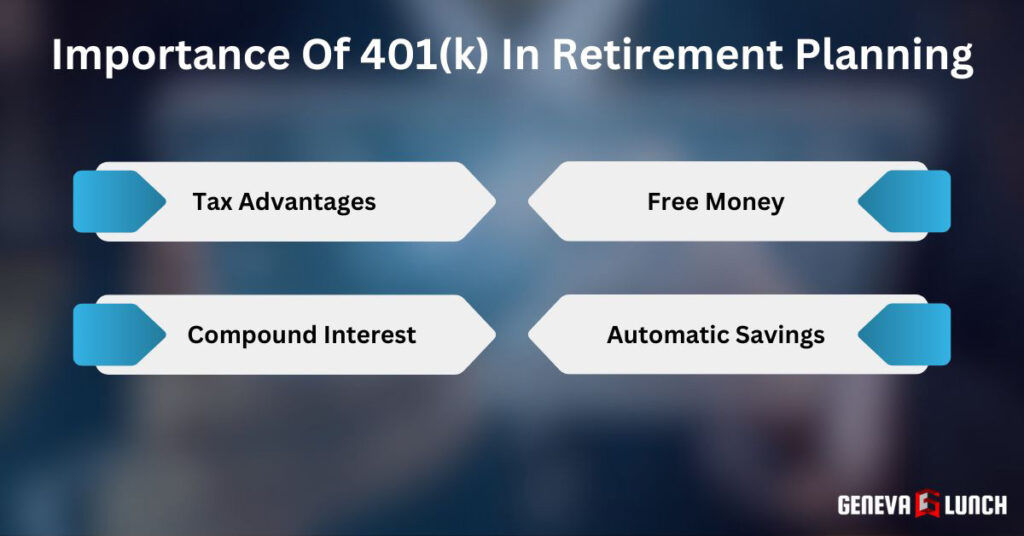
A 401(k) plan is very important for your future. You will need money to live on and stop working as you age. A 401(k) helps you save money to have it when you retire. Here’s why a 401(k) is so helpful when it comes to retirement planning:
- Tax Advantages: You make contributions with pre-tax dollars. This lowers your taxable income and may cut your tax bill now. Taxes on the money are deferred until you withdraw it in retirement, which could be at a lower tax bracket.
- Free Money: Many employers offer matching contributions. This gives you free money on top of your own. This is a benefit you don’t want to miss out on.
- Compound Interest: The money in your 401(k) grows with compound interest. This means your earnings also earn interest. The earlier you start saving, the more time your money has to grow.
- Automatic Savings: Setting up automatic contributions sends some of your paycheck into your 401(k) before you see it. This makes saving effortless and helps you stay on track for your retirement goals.
Saving with a 401(k) is a big part of planning for retirement. It helps you ensure you have enough money when you are older and not working. This way, you can enjoy your retirement without worrying about money.
Types Of 401(k) Plans
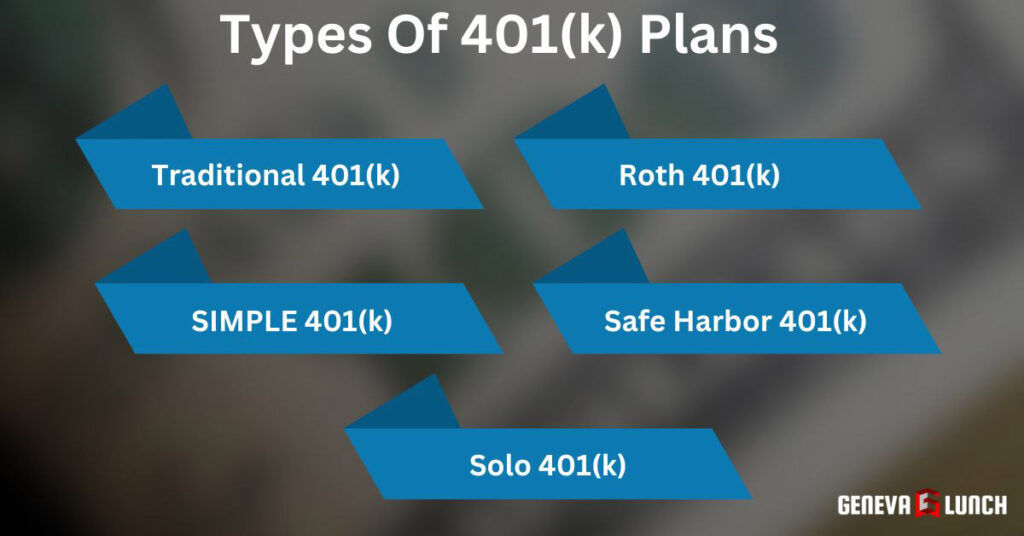
The basic concept of a 401(k) stays consistent. You save for retirement with tax advantages. But, different employers offer variations. Understanding these variations can help you choose the plan that best suits your financial goals. Let’s delve into the most common types of 401(k) plans:
1. Traditional 401(k)
This is the most common type of 401(k). Contributions are made with pre-tax dollars, reducing your taxable income for the year. Taxes are deferred until you withdraw the money in retirement, which can be advantageous if you expect to be in a lower tax bracket.
- Tax Benefits: As mentioned, contributions are pre-tax, lowering your current tax burden. Earnings in the account also grow tax-deferred.
- Employer Matching: Many employers offer matching contributions, essentially free money to boost your savings. Take advantage of this benefit by contributing enough to get the full match.
- Tax on Withdrawal: When you withdraw funds in retirement, you will pay income tax on the amount withdrawn.
2. Roth 401(k)
With a Roth 401(k), contributions are made with after-tax dollars. There’s no upfront tax break. However, withdrawals in retirement are tax-free if qualified. This can be a good option if you expect to be in a higher tax bracket in retirement.
- Tax on Contributions: Contributions are made with after-tax dollars, so you don’t get a tax break in the current year.
- Tax-Free Withdrawals: When you meet IRS requirements, qualified withdrawals in retirement are tax-free and penalty-free. This includes both your contributions and any earnings within the account.
- Eligibility: Not all employers offer Roth 401(k) plans. Check with your employer to see if this option is available.
3. SIMPLE 401(k)
SIMPLE 401(k)s are for small businesses with fewer than 100 employees. They offer simplified administration for employers and have some contribution limitations.
- Employer Contributions: Employers must make a matching contribution. It can be a percentage of employee salary (between 1% and 3%) or a fixed dollar amount.
- Eligibility: Eligible businesses have under 100 employees and no other retirement plans. They can offer a SIMPLE 401(k) plan.
- Contribution Limits: Employee contribution limits are lower than those for traditional or Roth 401(k)s. In 2024, the limit is $14,000, with a $3,000 catch-up contribution for those aged 50 and older.
4. Safe Harbor 401(k)
Safe Harbor 401(k) helps employers meet certain nondiscrimination testing rules. These plans have specific regulations regarding employer contributions and vesting schedules.
- Employer Contributions: Employers must make a fixed contribution for all eligible employees, regardless of their salary or whether they contribute themselves. The contribution can be a percentage of salary or a fixed dollar amount.
- Nondiscrimination Testing: Safe harbor plans automatically pass nondiscrimination testing, simplifying compliance for employers.
- Faster Vesting: Safe harbor plans often have faster vesting for employer contributions. This allows employees to access that money sooner if they leave.
5. Solo 401(k)
A Solo 401(k) is a unique option for self-employed people and business owners. They must have no employees other than a spouse who can count as an employee. This plan allows them to make employee and employer contributions, maximizing their retirement savings.
- Dual Contributions: Solo 401(k)s allow self-employed individuals to contribute as both employee and employer. In 2024, the employee contribution limit is $23,000, with a $7,500 catch-up contribution for those age 50 and older. As an employer, they can contribute up to 25% of their net self-employment income, with a maximum of $66,00
How To Set Up A 401(k) Plan?
Setting up a 401(k) plan is a big step toward financial security for your future. It involves several key steps, from choosing the right plan provider to managing it effectively. You can also get help from a financial advisor for 401k to set up the plan. Let’s walk through each part of the process to ensure you correctly set up your 401(k).
Choosing A Plan Provider
The first step in setting up a 401(k) is to pick a plan provider. This is usually a financial institution, such as a bank or company, that manages retirement plans.
Look for a provider with sound investment options, low fees, and excellent customer service. They should help you understand your options and make smart choices.
Establishing The Plan
Once you choose a provider, you need to establish the plan. This means deciding on the type of 401(k) – whether it’s a traditional 401(k), where you pay taxes later, or a Roth 401(k), where you pay taxes now.
You must also set rules for how much employees can contribute and whether your company will match these contributions.
Documentation And Filing Requirements
Setting up a 401(k) requires some paperwork. You must fill out forms to register your plan with the IRS and possibly other government agencies. Your plan provider can help you with these documents. Make sure everything is filled out correctly to avoid issues later.
Plan Administration
Running a 401(k) plan means doing some ongoing work. This includes keeping records, managing accounts, and reporting to the government annually. You must also ensure the plan aligns with federal laws and regulations. Many employers hire someone or use their plan provider to handle these tasks.
Employer Contributions
Employer contributions to a 401(k) are additional funds your employer adds to your retirement savings.
This is a key benefit as it boosts your savings without you having to do anything extra. Employers can add to your 401(k) in two main ways. They can make matching or non-elective contributions.
Matching Contributions
Your employer adds the same amount of money to your 401(k) that you do. They do this up to a certain percentage of your salary. For example, if you put 4% of your paycheck into your 401(k), your employer can match that.
This would double your contribution. The specific terms, like how much they match and the maximum they contribute, can vary by employer.
Non-Elective Contributions
Non-elective contributions are funds your employer adds to your 401(k). They add them regardless of whether you choose to put in any of your own money.
This type of contribution is made at the employer’s choice. It is usually a fixed percentage of your salary. It’s a benefit because you receive it even if you cannot contribute.
Contributions To 401(k) Plans
Putting money into a 401(k) plan is a smart way to save for retirement. Adding money to your 401(k) can grow and help you have enough when you retire. Let’s talk about how you can contribute.
Employee Contributions
When you work for a company offering a 401(k) plan, you can contribute some of your pay to this plan. This is called making an employee contribution.
The money you add goes directly into your 401(k) before taxes are taken out. This means you can save on taxes now and let your money grow until you need it when you retire.
Salary Deferral
Salary deferral is when you agree to take less pay now to put that money into your 401(k). It’s like telling your employer, “Keep some of my paycheck and put it in my retirement fund.”
This helps you save without having to think about it, and you pay less in taxes this year because you’re only taxed on the pay you take home.
Annual Contribution Limits
There’s a limit to how much you can put into your 401(k) each year. For 2024, you can contribute up to $22,500 if you are under 50. When you are 50 or older, you can add an extra $7,500 as a catch-up contribution, making it $30,000. Knowing these limits is important so you can plan your savings each year.
Catch-Up Contributions
Once you are 50 or older, you can save more money in your 401(k) than younger workers. This is called a catch-up contribution. It allows older employees to save additional funds to meet their retirement goals as they get closer to retiring.
Eligibility For Age 50+
To make these extra catch-up contributions, you must be 50 years old or older by the end of the year. There is no need to pass any special tests or conditions. Once you meet this age requirement, you can add more to your 401(k) as soon as your employer allows it.
Contribution Limits
The amount you can contribute to your 401(k) changes almost yearly because it is adjusted for inflation. For 2024, the regular limit is $22,500. This higher limit helps older adults save more in the years before retirement.
Investment Options Within 401(k) Plans
When you set up a 401(k), you can choose where your money goes. There are different types of investments you can pick from. Each type has its own features and fits different needs. Here’s a closer look at your options.
Types Of Investment Options

Your 401(k) plan can include different kinds of investments. Each type comes with its features and benefits. Understanding these can help you make better choices for your retirement savings. Here are some common options:
1. Mutual Funds
Mutual funds are a popular choice in 401(k) plans. They pool money from many people to buy a mix of stocks, bonds, or other assets. This mix helps spread out the risk. You can own a lot of investments.
2. Target-Date Funds
Target-date funds are set up based on when you plan to retire. As you get closer to retirement, these funds automatically change the mix of stocks, bonds, and other assets. They start to be risky and get safer as you near retirement age.
3. Exchange-traded Funds (ETFs)
ETFs are like mutual funds but trade on stock exchanges just like individual stocks. They often have lower fees than mutual funds. ETFs follow an index, a commodity, bonds, or a mix of assets.
4. Company Stock
Some companies let you invest in their stock through your 401(k). This means you own a part of the company you work for. However, having much of your retirement money in one stock is risky, even if it’s your employer’s.
Diversification Strategies
Diversification is a key strategy in managing your 401(k). It means spreading your investments across different types of assets.
This way, if one type of investment does poorly, the others can do well and balance things. By diversifying, you can reduce risk and aim for steady growth in your retirement fund.
Risk Tolerance And Asset Allocation
Understanding your risk tolerance is critical when choosing your 401(k) investments. Risk tolerance is how much risk you will take with your money. You can invest more in bonds if you don’t like risk, which are usually safer.
You can invest more in stocks if you can handle ups and downs. They can go up and down in value but grow more over time. This choice is called asset allocation. It helps you set up your investments to match your comfort with risk and saving goals.
Tax Implications Of 401(k) Plans
One of the biggest advantages of 401(k) plans is their favorable tax treatment. You must understand how taxes affect your deposits and withdrawals. This is key to getting the most out of your 401(k) for retirement.
Tax Benefits Of Contributions
Traditional 401(k) plans offer significant tax benefits for contributions:
- Reduced Taxable Income: Contributions are made with pre-tax dollars, lowering your taxable income for the year. This means you pay less income tax upfront.
- Tax-Deferred Growth: Earnings on your contributions and any investment gains within the account grow tax-deferred. You don’t pay taxes on these earnings until you withdraw the money in retirement.
Example: Suppose you contribute $5,000 to your 401(k) annually and your marginal tax bracket is 25%. You effectively save $1,250 in taxes by contributing pre-tax dollars that year.
Taxation On Withdrawals
Retirement withdrawal is taxed as ordinary income for traditional 401(k) plans. This means you’ll pay income tax on the amount you withdraw at your current tax rate. Ideally, you’ll be in a lower tax bracket in retirement.
It will be lower than in your working years. This will lead to a lower tax burden on your withdrawals.
There is a 10% penalty tax on early withdrawals. It applies before age 59 ½ unless you qualify for an exception. You must also make minimum withdrawals. You must start taking them by April 1st of the year after you turn 72.
Roth 401(k) Tax Advantages
Roth 401(k) plans offer a different tax advantage:
- Tax-Free Withdrawals: When you meet IRS requirements, withdrawals in retirement are tax-free and penalty-free. This includes both the money you put in with after-tax dollars. It also includes any earnings in the account.
The best tax treatment for you depends on your current tax bracket. It also depends on your projected retirement bracket.
Once you’re in a lower tax bracket, a traditional 401(k) may be better to get the upfront tax break. When you expect to be in a higher tax bracket in retirement, a Roth 401(k) could be better. It has tax-free withdrawals.
Tax Considerations For Employers

Employers offering 401(k) plans can also benefit from tax advantages:
- Tax-Deductible Contributions: Employers can deduct their contributions to 401(k) plans as a business expense, which can help reduce their overall tax liability.
- Employee Retention: Offering a 401(k) plan can be a valuable perk for employees and improve recruitment and retention.
- Compliance Requirements: Employers sponsoring 401(k) plans must follow IRS rules on administration and testing. They must also report as required.
Withdrawals From 401(k) Plans
When you save money in a 401(k) plan, you do so to use it during retirement. However, you must know when and how to take this money out.
Rules For Withdrawals
There are specific rules for withdrawing money from your 401(k). Doing so would cause penalties. These rules ensure that money serves its purpose. It will support you financially when you retire.
Age 59½ Rule
One main rule is the Age 59½ Rule. This rule allows you to start taking money out of your 401(k) at age 59 and a half. Once you withdraw before this age, you usually have to pay a 10% penalty. This rule helps ensure that the savings are used for retirement.
Required Minimum Distributions (RMDs)
Once you reach age 72 or 70½, you must start taking minimum withdrawals from your 401(k) each year. These are called Required Minimum Distributions (RMDs).
The amount you must withdraw is based on your life expectancy and account balance at the beginning of the year. You will be taxed on the amount you withdraw as income.
Early Withdrawals And Penalties
Usually, you have to pay a 10% penalty if you take money out of your 401(k) early. A 401(k) is for retirement; early withdrawal goes against this goal. You also pay taxes on the money you take out because it was saved without paying taxes at first.
Penalty Exceptions
Sometimes, you don’t have to pay a penalty even if you take out money early. These exceptions include:
- When you have big medical bills.
- When you become disabled.
- When you are a military reservist called to active duty.
Hardship Withdrawals
A hardship withdrawal is taking money out of your 401(k) for a big need. This could be to buy a home, prevent eviction, pay for college, or cover funeral costs.
To make a hardship withdrawal, you must prove that you need the money and have no other way. This withdrawal still requires you to pay taxes, but you may not have to pay the 10% penalty.
Loan Provisions
Sometimes, you can borrow money from your 401(k) instead of withdrawing. This lets you get money quickly without a penalty, as long as you follow the rules. You must pay back this money to avoid taxes and penalties.
Loan Limits
The amount you can borrow from your 401(k) has limits. You can borrow up to half your account balance or $50,000, whichever is less. This means if you have less money in your account, you can borrow less.
Repayment Terms
When you take a loan from your 401(k), you must pay it back within five years. You must pay at least every quarter, including principal and interest. And you may have to repay the entire loan immediately if you leave your job.
FAQs
What Does A 401(k) Actually Do?
A 401(k) is a retirement savings plan employers offer that allows employees to save and invest a portion of their paycheck before taxes are taken out. It helps build a nest egg for retirement by providing tax advantages, employer-matching contributions, and compounding interest over time.
Is A 401(k) A Good Investment?
Yes, a 401(k) is considered a strong investment choice for retirement savings. It offers tax advantages employer matching in many cases, and allows for automatic deductions from your salary. Over time, compound interest and tax deferrals have made it a valuable asset for future security.
What Is The Main Benefit Of A 401(k)?
The main benefit of a 401(k) is its tax advantages. Money contributed to a 401(k) is tax-deferred, meaning you pay taxes only when you withdraw it during retirement, potentially at a lower tax rate. Additionally, many employers match contributions, boosting your savings growth significantly.
What Is The 401(k) Deduction?
The 401(k) deduction refers to the amount of money that you can contribute to your 401(k) plan pre-tax. This means the money is taken out of your paycheck before income taxes are applied, reducing your taxable income and saving you money on taxes while helping you prepare for retirement.
Is It A Good Idea To Take Early Withdrawals From Your 401(k)?
Taking early withdrawals from your 401(k) is generally not advised. This is due to heavy penalties and taxes. Getting money early can reduce your retirement savings. Consider other options. You could use loans or take hardship withdrawals. These will keep your investment’s growth potential.
Can I Roll An Inherited Ira Into A 401(k)?
No, rolling an inherited IRA into a 401(k) is not allowed. Inherited IRAs must be managed separately from your personal retirement accounts. You have the option to transfer the funds into a designated inherited IRA, which allows you to handle the assets according to specific IRS rules.
What Is The 401(k) Limit For 2024?
The 401k contribution limit for employees in 2024 is $23,000. This is an increase from the 2023 limit of $22,500. There is also a catch-up contribution for those aged 50 and older. This allows them to contribute an additional $7,500 in 2024, bringing their total contribution limit to $30,500.
Final Words
A 401(k) is an effective retirement savings tool. Putting some of your paycheck into this account before taxes allows you to grow your retirement fund faster.
Setting up a 401(k) is simple. Enroll through your employer, pick how much to save, and choose your investments.
Integrating 401(k) management into your broader financial strategy ensures you take proactive steps. These steps will help you secure your future. Take charge of your finances by establishing your 401(k) today and make a significant impact.