Balance Sheet: How To Prepare, Components, And Examples
Every business, big or small, needs to keep track of its financial health. One of the most important tools for this is a financial statement. Companies use these statements to understand their financial position at any given time. Among these, the balance sheet is one of the key documents. So, what is a balance sheet?
A balance sheet is a financial statement that shows a company’s assets, liabilities, and equity at a specific point in time. It provides a clear picture of what the company owns, what it owes, and the value the value held by its owners. It helps assess the financial health and stability of a business.
In this guide, we’ll explore the components of a balance sheet. We’ll also discuss how to prepare one and the common errors to avoid.
Key Takeaways
- Overview of Financial Standing: A balance sheet shows a company’s assets, liabilities, and equity at a specific point in time.
- Understanding Assets and Liabilities: It helps determine a company’s financial position by detailing what it owns and owes.
- Evaluating Financial Health: The balance sheet is essential for evaluating a company’s overall financial health and stability.
- Guides Investor Decisions: Investors use the balance sheet to assess the company’s financial strength and investment potential.
- Supports Strategic Planning: The balance sheet informs key business decisions and helps plan for future growth.
What Is The Balance Sheet?
A balance sheet is a financial statement. It shows what a company owns and what it owes. The balance sheet is like a snapshot of a company’s finances at a specific time. It lists assets, liabilities, and equity. It is essential for financial planning, helping businesses plan for the future.
How Balance Sheets Work?
The balance sheet works by showing a company’s financial position. It lists assets first. Assets include cash, equipment, and buildings. Next, it lists liabilities. Liabilities are debts the company must pay. Examples are loans or bills. Finally, the balance sheet shows equity. Equity is what the owners would keep if the company sold all assets and paid all liabilities.
The balance sheet helps investors and owners understand if the company is healthy. When assets are much higher than liabilities, the company is in a strong position. For example, if a company has $200 in assets and $100 in liabilities, it has $100 in equity. This shows the company is financially stable.
Assets On The Balance Sheet
Assets are the things that a company owns. These items have value and can be used to pay debts or invest in the business. On a balance sheet, assets are divided into two main types: current and non-current. Both types are important because they show what the company owns and how it can use these assets to operate and grow.
What Is Included In Current Assets On A Balance Sheet?
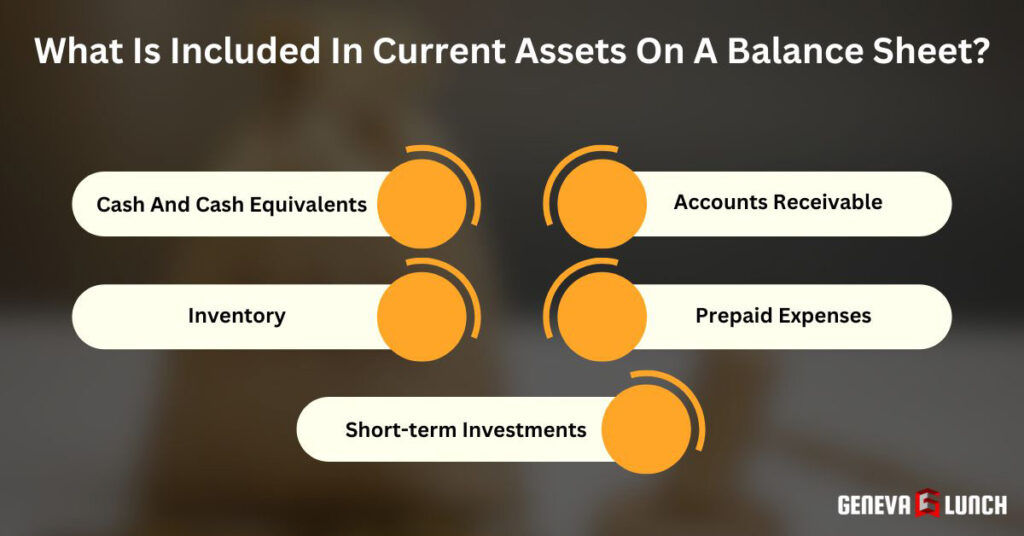
Current assets are items that a company expects to turn into cash or use up within a year. These assets are important because they show the company’s ability to pay its short-term debts. Current assets are usually listed first on the balance sheet. They include cash, accounts receivable, inventory, prepaid expenses, and short-term investments.
Cash And Cash Equivalents
Cash and cash equivalents are the most liquid assets a company has. Liquidity means that these assets can be quickly and easily turned into cash. Examples include actual cash on hand, money in the bank, and short-term investments that can be converted to cash quickly, such as treasury bills.
For example, if a company has $10,000 in the bank and $3,000 in short-term treasury bills, the total of $13,000 is listed under cash and cash equivalents. These assets are essential because they can be used immediately to pay bills or invest in the business.
Accounts Receivable
Accounts receivable is the money that customers owe to the company. This happens when the company sells goods or services on credit, meaning the customer will pay later. For example, if a company sells $8,000 worth of goods to a customer and the customer has 30 days to pay, this $8,000 is recorded as accounts receivable.
It is listed as a current asset because the company expects to receive the money within a short period, usually within a year. This asset is crucial because it represents future cash inflows that the company will use for its operations.
Inventory
Inventory includes all the goods that a company has in stock. This can be raw materials used to make products, products that are still being made, or finished goods ready for sale. For example, if a company has $10,000 worth of raw materials, $5,000 in products being made, and $15,000 in finished goods, the total inventory value of $30,000 is listed as a current asset.
Inventory is important because it shows what the company has available to sell, which will eventually bring in revenue when sold.
Prepaid Expenses
Prepaid expenses are payments that the company has made in advance for services or goods that it will receive in the future. A common example is insurance. If a company pays $1,200 for a one-year insurance policy, the $1,200 is initially recorded as a prepaid expense.
Each month, $100 is deducted from the prepaid expense as the insurance coverage is used. By the end of the year, the prepaid expense will be reduced to zero. Prepaid expenses are listed as current assets because they represent services or goods that will benefit the company within a year.
Short-term Investments
Short-term investments are investments that a company expects to convert into cash within a year. These can include things like stocks, bonds, or other financial instruments that are easy to sell. For example, if a company invests $5,000 in a stock that it plans to sell within six months, this $5,000 is listed as a short-term investment.
These investments are considered current assets because they can quickly be turned into cash if needed. Short-term investments are important because they provide the company with flexibility to quickly access cash for unexpected expenses or investment opportunities.
What Is Included In Non-current Assets On A Balance Sheet?
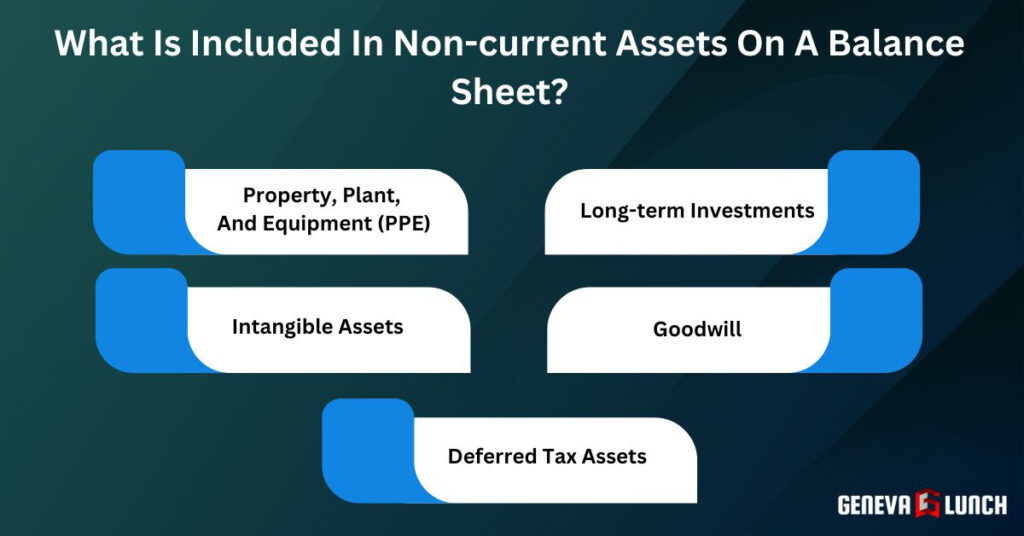
Non-current assets are long-term assets that a company expects to hold for more than one year. These assets are important because they are used to operate the business over the long term. Non-current assets are less liquid than current assets, meaning they cannot be quickly turned into cash. They include property, plant, and equipment (PPE), long-term investments, intangible assets, goodwill, and deferred tax assets.
Property, Plant, And Equipment (PPE)
Property, Plant, and Equipment (PPE) are long-term assets that a company uses to run its business. These assets include buildings, machinery, vehicles, and equipment. For example, if a company owns a factory building worth $150,000, machinery worth $50,000, and delivery trucks worth $20,000, the total value of $220,000 is listed under PPE.
These assets are not meant to be sold but are used to produce goods or provide services. PPE is important because it represents the physical resources a company uses to generate revenue over time.
Long-term Investments
Long-term investments are assets that a company plans to hold for more than a year. These investments can include things like stocks, bonds, or real estate. For example, if a company buys a piece of land for $100,000 with the intention of holding it for several years, this amount is recorded as a long-term investment.
These investments are listed as non-current assets because the company does not plan to convert them into cash in the near term. Long-term investments are important because they represent strategic investments that can grow in value over time and provide future financial benefits.
Intangible Assets
Intangible assets are non-physical items that have value to the company. These can include patents, trademarks, copyrights, and brand names. For example, if a company owns a patent for a new technology that is valued at $50,000, this amount is listed as an intangible asset.
Unlike physical assets like machinery or buildings, intangible assets cannot be seen or touched, but they can still provide significant value to the company by giving it a competitive advantage. Intangible assets are important because they can contribute to a company’s long-term success by protecting its products, services, or brand.
Goodwill
Goodwill is an intangible asset that arises when one company buys another company for more than the value of its net assets. Net assets are the value of all assets minus liabilities. For example, if Company A buys Company B for $200,000, but Company B’s net assets are only worth $180,000, the extra $20,000 paid is recorded as goodwill.
Goodwill represents the value of the acquired company’s reputation, customer relationships, and other factors that are not reflected in the value of its physical assets. Goodwill is important because it shows the value that a company places on its ability to generate future profits from the acquired business.
Deferred Tax Assets
Deferred tax assets are amounts that a company can use to reduce its future tax payments. These arise from differences between accounting income and taxable income, such as when a company pays more taxes upfront but will benefit from these payments in the future.
For example, if a company overpays $5,000 in taxes this year, it can carry this amount forward to reduce its tax bill in future years. This $5,000 is recorded as a deferred tax asset. Deferred tax assets are important because they represent future tax savings that can improve the company’s financial position.
Liabilities On The Balance Sheet
Liabilities are the debts and obligations that a company owes to others. These are listed on the balance sheet. Liabilities are divided into two main types: current and non-current. Understanding liabilities is important because it shows how much a company owes and when those debts need to be paid.
Current Liabilities
Current liabilities are debts that need to be paid within one year. These are short-term obligations that the company must settle soon. Current liabilities include things like accounts payable, short-term debt, and other immediate expenses. Companies must manage these liabilities carefully to ensure they have enough cash or assets to pay them on time.
Accounts Payable
Accounts payable is the money a company owes to its suppliers. This happens when the company buys goods or services on credit and agrees to pay later. For example, if a company buys $5,000 worth of supplies and agrees to pay the supplier in 30 days, this $5,000 is recorded as accounts payable.
It is considered a current liability because the company must pay it within a short period, usually within a year. Accounts payable is important because it represents the company’s short-term debts to its suppliers.
Short-term Debt
Short-term debt is any debt that the company must repay within a year. This can include loans, credit lines, or other borrowings that are due soon. For example, if a company takes out a $10,000 loan that must be repaid in six months, this $10,000 is listed as short-term debt.
Short-term debt is a current liability because it needs to be paid back quickly. It is important to track short-term debt because it shows the immediate financial obligations of the company.
Accrued Liabilities
Accrued liabilities are expenses that the company has incurred but not yet paid. These can include wages, taxes, and interest. For example, if a company owes $3,000 in wages to employees but has not yet paid them, this amount is recorded as an accrued liability.
It is considered a current liability because the company will pay it soon, usually within a year. Accrued liabilities are important because they represent the company’s unpaid expenses that must be settled in the near future.
Deferred Revenue
Deferred revenue is money that the company has received in advance for goods or services it has not yet delivered. For example, if a company receives $2,000 from a customer for a service that will be provided next month, this $2,000 is recorded as deferred revenue.
It is listed as a current liability because the company still owes the service to the customer. Deferred revenue is important because it shows the company’s obligation to provide goods or services in the future.
Current Portion Of Long-term Debt
The current portion of long-term debt is the part of a long-term loan that must be paid within the next year. For example, if a company has a $50,000 loan and must pay $5,000 of it this year, that $5,000 is recorded as the current portion of long-term debt.
This is a current liability because it is due soon. The current portion of long-term debt is important because it shows the immediate financial commitments the company must meet within the year.
Non-Current Liabilities
Non-current liabilities are debts that the company does not need to pay within one year. These are long-term obligations that will be settled over several years. Non-current liabilities include items like long-term debt, deferred tax liabilities, and pension obligations. These liabilities are important for understanding the company’s long-term financial commitments.
Long-term Debt
Long-term debt is any debt that is due in more than a year. This can include loans, bonds, or other borrowings. For example, if a company takes out a $100,000 loan that it must repay over 10 years, this amount is listed as long-term debt.
Only the payments due after the first year are considered long-term. Long-term debt is a non-current liability because it does not need to be paid immediately. It is important because it shows the company’s long-term financial obligations.
Deferred Tax Liabilities
Deferred tax liabilities are taxes that the company will owe in the future due to differences between accounting and tax rules. For example, if a company has a $5,000 tax obligation that it will pay in future years, this amount is recorded as a deferred tax liability.
It is a non-current liability because the tax payment is not due within a year. Deferred tax liabilities are important because they represent future tax payments that the company must plan for.
Pension And Post-retirement Obligations
Pension and post-retirement obligations are the promises a company has made to pay benefits to its employees after they retire. For example, if a company owes $200,000 in future pension payments to its retirees, this amount is recorded as a pension obligation.
This is a non-current liability because the payments will be made over many years. Pension and post-retirement obligations are important because they represent long-term financial commitments to employees.
Lease Obligations
Lease obligations are the payments that a company has agreed to make for leasing property, equipment, or other assets. For example, if a company has a lease for office space that requires $10,000 payments each year for five years, the future payments are recorded as lease obligations.
This is a non-current liability because the payments will be made over several years. Lease obligations are important because they show the company’s long-term rental commitments.
Bonds Payable
Bonds payable are amounts that the company owes to bondholders. Bonds are a form of long-term borrowing where the company agrees to pay back the principal amount plus interest over time. For example, if a company issues $500,000 in bonds that are due in 10 years, this amount is recorded as bonds payable.
It is a non-current liability because the repayment is not due within a year. Bonds payable are important because they represent a significant long-term debt that the company must manage.
Equity On The Balance Sheet
Equity represents the ownership value in a company. It shows what the owners or shareholders own after all liabilities are paid off. It tells us how much the owners would receive if the company’s assets were sold and all debts were paid. Equity is divided into different categories depending on the type of ownership and the structure of the company.
Shareholders’ Equity
Shareholders’ equity refers to the ownership value held by shareholders in a corporation. This includes the money invested by shareholders and the profits that the company has retained over time. Shareholders’ equity is important because it shows the value that shareholders have in the company.
Common Stock And Preferred Stock
Common stock and preferred stock represent the shares that a company has issued to its shareholders. Common stock gives shareholders voting rights, while preferred stock usually does not, but it may have other benefits, like fixed dividends.
For example, if a company issues 1,000 shares of common stock at $10 each, it would have $10,000 recorded as common stock. Preferred stock might be issued at a different value and with different terms. These stocks are listed under shareholders’ equity because they represent ownership in the company.
Additional Paid-in Capital
Additional paid-in capital is the money shareholders pay for shares above their par value. Par value is the nominal value of a stock, often set at a very low amount. For example, if a company issues stock with a par value of $1 but sells it for $10, the additional $9 per share is recorded as additional paid-in capital.
When 1,000 shares are sold, the company would record $9,000 as additional paid-in capital. This amount is part of shareholders’ equity because it shows extra money invested by shareholders.
Retained Earnings
Retained earnings are the profits that a company has kept over time instead of paying them out as dividends to shareholders. For example, if a company earns $50,000 in profit and decides to keep $20,000 to reinvest in the business, that $20,000 is added to retained earnings.
Retained earnings grow over time as the company earns more profit and decides to retain it. This amount is part of shareholders’ equity because it represents the accumulated profits that belong to the shareholders.
Treasury Stock
Treasury stock is the company’s own stock that it has bought back from shareholders. For example, if a company buys back 500 shares of its own stock at $15 per share, it would record $7,500 as treasury stock.
Treasury stock is listed under shareholders’ equity as a negative amount because it represents shares that are no longer outstanding and do not provide voting rights or dividends. Buying back shares can reduce the number of shares on the market and increase the value of remaining shares.
Accumulated Other Comprehensive Income
Accumulated other comprehensive income includes items that are not included in net income but still affect shareholders’ equity. This can include unrealized gains or losses on investments, foreign currency translation adjustments, and other items.
For example, if a company has an unrealized gain of $3,000 on an investment, this amount is recorded under accumulated other comprehensive income. This figure is part of shareholders’ equity because it represents potential changes in value that affect the overall financial position of the company.
Owner’s Equity
Owner’s equity refers to the ownership value in a business that is not a corporation. This is common in sole proprietorships or partnerships. Owner’s equity represents the owner’s investment in the business plus any profits that the business has earned and kept.
For example, if an owner invests $20,000 in their business and the business earns an additional $10,000 in profit, the total owner’s equity would be $30,000. This amount is listed on the balance sheet as owner’s equity and represents the owner’s claim on the business’s assets after all liabilities are paid.
How To Prepare A Balance Sheet?
Preparing a balance sheet is an important task for any business. It shows a company’s financial position at a specific point in time. To create a balance sheet, you need to follow certain steps. These steps involve listing all assets, identifying all liabilities, and calculating equity. It is essential to ensure that everything is recorded accurately. This helps in understanding the financial health of the company.
Preparing A Balance Sheet
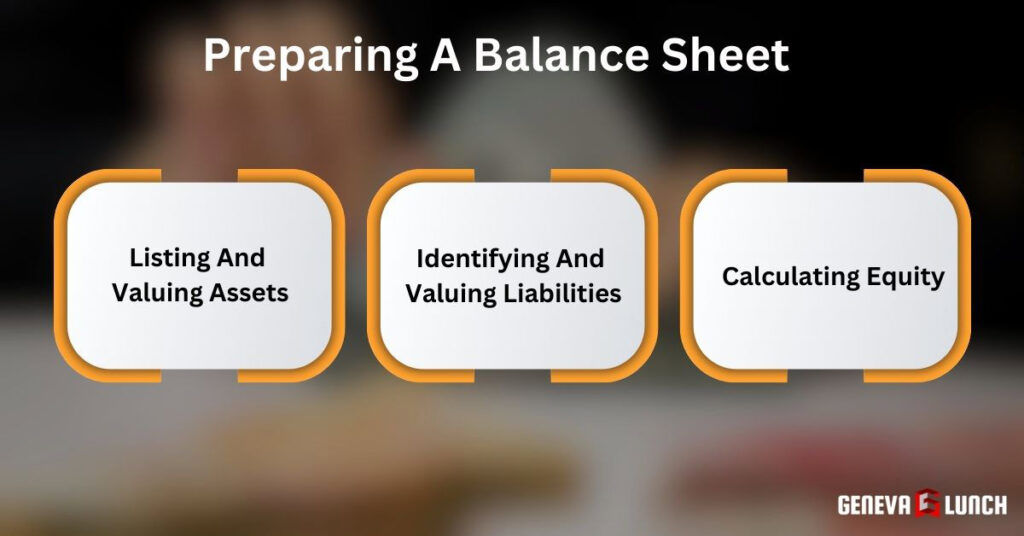
When preparing a balance sheet, it is important to organize all the financial information correctly. The first step is to list all the company’s assets and determine their value. Next, you identify all the liabilities and calculate their total. Finally, you calculate the equity, which is the difference between the assets and liabilities.
Listing And Valuing Assets
The first step in preparing a balance sheet is to list all the assets the company owns. Assets are divided into current and non-current categories. Current assets include items like cash, inventory, and accounts receivable. Non-current assets include long-term investments, property, and equipment. Each asset is listed with its value.
For example, if a company has $10,000 in cash, $20,000 in inventory, and a building worth $100,000, these amounts are recorded as assets. The total value of all assets is then calculated and noted on the balance sheet.
Identifying And Valuing Liabilities
After listing the assets, the next step is to identify all the liabilities. Liabilities are the debts and obligations that the company owes to others. They are also divided into current and non-current liabilities. Current liabilities include accounts payable, short-term debt, and other obligations due within a year. Non-current liabilities include long-term debt and other obligations that are due after one year. Each liability is listed with its value.
For example, if a company owes $5,000 in accounts payable and has a $50,000 loan due in five years, these amounts are recorded as liabilities.
Calculating Equity
Once the assets and liabilities are listed, the next step is to calculate the equity. Equity is the difference between the total assets and total liabilities. It represents the owners’ or shareholders’ stake in the company.
For example, if a company has $150,000 in assets and $55,000 in liabilities, the equity would be $95,000. This amount is recorded as equity on the balance sheet. The equity section may include items like common stock, retained earnings, and additional paid-in capital. Calculating equity is crucial because it shows the net value of the company.
Understanding Double-Entry Accounting
Double-entry accounting is a system used to record financial transactions. It is based on the idea that every transaction has two sides: a debit and a credit. This system ensures that the balance sheet balances, meaning the total assets equal the total liabilities plus equity. Understanding double-entry accounting is important for preparing accurate financial statements.
The Role Of Debits And Credits
Debits and credits are the foundation of double-entry accounting. Every financial transaction affects at least two accounts. One account is debited, and another is credited. For example, if a company buys equipment for $5,000, the equipment account is debited, and the cash account is credited.
Debits increase asset accounts and decrease liability and equity accounts. Credits decrease asset accounts and increase liability and equity accounts. The total amount of debits must always equal the total amount of credits. This balance ensures that the accounting records are accurate.
Ensuring The Balance Sheet Balances
Ensuring that the balance sheet balances is crucial. This means that the total value of assets must equal the total value of liabilities plus equity. If the balance sheet does not balance, it indicates an error in recording transactions.
For example, if a company lists $100,000 in assets, $60,000 in liabilities, and $40,000 in equity, the balance sheet balances because $100,000 equals $60,000 plus $40,000. When these amounts do not match, the company needs to review its transactions to find and correct the mistake.
Using Accounting Software
Using accounting software can make preparing a balance sheet easier. Accounting software helps automate many of the tasks involved in double-entry accounting. It allows you to input transactions, and the software automatically updates the accounts and ensures that the balance sheet balances.
For example, if a company uses accounting software, it can quickly generate a balance sheet by entering all its financial data. The software will calculate the totals for assets, liabilities, and equity, saving time and reducing the chance of errors. This makes managing financial records more efficient.
Analyzing The Balance Sheet
Analyzing a balance sheet helps you understand a company’s financial health. It allows you to see how well the company is managing its assets, liabilities, and equity. By looking at different financial ratios, you can learn more about the company’s strengths and weaknesses. These ratios help you compare the company’s performance over time or against other companies.
Financial Ratios Derived From The Balance Sheet
Financial ratios are key tools used to analyze a balance sheet. These ratios help you understand different aspects of a company’s financial position. There are several types of ratios, each providing specific insights.
Liquidity Ratios
Liquidity ratios show how easily a company can pay its short-term debts. Most common liquidity ratios are the current ratio and the quick ratio. The current ratio is calculated by dividing total current assets by total current liabilities.
For example, if a company has $50,000 in current assets and $25,000 in current liabilities, the current ratio would be 2.0. This means the company has twice as many current assets as it has current liabilities, which is a good sign of financial health.
Solvency Ratios
Solvency ratios measure a company’s ability to meet its long-term obligations. The debt-to-equity ratio is a common solvency ratio. It is calculated by dividing total liabilities by total equity.
For example, if a company has $150,000 in total liabilities and $100,000 in total equity, the debt-to-equity ratio would be 1.5. This means the company has $1.50 in debt for every $1 of equity. A lower ratio indicates less risk, while a higher ratio suggests more financial leverage and risk.
Efficiency Ratios
Efficiency ratios show how well a company uses its assets to generate income. The inventory turnover ratio is one such ratio. It is calculated by dividing the cost of goods sold by average inventory.
For example, if a company has $200,000 in cost of goods sold and $50,000 in average inventory, the inventory turnover ratio would be 4.0. This means the company sells and replaces its inventory four times a year. Higher ratios indicate more efficient use of inventory.
Trend Analysis
Trend analysis involves comparing financial data over several periods to identify patterns. For example, if a company’s total assets have grown from $500,000 to $600,000 over three years, this shows positive growth.
By analyzing trends, you can see whether the company is improving or declining in certain areas. Trend analysis is important because it helps you understand the company’s long-term performance and make predictions about its future.
Common Size Balance Sheet
A common size balance sheet expresses each item as a percentage of total assets. This helps in comparing companies of different sizes or analyzing trends within the same company over time. For example, if cash is $10,000 and total assets are $100,000, cash would be 10% of total assets.
By converting figures into percentages, a common size balance sheet makes it easier to see how each item contributes to the overall financial position. This type of analysis is useful for comparing financial statements across different periods or companies.
Importance Of The Balance Sheet
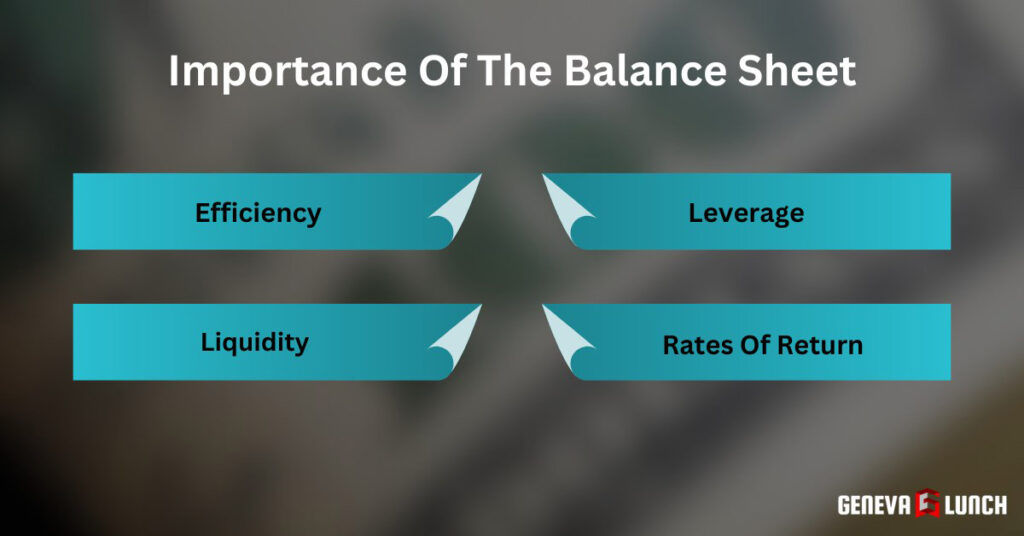
The balance sheet is a key financial statement. It shows a company’s financial position at a specific time. This information is important for understanding how well a company is doing. The balance sheet helps in making decisions about investing, lending, or managing the company. By looking at the balance sheet, you can see how efficiently a company is using its resources, how much debt it has, and how easily it can pay its bills.
Efficiency
Efficiency on the balance sheet shows how well a company uses its assets to generate income. For example, a company with $200,000 in total assets that generates $100,000 in sales is using its assets efficiently.
When a company uses its assets well, it can produce more income with fewer resources. This is a sign of good management. Analyzing efficiency helps in understanding whether the company is getting the most out of its investments in assets like equipment, inventory, and cash.
Leverage
Leverage refers to the amount of debt a company uses to finance its operations. The balance sheet shows how much debt the company has compared to its equity. For example, if a company has $300,000 in debt and $150,000 in equity, it has a high level of leverage.
High leverage means the company is relying more on borrowed money. This can be risky because the company must make regular payments on its debt. However, leverage can also increase returns if the company invests the borrowed money wisely.
Liquidity
Liquidity on the balance sheet shows how easily a company can pay its short-term debts. This is important because a company needs to have enough cash or assets that can quickly be turned into cash to meet its immediate obligations.
For example, if a company has $50,000 in current assets and $30,000 in current liabilities, it has good liquidity. High liquidity means the company can easily pay its bills and avoid financial trouble. Analyzing liquidity helps in understanding the company’s ability to manage its day-to-day operations.
Rates Of Return
Rates of return measure how much profit a company generates from its investments. The balance sheet helps calculate these rates by providing information on assets, equity, and earnings. For example, if a company has $100,000 in equity and earns $10,000 in profit, the return on equity (ROE) is 10%.
This means the company earns 10% on each dollar of equity. High rates of return are a sign of a profitable and efficient business. The balance sheet is essential for calculating these important financial metrics.
Challenges And Limitations Of The Balance Sheet
While the balance sheet is a useful tool, it also has some challenges and limitations. It provides a snapshot of a company’s financial position at a specific time, but it does not tell the whole story. Some items are difficult to value accurately, and others may not be included on the balance sheet at all. It is important to be aware of these limitations to avoid making incorrect conclusions about the company’s financial health.
Valuation Of Assets
Valuing assets on the balance sheet can be challenging. Some assets, like cash, are easy to value because they have a clear, fixed amount. However, other assets, like property or investments, can be harder to value because their worth can change over time.
For example, the value of real estate can go up or down depending on the market. Also, intangible assets like patents can be difficult to measure accurately. These challenges can lead to overestimating or underestimating the actual value of a company’s assets.
Off-Balance Sheet Items
Off-balance sheet items are financial obligations or assets that do not appear on the balance sheet. These might include leases, partnerships, or certain types of debt. For example, a company might lease a building, but the lease payments are not listed as a liability on the balance sheet.
This can make the company’s financial position look better than it actually is. Off-balance sheet items can be risky because they hide important information from investors and other stakeholders who are analyzing the company’s financial health.
Misinterpretation Of Data
Misinterpreting the data on a balance sheet is another common challenge. The balance sheet shows a lot of important information, but it can be difficult to understand without the right context. For example, a high level of debt might seem bad, but it could be normal for a company in a specific industry.
Similarly, large amounts of cash might seem positive, but it could also indicate that the company is not investing enough in growth. Without understanding the context, people might draw the wrong conclusions from the balance sheet.
Common Balance Sheet Mistakes And How To Avoid Them
Preparing a balance sheet requires careful attention to detail. However, mistakes can happen, and these mistakes can lead to incorrect conclusions about a company’s financial health. Some common errors include overstating or understating assets or liabilities, incorrect valuation of assets, and omitting important liabilities. Consulting a financial advisor can help create an accurate and reliable financial statement.
Overstating/Understating Assets Or Liabilities
Overstating or understating assets or liabilities is a common mistake on the balance sheet. This happens when the value of an asset or liability is recorded incorrectly. For example, if a company reports $120,000 in inventory when it actually has $100,000, it is overstating its assets. Similarly, if a loan of $50,000 is not recorded, the liabilities are understated.
These mistakes can give a false picture of the company’s financial position. To avoid this, it is important to double-check all values and ensure they are accurate.
Incorrect Valuation Of Assets
Incorrect valuation of assets is another common mistake. Some assets, like cash, are easy to value, but others, like property or equipment, can be more difficult. For example, if a company overestimates the value of a building at $500,000 when it is actually worth $400,000, this leads to an incorrect balance sheet.
Overvalued assets can make the company look stronger than it really is. To avoid this mistake, assets should be valued based on current market conditions or using reliable valuation methods.
Omitting Contingent Liabilities
Omitting contingent liabilities is a serious mistake that can mislead users of the balance sheet. Contingent liabilities are potential liabilities that may occur depending on the outcome of a future event, such as a lawsuit. For example, if a company is involved in a legal case that could result in a $100,000 payment, this should be noted on the balance sheet.
When these liabilities are not included, it can make the company’s financial situation appear better than it is. To avoid this, it is important to include all known contingent liabilities.
Misclassifying Assets And Liabilities
Misclassifying assets and liabilities is another common error. This happens when items are placed in the wrong category on the balance sheet. For example, if a long-term loan is classified as a current liability, it can create confusion and inaccuracies.
Similarly, if a short-term investment is classified as a non-current asset, it can distort the financial picture. To avoid this mistake, it is important to understand the difference between current and non-current items and ensure they are correctly classified.
Failing To Reconcile Accounts
Failing to reconcile accounts is another common mistake. Reconciliation involves comparing the company’s records with external statements, such as bank statements, to ensure everything matches. For example, if a company’s cash account shows $5,000 but the bank statement shows $4,500, there is a discrepancy that needs to be resolved.
Not reconciling accounts can lead to errors in the balance sheet, making it inaccurate. To avoid this mistake, regularly reconcile all accounts to ensure that the balance sheet reflects the true financial position of the company.
FAQs
How Often Should A Balance Sheet Be Prepared?
A balance sheet should be prepared at least once a year. Many companies prepare it every quarter, which means four times a year. This helps in keeping track of the company’s financial position regularly. Some businesses may prepare a balance sheet every month to closely monitor their financial health.
How Is A Balance Sheet Different From An Income Statement?
A balance sheet shows a company’s financial position at a specific point in time. This lists assets, liabilities, and equity. An income statement shows the company’s financial performance over a period of time, such as a month, quarter, or year. It lists revenues and expenses to calculate net income.
How Is Goodwill Recorded On A Balance Sheet?
Goodwill is recorded on the balance sheet as an intangible asset. It appears under the non-current assets section. Goodwill represents the extra value paid when one company buys another for more than the value of its net assets. The value represents factors like brand reputation or customer relationships.
What Is The Impact Of Depreciation On A Balance Sheet?
Depreciation reduces the value of assets on the balance sheet over time. It is recorded as a reduction in the asset’s value in the non-current assets section. Depreciation can also affect equity by reducing the retained earnings since it is treated as an expense that reduces net income.
What Are Common Errors To Avoid When Preparing A Balance Sheet?
Common errors include overstating or understating assets and liabilities, misclassifying them and omitting contingent liabilities. Incorrectly valuing assets and not reconciling accounts are also mistakes. These errors lead to inaccurate balance sheets. Double-checking everything helps avoid these problems.
Final Words
In conclusion, the balance sheet is a vital tool for understanding a company’s financial health. It provides a clear overview of what the company owns, what it owes, and the value held by its owners or shareholders. By regularly reviewing the balance sheet, businesses can make informed decisions, plan for the future, and maintain financial stability.