Bond Market: How It Works, Types, Invest, Risk & Strategies
The bond market plays a crucial role in the financial world. It allows companies and governments to raise money by issuing bonds. Investors buy these bonds to earn interest income. So, what exactly is the bond market?
The bond market is where investors buy and sell bonds. Bonds are loans that investors give to companies or governments. The issuer pays interest to the investor and repays the principal amount at maturity. The bond market helps fund projects, manage debt, and provide steady income to investors.
In this guide, we’ll explain what bonds are and how the bond market operates. We’ll discuss different types of bonds, the key players, market strategies and the risks associated with bonds.
Key Takeaways
- Role of the Bond Market: The bond market allows investors to buy and sell bonds for steady income.
- Function of Bonds: Bonds are loans to companies or governments, repaid with interest at maturity.
- Funding Projects: The bond market helps fund public and private projects efficiently.
- Debt Management: It provides a way for governments and companies to manage and restructure debt.
- Lower Risk: Bonds offer lower risk compared to stocks, making them a safer investment choice.
What Are Bonds?
Bonds are loans given to companies or governments. When you buy a bond, you lend money. The borrower agrees to pay back the money on a set date. The borrower also pays interest. Interest is extra money paid to the lender. It is a less risky and smart way to manage your finances.
How Do The Bond Market Work?
The bond market is a place where people buy and sell bonds. It is also called the debt market. When bonds are sold, the buyer lends money to the seller. The seller pays interest to the buyer. Bonds can be bought and sold before they mature.
The price of bonds can change. When many people want a bond, the price goes up. When fewer people want it, the price goes down. Interest rates also affect bond prices. When interest rates go up, bond prices go down. When interest rates go down, bond prices go up.
For example, if you sell a $1,000 bond for $1,100, you make a profit of $100. The bond market is important for raising money and managing debt.
Who Are The Key Players In The Bond Market?

The bond market has three main players. These players are issuers, investors, and intermediaries. Each one has a specific role in the market. They work together to keep the market running smoothly. Let’s look at each group in detail.
Issuers
Issuers are the ones who create and sell bonds. They can be companies, governments, or other organizations. They need money for projects or expenses. For example, a city may issue bonds to build a new school. The issuer agrees to pay back the money with interest.
When a company issues a $1,000 bond with a 5% interest rate, they will pay $50 in interest each year. Issuers play a crucial role in the bond market by providing opportunities for investment.
Investors
Investors are people or organizations who buy bonds. They lend money to issuers and earn interest. Investors can be individuals, banks, or pension funds. They choose bonds because they are safer than stocks.
For example, if an investor buys a $1,000 bond with a 4% interest rate, they will earn $40 each year. Investors provide the money needed by issuers. They look for bonds that offer good returns and low risk.
Intermediaries (Brokers, Dealers)
Intermediaries are the middlemen in the bond market. Brokers help investors buy and sell bonds. They charge a fee for their service. Dealers buy bonds and sell them to investors. They make money from the difference in prices.
For example, a dealer may buy a bond for $950 and sell it for $1,000, making a $50 profit. Intermediaries make the bond market work smoothly. They help match buyers and sellers, making it easier to trade bonds.
Types Of Bonds
There are many types of bonds in the market. Each type of these bonds serve a different purpose. Let’s explore the main categories of bonds and their specific examples.
What Are Government Bonds?
Government bonds are bonds which are issued by national governments. They are used to raise money for public projects. These bonds are considered very safe because the government backs them.
Treasury Bonds, Notes, And Bills
Treasury bonds, notes, and bills are issued by the U.S. government. Treasury bonds have terms up to 30 years and pay interest every six months.
Treasury notes have terms from 2 to 10 years. Treasury bills are short-term, less than 1 year. For example, a 10-year Treasury note may pay 3% interest. These bonds help fund government expenses and are a low-risk investment.
Savings Bonds
Savings bonds are also issued by the U.S. government. They are a low-risk investment option. People buy them to save money over time.
For example, a $50 savings bond bought today might be worth $100 in 20 years. These bonds are easy to buy and redeem. They are often used for long-term savings goals like education.
Agency Bonds
Agency bonds are issued by government agencies. They help fund specific projects, such as housing. For example, Fannie Mae issues agency bonds to support home loans.
Agency bonds are considered safe but may offer higher returns than Treasury bonds. They support various government-related activities and provide essential funding for national projects.
What Are Corporate Bonds?

Corporate bonds are issued by companies. This type of bonds help raise money for business activities. These bonds usually offer higher returns than government bonds but come with more risk.
Investment-Grade Bonds
Investment-grade bonds are issued by stable companies. They have a low risk of default, meaning the company is likely to repay. For example, a large, well-known company may issue an investment-grade bond.
Investment-grade bonds have ratings of BBB or higher. They offer lower interest rates but are safer. Investors choose these bonds for steady returns and security.
High-Yield Bonds (Junk Bonds)
High-yield bonds are issued by companies with lower credit ratings. They are also known as junk bonds. These bonds have higher risk but offer higher returns.
For example, a new company might issue a high-yield bond with a 10% interest rate. Investors can earn more money but face more risk. These bonds are attractive to those willing to take more risk for greater rewards.
Convertible Bonds
Convertible bonds can be turned into company stock. They offer the benefits of bonds and stocks. For example, an investor might buy a convertible bond for $1,000. Later, they can convert it into 50 shares of the company’s stock.
Convertible bonds provide flexibility and potential growth. They allow investors to benefit from the company’s success both as a bondholder and a shareholder.
What Are Municipal Bonds?
Municipal bonds are issued by local governments. These bonds usually fund public projects like schools and roads. Municipal bonds are often tax-exempt, making them attractive to investors.
General Obligation Bonds
General obligation bonds are backed by the issuer’s credit. They fund various public projects. For example, a city might issue a general obligation bond to build a new park.
General obligation bonds are considered very safe. They rely on the issuer’s ability to tax and repay. Investors like these bonds for their security and community benefits.
Revenue Bonds
Revenue bonds are repaid with money from specific projects. For example, a toll road might issue a revenue bond. The tolls collected are used to pay back the bond. These bonds are tied to the success of the project.
Revenue bonds may offer higher returns than general obligation bonds. Investors choose revenue bonds for the potential higher returns linked to specific revenue-generating projects.
What Are International Bonds?
International bonds are bonds which are issued by foreign entities. These bonds usually help diversify investment portfolios. International bonds can come with additional risks, such as currency risk.
Foreign Bonds
Foreign bonds are issued by a country other than your own. For example, a U.S. investor might buy a bond issued by the Canadian government. These bonds are sold in the currency of the issuing country.
Foreign bonds provide exposure to international markets. Investors use foreign bonds to diversify their holdings and benefit from foreign economic growth.
Eurobonds
Eurobonds are issued in a currency not native to the issuer. For example, a Japanese company might issue a bond in U.S. dollars. These bonds are sold in multiple countries.
Eurobonds offer flexibility and access to global investors. Eurobonds help companies raise money in foreign currencies and reach a broader audience of investors.
Bond Market Analysis
Bond market analysis helps investors understand how bonds work and how to make smart investments. This analysis includes understanding bond yields, credit ratings, and bond market indices. Let’s explore these topics in detail.
Understanding Bond Yields
Bond yields show how much money you can earn from a bond. They help investors compare different bonds. There are different ways to measure bond yields. Knowing bond yields helps investors make better choices.
Current Yield
Current yield is the annual interest payment divided by the bond’s current price. For example, if a bond pays $50 in interest each year and costs $1,000, the current yield is 5%.
Current yield helps investors see the return on investment based on the current price. It is a simple way to compare bonds.
Yield To Maturity (YTM)
Yield to Maturity (YTM) is the total return if you hold the bond until it matures. It includes all interest payments and any gain or loss if the bond was bought at a price different from its face value.
For example, if you buy a bond for $900 and hold it until it matures at $1,000, YTM includes this gain. YTM is a more complete measure of a bond’s return.
Yield To Call (YTC)
Yield to Call (YTC) is the return if the bond is called before it matures. Some bonds can be repaid early by the issuer. For example, if a bond with a face value of $1,000 is called at $1,050 in 5 years, YTC includes this extra amount.
YTC is important for bonds that can be called early. It helps investors understand the potential return if the bond is called.
Credit Ratings And Bond Risk
Credit ratings show the risk of a bond. Higher ratings mean lower risk. Lower ratings mean higher risk. Rating agencies provide these ratings. They give investors important information about bond safety.
Rating Agencies (Moody’s, S&P, Fitch)
Three main agencies rate bonds: Moody’s, Standard & Poor’s (S&P), and Fitch. They analyze the issuer’s ability to repay the bond. For example, a company with a strong financial history might get a high rating.
These agencies help investors understand the risk of bonds. Their ratings are trusted and widely used.
Credit Rating Scales
Credit rating scales range from high to low. For example, S&P’s highest rating is AAA. The lowest is D. Bonds rated BBB or higher are called investment-grade. Bonds rated BB or lower are called high-yield or junk bonds.
These scales help investors compare the risk of different bonds. Higher-rated bonds are safer but offer lower returns.
Importance Of Credit Ratings

Credit ratings are crucial for investors. They show how likely the issuer is to repay the bond. Higher ratings mean safer investments. Investors use these ratings to make informed decisions. Here are some key points about the importance of credit ratings:
- Safety: Higher ratings indicate lower risk. For example, a government bond with an AAA rating is very safe.
- Investment Decisions: Credit ratings help investors choose bonds that match their risk tolerance. They provide a clear picture of the bond’s safety.
- Comparison: Ratings allow investors to compare the risk of different bonds. Higher-rated bonds are safer but offer lower returns.
- Trusted Information: Ratings from agencies like Moody’s, S&P, and Fitch are trusted and widely used. These agencies analyze the issuer’s ability to repay the bond.
- Market Confidence: Good credit ratings can boost investor confidence in the bond market. They help attract more investors.
Bond Market Indices
Bond market indices track the performance of groups of bonds. They help investors understand how the bond market is doing. Indices provide a snapshot of market trends.
Bloomberg Barclays Aggregate Bond Index
The Bloomberg Barclays Aggregate Bond Index includes many types of bonds. These include government, corporate, and mortgage-backed bonds. It is a broad measure of the bond market.
For example, if the index goes up, it means bond prices are rising. This index helps investors see overall bond market trends. It is widely used as a benchmark.
Other Major Bond Indices
Other major bond indices include the Merrill Lynch Domestic Master and the Citi US Broad Investment-Grade Bond Index. These indices track different groups of bonds.
For example, the Merrill Lynch index tracks U.S. corporate bonds. These indices help investors compare different parts of the bond market. They provide valuable information for making investment decisions.
Investing In Bonds
Investing in bonds is a way to grow your money safely. Bonds can be a good financial investment for many investors. Let’s explore why you should invest in bonds, how to buy them, and important metrics for bond investors.
Why Invest In Bonds?
Bonds offer many benefits. They are safer than stocks and provide steady income. There are several reasons why investing in bonds can be a smart choice. Bonds can also help preserve capital.
Risk And Return Profile
Bonds have lower risk compared to stocks. They provide steady returns. For example, a bond paying 4% interest each year is less risky than a stock. This makes bonds a good choice for conservative investors. They offer a predictable income stream. Investors who prefer low-risk investments often choose bonds.
Diversification Benefits
Bonds help diversify your investment portfolio. Diversification means spreading your money across different types of investments. This reduces risk.
For example, if you have stocks and bonds, a loss in stocks may be offset by gains in bonds. Diversifying with bonds can make your portfolio more stable. A balanced portfolio includes both stocks and bonds.
Income Generation
Bonds generate income through interest payments. This income can be predictable and steady. For example, a $1,000 bond paying 5% interest will give you $50 each year. This income can be used for daily expenses or reinvested.
Bonds are a reliable source of income for many investors. Retirees often use bonds to generate regular income.
How To Buy Bonds
Buying bonds can be simple. There are different ways to purchase bonds. Knowing where to buy bonds is essential. Understanding the options can help you make better decisions.
Primary Market Vs. Secondary Market
Bonds can be bought in the primary market or the secondary market. In the primary market, you buy directly from the issuer. For example, you might buy a new government bond.
In the secondary market, you buy from other investors. Prices can change based on demand. Both markets offer opportunities to buy bonds. Each market has its own advantages.
Bond Brokers And Online Platforms
Bond brokers help you buy and sell bonds. They charge a fee for their services. Online platforms also allow you to buy bonds. These platforms are easy to use.
For example, you can buy a bond from your computer at home. Brokers and online platforms make buying bonds convenient. You can choose the method that suits you best.
Bond Funds And ETFs
Bond funds and ETFs pool money from many investors to buy bonds. They offer diversification. For example, a bond fund may include government, corporate, and municipal bonds.
ETFs trade like stocks and can be bought and sold easily. These options provide a way to invest in a variety of bonds. They are ideal for investors looking for a diversified bond investment.
Key Metrics For Bond Investors

Certain metrics help investors have a better understanding of bonds. These metrics can include credit rating, duration, convexity, and yield spread. Knowing these metrics can improve your investment decisions.
Credit Rating
Credit rating shows the risk of a bond. Higher ratings mean safer bonds. For example, an AAA rating means the bond is very safe. Lower ratings, like BB, mean higher risk.
Investors use credit ratings to choose bonds that match their risk tolerance. Ratings are given by agencies like Moody’s, S&P, and Fitch.
Duration
Duration measures how sensitive a bond’s price is to interest rate changes. A higher duration means more sensitivity. For example, a bond with a duration of 5 years will be more affected by interest rate changes than a bond with a duration of 2 years.
Duration helps investors understand the risk of price changes. It is a key measure for managing interest rate risk.
Convexity
Convexity measures how the duration of a bond changes with interest rates. It shows the relationship between bond prices and interest rate changes. For example, a bond with high convexity will have bigger price changes with interest rate changes.
Investors use convexity to understand how bond prices will react to different interest rates. It adds an extra layer of understanding to duration.
Yield Spread
Yield spread is the difference between the yields of two bonds. It shows the extra return you get for taking on more risk. For example, if a corporate bond yields 6% and a government bond yields 4%, the yield spread is 2%.
Investors use yield spread to compare the risk and return of different bonds. A wider spread indicates higher risk and potential return.
Risks Associated With Bonds
Investing in bonds has risks. Understanding these risks helps investors make better decisions. Financial advisors can help you understand these risks. Here are some common risks associated with bonds. Knowing these risks can help you avoid potential losses.
Interest Rate Risk
Interest rate risk occurs when interest rates change. When interest rates go up, bond prices go down. For example, if you buy a bond at 4% and new bonds offer 5%, your bond’s price will drop.
This is because investors prefer the higher interest rate of new bonds. Interest rate risk affects all bonds, especially long-term bonds.
Credit Risk
Credit risk is the chance that the bond issuer cannot pay back the bond. When the issuer defaults, investors may lose money. For example, if a company with a low credit rating issues a bond, there is a higher risk of default.
Bonds with lower credit ratings have higher credit risk. Investors need to check the credit rating before buying a bond.
Inflation Risk
Inflation risk happens when rising prices reduce the bond’s purchasing power. When inflation goes up, the fixed interest payments from bonds are worth less. For example, if a bond pays 3% interest but inflation is 4%, the real return is negative.
Inflation risk can hurt long-term bonds more because inflation can rise over time. This risk reduces the bond’s real value.
Reinvestment Risk
Reinvestment risk occurs when interest rates are low, and investors must reinvest bond income at lower rates. For example, if you have a bond paying 5% and it matures, you might only find new bonds paying 3%. This lowers your income.
Reinvestment risk is higher when interest rates are falling. It affects bonds with callable features or short maturities.
Liquidity Risk
Liquidity risk is the chance that you cannot sell your bond easily. Some bonds are hard to sell without losing money. For example, if you need to sell a bond quickly but there are few buyers, you may have to sell at a lower price.
This risk is higher for bonds that are not widely traded. Investors prefer bonds with high liquidity for easier selling.
Bond Market Strategies
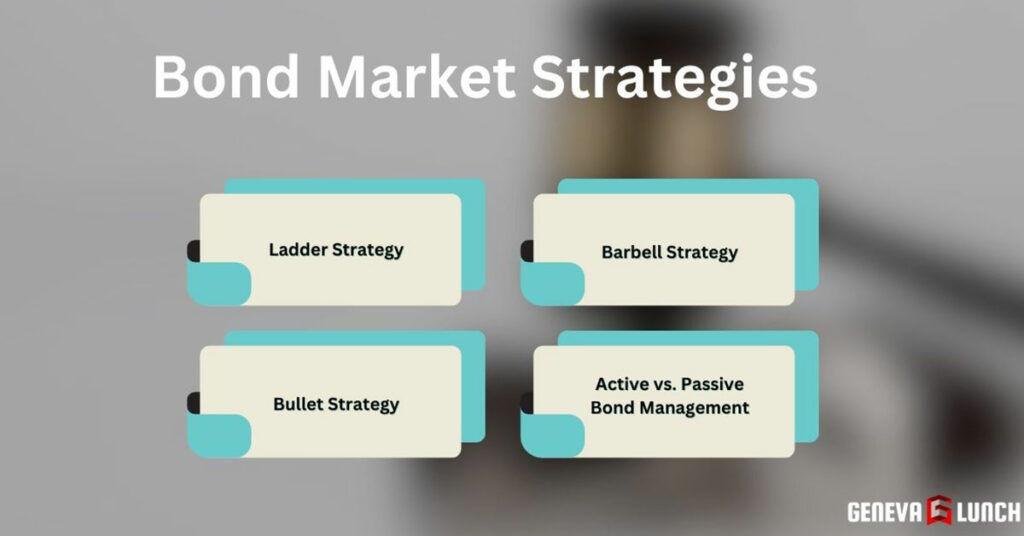
Bond market strategies help investors manage their bond investments. Different strategies can match different goals and risk levels. Choosing the right strategy is important for maximizing returns and minimizing risks. Let’s explore some common bond market strategies in detail.
Ladder Strategy
The ladder strategy involves buying bonds with different maturity dates. This spreads out the investment over time. For example, an investor might buy bonds that mature in 1 year, 3 years, and 5 years. When a bond matures, the money can be reinvested in a new bond.
This strategy reduces interest rate risk because not all bonds mature at the same time. It provides a steady income stream and flexibility.
Barbell Strategy
The barbell strategy involves buying short-term and long-term bonds. This creates a balance between risk and return. For example, an investor might buy bonds that mature in 1 year and bonds that mature in 10 years.
Short-term bonds provide liquidity and stability, while long-term bonds offer higher returns. This strategy helps manage interest rate risk by spreading investments across different maturities. It combines safety and potential growth.
Bullet Strategy
The bullet strategy involves buying bonds that all mature at the same time. This focuses the investment on a specific date. For example, an investor might buy bonds that all mature in 5 years.
This strategy is useful when an investor needs a large sum of money at a specific time, such as for retirement or a major purchase. It minimizes reinvestment risk by locking in interest rates for a set period.
Active Vs. Passive Bond Management
Active bond management involves buying and selling bonds to maximize returns. Managers make decisions based on market conditions and economic forecasts. For example, they may sell bonds if they expect interest rates to rise.
Passive bond management involves holding bonds until maturity. Managers follow a set strategy and do not make frequent changes. For example, they might use a bond index fund to match market returns.
Active management seeks higher returns but involves more risk and fees. Passive management offers stability and lower costs.
FAQs
What Is The Difference Between Bonds And Stocks?
Bonds and stocks are different types of investments. Bonds are loans you give to companies or governments. They pay you interest. Stocks are shares you own in a company. Bonds are less risky than stocks. Bonds provide steady income, while stocks can offer higher returns but come with more risk.
How Do I Buy Bonds?
You can buy bonds in the primary or secondary market. In the primary market, you buy directly from the issuer. In the secondary market, you buy from other investors. You can use bond brokers or online platforms to buy bonds. Bond funds and ETFs are other ways to invest in bonds.
What Factors Affect Bond Prices?
Several factors affect bond prices. Interest rates are a major factor. When interest rates go up, bond prices go down. The bond’s credit rating and inflation can also affect its price. Higher-rated bonds are more expensive. Changes in financial markets can also influence bond prices.
Are Bonds A Safe Investment?
Bonds are generally a safer investment than stocks. They provide steady income through interest payments. Government bonds are considered very safe. Corporate bonds are riskier, however, offer higher returns. The bond’s credit rating indicates its safety. Higher-rated bonds are safer.
How Do Interest Rates Impact Bonds?
Interest rates have a big impact on bonds. When interest rates go up, bond prices go down. When interest rates go down, bond prices go up. For example, if you have a bond paying 4% and new bonds offer 5%, your bond’s price will drop. This is because investors prefer the higher interest rate of new bonds.
Final Words
The bond market is important for both investors and issuers. It helps companies and governments raise money. It also provides steady income for investors.
Understanding bonds and the bond market can help you make smart investment choices. Bonds are less risky than stocks and can balance your investment portfolio. Learning about bond types, risks, and strategies will improve your financial knowledge and decisions.