Certified Public Accountant (CPA): Exam, Certification & Career Paths

Accounting plays a vital role in managing and understanding finances for individuals and businesses. Professionals in this field ensure that financial records are accurate and comply with laws. Among these professionals, Certified Public Accountants (CPAs) stand out due to their advanced skills and qualifications. So, what is a Certified Public Accountant (CPA)?
A Certified Public Accountant (CPA) is a professional who has passed the CPA exam and met state licensing requirements. CPAs are qualified to provide accounting, auditing, tax, and consulting services. They help businesses and individuals manage their finances and make informed financial decisions.
In this guide, we’ll explore the essentials about becoming a Certified Public Accountant (CPA). We’ll cover how this certification can enhance your career, provide job stability, and offer numerous professional opportunities.
Key Takeaways
- CPA Definition: Certified Public Accountants (CPAs) are licensed professionals in accounting, auditing, tax, and consulting.
- Role of a CPA: CPAs ensure financial records are accurate and comply with laws and regulations.
- Services Provided: CPAs offer financial planning, tax preparation, auditing, and business consulting services.
- Career Advancement: Becoming a CPA offers career advancement opportunities and higher earning potential.
- Job Stability: CPAs enjoy job stability due to the constant demand for financial expertise.
What Is A Certified Public Accountant (CPA)?
A Certified Public Accountant (CPA) is a professional who helps people with their finances. CPAs pass a special exam to get their license. They also meet education and experience requirements. This license is given by the state. CPAs can work in many places like firms, businesses, or for the government.
What Does A Certified Public Accountant (CPA) Do?
A Certified Public Accountant (CPA) does many important tasks. They prepare and review financial statements. CPAs also do audits to check if financial reports are correct. They help with taxes, making sure people pay the right amount. CPAs give advice on how to save money and plan for the future.
They help businesses make smart financial decisions. For example, a CPA may help a company save $10,000 on taxes. CPAs also protect against fraud and errors in financial records.
Certified Public Accountant (CPA) Certification Process
Becoming a CPA involves several steps. You must meet certain requirements and pass an exam. Here is a detailed guide to help you understand the process. It will cover eligibility, the exam, preparation, application, and passing the exam.
Eligibility Requirements
Before you can take the CPA exam, you must meet certain eligibility requirements. These requirements ensure that candidates have the necessary knowledge and experience. Meeting these requirements is the first step in becoming a CPA.
Educational Requirements
To become a CPA, you need a college degree. Most states require 150 credit hours of education. This usually means getting a bachelor’s degree and taking extra courses. Some people get a master’s degree to meet this requirement.
For example, you might need classes in accounting, business, and ethics. These classes help prepare you for the CPA exam. It is important to check your state’s specific rules because they can vary.
Work Experience Requirements
To become a CPA, you need work experience. Most states require at least 1 year of work under a licensed CPA. This work can be in accounting, auditing, or tax. Some states need more experience.
For example, New York requires 2 years. This experience helps you learn important skills. It also shows that you can do the job well. Working with a CPA helps you understand real-world problems.
CPA Exam Structure
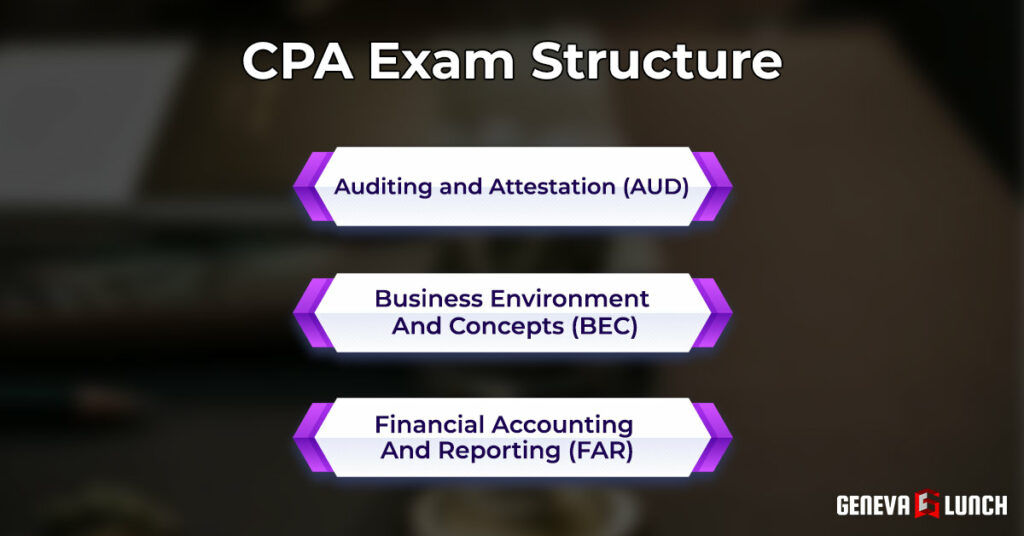
The CPA exam is divided into four sections. Each section tests different knowledge areas. You must pass all four sections to become a CPA. The exam is challenging, so it is important to understand the structure.
Auditing and Attestation (AUD)
The Auditing and Attestation (AUD) section of the CPA exam covers audits, reviews, and attestation services. It tests your knowledge of auditing standards. You must understand how to plan and conduct audits. This part also covers how to report audit findings.
It is a four-hour exam with multiple-choice questions and task-based simulations. For example, you may answer questions about audit processes and legal requirements.
Business Environment And Concepts (BEC)
The Business Environment and Concepts (BEC) section tests your understanding of business topics. This includes corporate governance, economics, and information technology. It also covers financial management and business strategies.
The exam is four hours long. It includes multiple-choice questions, task-based simulations, and written communication tasks. For example, you may need to write a memo explaining a business decision.
Financial Accounting And Reporting (FAR)
The Financial Accounting and Reporting (FAR) section covers financial accounting standards. It includes topics like financial statements, transactions, and reporting for governments and nonprofits.
The exam is four hours long. It has multiple-choice questions and task-based simulations. For example, you might answer questions about how to prepare financial statements according to GAAP.
Regulation (REG)
The Regulation (REG) section tests your knowledge of tax laws and business regulations. This includes federal taxation, ethics, and business law. The exam is four hours long. It has multiple-choice questions and task-based simulations. For example, you may answer questions about individual and corporate tax returns.
CPA Exam Preparation
Preparing for the CPA exam is essential for success. You need the right study materials and a solid plan. Preparation involves understanding the exam content and practicing with sample questions. A well-organized study plan will help you cover all necessary topics and stay on track.
Study Materials And Resources
To prepare for the CPA exam, you need good study materials. Many people use review courses, textbooks, and online resources. These materials cover all exam topics.
Some popular review courses are Becker, Wiley, and Roger CPA Review. Using these materials can help you understand the content and practice exam questions. They also provide study plans to keep you on track.
Recommended Study Time
Preparing for the CPA exam requires a lot of study time. Experts recommend studying 300-400 hours for the entire exam. This means about 100 hours for each section.
You should spread this time over several months. For example, studying 10-15 hours per week can help you stay on track. Consistent studying helps you remember the material better.
Practice Exams And Mock Tests
Practice exams and mock tests are important for CPA exam preparation. They help you get used to the exam format and time limits. Many review courses offer practice exams. Taking these tests can show you which areas need more study.
For example, scoring 75% on practice exams can indicate you are ready. Regular practice helps you feel more confident on exam day.
Applying For The CPA Exam
The application process for the CPA exam involves several steps. You need to check your state’s requirements and submit the necessary documents. Completing the application correctly is important.
Application Process
To apply for the CPA exam, you need to follow specific steps. First, check your state’s requirements. Next, complete the application form and submit your transcripts. You also need to pay application fees. Some states require additional documents, like proof of work experience.
After your application is approved, you will receive a Notice to Schedule (NTS). This allows you to schedule your exam dates.
Fees And Costs
Taking the CPA exam involves several fees. The application fee ranges from $50 to $200, depending on the state. Each exam section costs about $200. So, the total cost for all four sections is around $800. There may also be additional fees for study materials and review courses. For example, a review course can cost between $1,000 and $3,000.
Scheduling The Exam
After receiving your Notice to Schedule (NTS), you can schedule your exam. You can choose your exam dates and locations. The CPA exam is offered at Prometric test centers.
You can schedule one section at a time or multiple sections. It is important to schedule early to get your preferred dates. You have 18 months to pass all four sections once you pass the first section.
Passing The CPA Exam
To become a CPA, you need to pass all four sections of the exam. Each section tests different knowledge and skills. It is important to prepare well for each part. Understanding the scoring system and what happens if you fail a section is also important.
Scoring And Results
To pass the CPA exam, you need a score of 75 or higher on each section. The exam is scored on a scale from 0 to 99. Your scores are based on your performance on multiple-choice questions and simulations.
You will receive your results within a few weeks after taking the exam. Passing all four sections is required to become a CPA.
Retaking Failed Sections
When you fail a section of the CPA exam, you can retake it. You must wait for the next testing window to retake the section. There are four testing windows each year. You have 18 months to pass all four sections from the date you pass your first section.
For example, if you pass one section in January, you have until July of the following year to pass the remaining sections.
Certified Public Accountant (CPA) Licensure
Becoming a CPA involves getting licensed after passing the CPA exam. Each state has its own rules for licensure. You must meet these requirements to practice as a CPA. Here is an overview of the licensure process, including state board requirements, how to apply, and continuing professional education.
State Board Requirements
Each state has a board that sets requirements for CPA licensure. These boards ensure that candidates meet high standards. Requirements usually include passing the CPA exam, having a certain amount of work experience, and meeting education criteria.
For example, some states require 150 credit hours of college education and two years of work experience under a licensed CPA. It is important to check your state board’s specific requirements before applying.
Applying For A CPA License
After meeting all requirements, you can apply for a CPA license. The application process includes submitting proof of education and work experience. You also need to provide your CPA exam scores. Some states require additional documents, like character references.
The application fee varies by state but is usually between $50 and $200. Once your application is approved, you will receive your CPA license, allowing you to practice as a CPA.
Continuing Professional Education (CPE)
To keep your CPA license, you need to complete Continuing Professional Education (CPE). CPE helps CPAs stay current with new laws, regulations, and practices. Most states require CPAs to complete a certain number of CPE hours each year. This ensures that CPAs maintain their skills and knowledge throughout their careers.
Importance Of CPE
Continuing Professional Education (CPE) is important for CPAs to stay updated with new laws, regulations, and practices. It ensures that CPAs provide accurate and current advice to clients. This helps CPAs stay knowledgeable and effective in their roles. Here’s why CPE is important:
- Staying Current with Industry Changes: CPE keeps CPAs informed about new laws, regulations, and accounting standards. For example, new tax laws might affect how you advise clients.
- Maintaining Professional Competence: Regular education ensures that CPAs continue to provide accurate and reliable services. Without CPE, a CPA might miss important updates and provide outdated advice.
- Meeting State Requirements: Most states require CPAs to complete a specific number of CPE hours each year. For instance, many states require 40 hours of CPE annually.
- Fostering Professional Growth: CPE helps CPAs expand their knowledge and skills, which can lead to better job performance and career advancement.
- Upholding Ethics and Standards: CPE courses often include ethics training, ensuring that CPAs adhere to professional standards and practices.
Types Of CPE Courses

CPE courses cover a wide range of topics to help CPAs stay informed and skilled in their profession. Here are some common types of CPE courses:
- Tax Updates: These courses cover the latest changes in tax laws and regulations. For example, a course might explain new tax credits or deductions available to businesses.
- Ethics: Ethics courses ensure CPAs adhere to high professional standards. They often cover ethical dilemmas and how to handle them.
- Accounting Standards: Courses on new accounting standards help CPAs understand and apply the latest rules. This ensures financial reports are accurate and comply with regulations.
- Technology: Technology courses teach CPAs about new software and tools that can improve efficiency. For example, learning about new accounting software can streamline processes.
- Industry-Specific Courses: These courses focus on issues relevant to specific industries, such as healthcare, construction, or finance.
Maintaining Your License
Maintaining your CPA license requires completing the required CPE hours and reporting them to your state board. You must keep records of the courses you take and the hours you complete. Most states have an online system for reporting CPE.
When you do not complete the required CPE, you risk losing your license. Keeping up with CPE ensures that you remain a licensed CPA and continue to provide high-quality services.
Roles And Responsibilities Of A Certified Public Accountant (CPA)
CPAs play many important roles in business and finance. They help individuals and companies manage their money. CPAs ensure financial records are accurate and taxes are filed correctly. Here are some key responsibilities of a CPA.
Auditing And Assurance Services
CPAs perform audits to check financial records. They make sure financial statements are correct. This helps prevent fraud and errors. For example, a CPA might audit a company’s books to ensure $1,000,000 in sales is accurately reported.
Audits give confidence to investors and regulators that financial information is reliable. CPAs also review financial processes to improve accuracy. Auditing services are vital for trust in financial reporting.
Tax Preparation And Planning
CPAs prepare tax returns for individuals and businesses. They ensure taxes are paid correctly and on time. CPAs also plan strategies to save money on taxes. For example, a CPA might find tax credits that save a business $5,000.
CPAs stay updated on tax laws to give the best advice. They help clients understand complex tax rules. Good tax planning and financial planning can result in significant savings. CPAs make sure all tax forms are completed accurately.
Financial Analysis And Reporting
CPAs analyze financial data to help businesses make decisions. They prepare reports showing how a company is doing financially. For example, a CPA may create a report showing profits increased by 10% in one year.
These reports include balance sheets and income statements. Financial analysis helps businesses plan for the future. CPAs use this information to advise on budgeting and investing. Accurate financial reporting is essential for business growth.
Consulting Services
CPAs provide advice on business plans, budgeting, and financial strategies. For example, a CPA might help a new business owner plan a budget to avoid overspending. CPAs offer guidance on improving efficiency and profitability.
CPAs assist with risk management and strategic planning. Their advice helps businesses grow and succeed. They also help with mergers and acquisitions. As financial advisors, they offer valuable insights for business development.
Forensic Accounting
Forensic accountants investigate financial crimes like fraud and embezzlement. They examine financial records to find evidence of wrongdoing. For example, a forensic accountant might find $50,000 was stolen from a company. They work with law enforcement to solve financial crimes.
Forensic accountants testify in court as expert witnesses. They help businesses prevent fraud by improving internal controls. This field combines accounting, auditing, and investigative skills.
Information Technology Services
CPAs help businesses with financial-related IT. They advise on software and systems to improve operations. For example, a CPA might recommend accounting software saving a business 20 hours of work monthly.
They ensure IT systems are secure and efficient. CPAs help implement financial management systems. They advise on cybersecurity to protect financial data. IT services from CPAs enhance accuracy and efficiency.
Regulatory Compliance
CPAs ensure businesses follow laws and regulations. They make sure financial practices meet legal standards. For example, a CPA might check if a company complies with federal tax laws. This helps businesses avoid fines and legal issues.
CPAs stay updated on regulations to keep clients compliant. They advise on industry-specific rules and reporting requirements. Regulatory compliance maintains a company’s reputation. CPAs help navigate complex regulatory environments.
Benefits Of Becoming A Certified Public Accountant (CPA)

Becoming a CPA has many benefits. CPAs have a wide range of career options. They enjoy job security and higher earnings. CPAs are respected professionals in the field of accounting. They have diverse opportunities and can work in different industries. Here are some key benefits of becoming a CPA:
Career Advancement
Becoming a CPA can lead to career advancement. CPAs are often promoted to higher positions. For example, a CPA might become a financial manager or controller.
Many CPAs move into executive roles. Having a CPA license shows you have advanced skills. This helps you get better job opportunities. CPAs are trusted leaders in their field. They often oversee important financial decisions.
Job Security And Stability
CPAs have strong job security. Financial skills are always in demand. Even during economic downturns, CPAs are needed. They help businesses manage finances and stay compliant with laws.
For example, a company might hire a CPA to handle audits and taxes. CPAs have stable careers because their skills are essential. This makes them less likely to lose their jobs compared to other professions.
Higher Earning Potential
CPAs earn higher salaries than non-CPAs. On average, CPAs make 10-15% more than accountants without a CPA license. For example, a CPA might earn $80,000 per year, while a non-CPA earns $70,000.
This higher earning potential increases with experience. CPAs in senior roles can earn over $100,000 annually. Higher salaries are a significant benefit of becoming a CPA.
Professional Recognition And Prestige
Being a CPA gives you professional recognition. It is a respected and prestigious title. CPAs are seen as experts in accounting and finance. This recognition can open many doors in your career.
For example, clients and employers trust CPAs to handle important financial tasks. Having CPA after your name shows you have met high standards. It boosts your credibility and reputation.
Diverse Career Opportunities
CPAs have diverse career opportunities. They can work in various fields such as auditing, tax, consulting, and finance. For example, a CPA might work in public accounting, government, or private industry.
This diversity allows CPAs to find roles that match their interests. CPAs can switch careers easily within the finance and accounting sector. This flexibility is a major advantage.
Networking Opportunities
Becoming a CPA provides many networking opportunities. CPAs can join professional organizations like the AICPA. These groups offer events, seminars, and conferences. Networking helps CPAs meet other professionals and learn new skills.
For example, attending a conference can lead to job offers or business partnerships. Building a strong professional network is valuable for career growth.
Challenges And Considerations
Becoming a CPA has many benefits, but it also has challenges. It requires hard work and dedication. CPAs must be prepared for intensive study, long hours, and ongoing education. Understanding these challenges can help you decide if becoming a CPA is right for you. Here are some challenges and considerations for becoming a CPA.
Intensive Study And Preparation
Becoming a CPA requires intensive study and preparation. The CPA exam is very difficult. It covers many topics like auditing, tax, and accounting. Most people study 300-400 hours for the entire exam.
For example, studying 15 hours per week for six months. Passing the exam requires a lot of focus and hard work. Many candidates take review courses to help them prepare.
Work-Life Balance
Maintaining work-life balance can be challenging for CPAs. They often work long hours, especially during tax season. For example, a CPA might work 60 hours a week from January to April.
This can make it hard to spend time with family and friends. Finding time for relaxation and hobbies is important. CPAs need to manage their time well to avoid burnout.
Continuing Education Requirements
CPAs need to complete continuing education requirements. Most states require 40 hours of Continuing Professional Education (CPE) each year. For example, taking courses on tax updates and new accounting standards.
This helps CPAs stay updated with changes in the field. It can be time-consuming to find and complete these courses. Failing to meet CPE requirements can result in losing the CPA license.
Staying Updated With Regulations
CPAs need to stay updated with regulations. Laws and rules in accounting and tax often change. For example, new tax laws may be passed each year. CPAs need to learn these changes to give correct advice.
This requires constant learning and attention to detail. Keeping up with regulations ensures CPAs provide accurate and legal financial services.
Ethical Responsibilities
CPAs have strong ethical responsibilities. They must act with honesty and integrity. For example, they cannot hide or change financial information to deceive others. CPAs follow a code of ethics to maintain trust.
They need to avoid conflicts of interest and protect client confidentiality. Ethical behavior is crucial for maintaining a good reputation. CPAs must always put their clients’ best interests first.
How To Choose The Right Certified Public Accountant (CPA) Program
Choosing the right CPA program is very important. The right program can help you pass the CPA exam and start a successful career. You should look at accreditation, program type, and other important details. Here is a guide to help you choose the best CPA program for your needs.
Accredited CPA Programs
Accreditation is important when choosing a CPA program. Accredited programs meet high standards of quality. They are recognized by professional organizations. For example, programs accredited by AACSB or ACBSP are good choices.
Accreditation ensures you get a good education. It also makes it easier to get licensed. Always check if the program is accredited before applying. This can impact your future career opportunities.
Online Vs. Traditional Programs
CPA programs can be online or traditional. Online programs offer flexibility. You can study from home at your own pace. This is good if you have a job or family responsibilities.
Traditional programs have in-person classes. You can interact with teachers and classmates. This is good if you prefer a structured environment. Both types have advantages. Choose the one that fits your lifestyle and learning style.
Factors To Consider
Choosing the right CPA program is crucial for your success. Several factors can affect your decision. It is important to think about your personal needs and career goals. Here are some key factors to consider:
Cost
Cost is an important factor. CPA programs can be expensive. Tuition fees, books, and other materials add up. For example, some programs may cost $10,000 per year. Look for programs that fit your budget.
Check if they offer financial aid or scholarships. Comparing costs can help you find an affordable option.
Flexibility
Flexibility is key if you have other commitments. Online programs often offer more flexibility. You can study at any time that suits you. This is helpful if you work full-time or have a family. Traditional programs have set class times. Choose a program that allows you to balance your studies with your other responsibilities.
Reputation
Reputation matters when choosing a CPA program. A program with a good reputation is recognized for its quality. Employers may prefer graduates from well-known programs. Research the program’s success rates.
For example, find out how many graduates pass the CPA exam. Good programs have high pass rates and positive reviews from students.
Support Services
Support services are important for success. Look for programs that offer tutoring, career services, and study resources. For example, some programs provide access to CPA review courses and practice exams.
Good support can help you understand the material and prepare for the exam. It can also help you find a job after graduation. Choose a program that offers strong support services to help you succeed.
Career Paths For Certified Public Accountant (CPA)

CPAs have many career paths to choose from. They can work in various fields and industries. This flexibility makes the CPA profession attractive. Understanding the different career paths can help you decide what is best for you. Here are some common career paths for CPAs.
Public Accounting
Public accounting involves working for accounting firms. CPAs in public accounting provide services to clients. These services include auditing, tax preparation, and consulting. For example, a CPA might help a business prepare its financial statements.
Public accounting offers diverse work experiences. CPAs can work with many different clients and industries. This path is ideal for those who enjoy variety and client interaction.
Corporate Accounting
Corporate accounting involves working for a single company. CPAs in corporate accounting handle the company’s financial records. They prepare financial reports, manage budgets, and ensure compliance with laws.
For example, a CPA may prepare a monthly budget report showing the company’s expenses. Corporate accounting offers stability and a clear career path. CPAs can advance to roles like financial manager or chief financial officer (CFO).
Government Accounting
Government accounting involves working for government agencies. CPAs in government accounting manage public funds. They ensure that taxpayer money is used properly. For example, a CPA might audit a government program to ensure funds are spent correctly.
Government accounting offers job security and good benefits. CPAs can work at the local, state, or federal level. This path is ideal for those who want to serve the public.
Non-Profit Accounting
Non-profit accounting involves working for non-profit organizations. CPAs in non-profit accounting manage the organization’s finances. They ensure that funds are used to support the organization’s mission.
For example, a CPA may prepare financial reports for a charity. Non-profit accounting offers the chance to make a positive impact. CPAs can help organizations like schools, hospitals, and charities. This path is ideal for those who want to support a cause.
Academia And Teaching
Academia and teaching involve working at educational institutions. CPAs in academia teach accounting courses to students. They may also conduct research and publish articles. For example, a CPA might teach a college course on financial accounting.
Academia offers a chance to educate future accountants. CPAs in this field can also enjoy a flexible schedule and intellectual challenges. This path is ideal for those who enjoy teaching and research.
Specializations Within Accounting
CPAs can choose to specialize in specific areas of accounting. Specializations include forensic accounting, tax accounting, and management accounting. For example, a forensic accountant investigates financial crimes.
Specializing allows CPAs to become experts in a particular field. This can lead to higher earning potential and unique career opportunities. Specializations require additional training and certifications. CPAs should choose a specialization based on their interests and career goals.
Future Of The Certified Public Accountant (CPA) Profession

The CPA profession is changing. New trends and technology are shaping the industry. CPAs need to stay updated to succeed. Understanding these changes can help you prepare for the future. Here are some important aspects of the future of the CPA profession.
Trends In The Accounting Industry
The accounting industry is seeing new trends. More businesses are using digital tools. This makes accounting faster and more accurate. For example, cloud-based accounting software is becoming popular. Sustainability and environmental accounting are also growing fields.
Businesses want to show their commitment to the environment. These trends are creating new opportunities for CPAs. Staying informed about industry trends is important for success.
Impact Of Technology On The CPA Role
Technology is changing the CPA role. Automation can handle routine tasks like data entry. This allows CPAs to focus on more complex work. For example, artificial intelligence can analyze financial data quickly.
Technology also helps with data security. CPAs need to learn new tools and software. Keeping up with technology is essential. This makes CPAs more efficient and valuable to their clients.
Emerging Areas Of Expertise
New areas of expertise are emerging in accounting. CPAs can specialize in fields like forensic accounting and data analytics. For example, a forensic accountant investigates financial crimes. Data analytics helps businesses make informed decisions.
Specializing in these areas can increase job opportunities. CPAs need to stay updated with new skills and certifications. This helps them remain competitive in the job market.
Globalization And International Opportunities
Globalization is opening international opportunities for CPAs. Businesses are expanding worldwide. CPAs can work with international clients and companies. For example, a CPA might help a U.S. company with operations in Europe.
Understanding international accounting standards is important. This can lead to exciting career opportunities abroad. CPAs with global experience are in high demand. Learning new languages and cultures can also be beneficial.
FAQs
What Skills Are Essential For A Successful CPA?
The essential skills for a successful CPA include strong math skills, attention to detail, and good communication. Problem-solving and time management are also crucial. These skills help CPAs handle financial data, find errors, explain information, meet deadlines, and solve financial issues effectively.
What Technology Should CPAs Be Familiar With?
CPAs should be familiar with accounting software like QuickBooks, Xero, and Microsoft Excel. They need to know cloud-based accounting tools, data analytics software, and cybersecurity measures to protect financial data. Understanding these technologies helps CPAs work efficiently and securely.
What Are The Ethical Responsibilities Of A CPA?
The ethical responsibilities of a CPA include acting with honesty and integrity, avoiding conflicts of interest, maintaining client confidentiality, and following laws. CPAs must report illegal or unethical activities and always act in their clients’ best interests. Ethics maintain trust and credibility.
How Can A CPA Help A Small Business?
A CPA can help a small business by preparing financial statements, filing taxes correctly, and budgeting. They provide advice on profitability and expense management, and assist with payroll. They serve as a financial advisor for businesses, offering expertise that helps small businesses grow and succeed.
What Is The Difference Between A CPA And A CMA?
A CPA and a CMA have different focuses. A CPA focuses on accounting, auditing, and tax services. They often work in public accounting firms or as auditors. A CMA focuses on management accounting and financial management. They often work within companies, helping with budgeting and strategy.
How Can CPAs Aid In Mergers And Acquisitions?
CPAs aid in mergers and acquisitions by conducting financial due diligence. This involves reviewing the financial health of companies involved. CPAs assess the value of businesses and identify any risks. They help structure the deal to be financially beneficial. CPAs also assist with tax planning.
Final Words
Becoming a Certified Public Accountant (CPA) offers many benefits, including career advancement, job stability, and higher earning potential. CPAs play a vital role in ensuring accurate financial records and compliance with laws. They provide valuable services like financial planning, tax preparation, and business consulting. Choosing to become a CPA can open many doors and provide a rewarding career.