Debt Management: Types, Strategies And Tips For Reduction

Managing your finances effectively is crucial for long-term security. A vital aspect of this is understanding how to manage and minimize debt, ensuring it doesn’t overwhelm your budget or your future financial plans. But what exactly is debt management?
Debt management involves organizing and adjusting your finances so you can pay off debts in a manageable way. This includes creating a budget that covers your debts and prioritizing higher interest debts. It also involves consistently monitoring your spending to prevent accruing more debt.
In this guide, we will explore different strategies for managing debt. We’ll cover how effective debt management can improve your credit score, and discuss tools that can assist in keeping you on track.
Key Takeaways
- Prioritize High-Interest Debts: Focus on paying off debts with the highest interest rates first to save money.
- Create a Budget: Establish a clear budget to effectively manage and allocate funds toward debts.
- Review and Adjust: Regularly assess and modify your debt management plan as financial situations change.
- Use Automation: Set up automatic payments to ensure consistent, timely debt repayment.
- Seek Professional Help: Consider consulting with a debt management expert if debts become overwhelming.
What Is Debt Management?
Debt management involves creating a plan to pay off debts in a systematic way. This plan helps people combine their debts into a single payment, often with a lower interest rate. Debt management makes it easier to manage monthly payments and saves money on interest over time.
Importance Of Effective Debt Management
Effective debt management is crucial because it helps individuals avoid financial stress and maintain good credit scores. By managing debts properly, people can avoid late payments, which can lead to higher interest rates and decreased credit scores. Also, effective debt management can prevent the risk of bankruptcy by ensuring that debts are paid in a manageable way.
For example, if a person has $10,000 in credit card debt with an average interest rate of 20%, a well-structured debt management plan could reduce the interest rate to 10%, significantly lowering monthly payments and the total interest paid over time.
What Is The Main Type Of Debt?

Understanding the various types of debt is key to effective financial management. Each type has distinct features and implications for repayment. Here, we explore five main categories to clarify how they affect borrowers differently.
Secured Vs. Unsecured Debt
Secured debts are linked to a specific asset, such as a house or car, which serves as collateral. This means if the borrower fails to make payments, the lender can claim the asset. Examples include mortgages and auto loans.
Unsecured debts, on the other hand, do not involve collateral. Common examples are credit card debts and personal loans. Failure to pay unsecured debt affects your credit score and may lead to legal action but doesn’t involve losing a specific asset directly.
Revolving Vs. Installment Debt
Revolving debts allow you to borrow repeatedly up to a set limit while making monthly payments. This flexibility makes credit cards a popular form of revolving debt.
Installment debts involve loans with fixed payments over a set period. Typical examples are mortgages and auto loans, where you know the exact payment amount and timeline for full repayment, offering more predictable financial planning.
Fixed-Rate Vs. Variable-Rate Debt
Fixed-rate debts lock in the interest rate for the duration of the loan, ensuring consistent payment amounts. This predictability helps with budgeting over long periods.
Variable-rate debts have interest rates that can change based on market conditions. While they might offer lower rates initially, they pose a risk of increasing costs over time. Home equity lines of credit often feature variable rates.
Short-Term Vs. Long-Term Debt
Short-term debts are designed to be repaid within a short timeframe, usually within a year. They are typically used for immediate cash flow needs in businesses or short-term personal expenses.
Long-term debts extend for several years and are more suited for significant investments like homes or education. These debts are structured to ease the financial burden by spreading it over many years.
Callable Vs. Non-Callable Debt
Callable debts give the lender the right to demand full repayment before the agreed-upon end date, often under specific conditions. This can be risky for borrowers if they’re not prepared to settle the debt early.
Non-callable debts provide more stability as they can’t be called in early. This ensures that the borrower retains the full term to repay as planned.
Specific Types Of Debt
Different debts serve various financial needs, ranging from personal purchases to investments in real estate or education. Knowing the specifics of each type is very important. It helps in managing and prioritizing them for better financial health.
Consumer Debt
Consumer debt involves money borrowed for purchasing everyday goods and services that don’t increase in value over time. It’s one of the most common types of debt that affects a large number of people. This type of debt includes several categories:
Credit Card Debt
Credit card debt occurs when you buy things with a credit card and do not pay the full amount owed each month. This debt usually carries high interest rates, which can compound quickly if not managed carefully.
For example, if you owe $5,000 on a credit card with an annual interest rate of 18%, and you make only minimum payments, you might end up paying much more than the original amount due to interest.
Personal Loans
Personal loans are amounts borrowed for personal use that aren’t backed by collateral, hence they might have higher interest rates than secured loans. They are generally used to consolidate other debts or cover large expenses.
For instance, a $10,000 personal loan with a 9% interest rate and a repayment period of 5 years would require monthly payments around $207, totaling approximately $12,420 paid back by the end.
Auto Loans
These loans are specifically for purchasing vehicles. The car bought with the loan serves as collateral, which means the lender can take it back if payments are missed.
An example of an auto loan could be a $20,000 loan with a 6% interest rate over a 5-year period, resulting in monthly payments of about $386. The total amount paid by the end would be around $23,160.
Mortgage Debt
Mortgage debt is used primarily for purchasing property. This is the largest type of debt most people will take on, involving a property as collateral to secure the loan. The terms of the loan are typically 15 to 30 years.
For example, someone with a $250,000 mortgage at a 4% fixed interest rate on a 30-year term would have to pay about $1,194 monthly, totaling $429,674 over the duration of the loan.
Student Loans
Student loans are designed to help students cover education costs, such as tuition, books, and living expenses. These loans usually come with more flexible repayment options which often don’t begin until after graduation.
For instance, a federal student loan amounting to $30,000 with an annual interest rate of 5% paid over 10 years results in monthly payments of $318 and a total payment of $38,184 by the end of the term.
Business Debt
Business debt is acquired for business operations, whether to start a new business, expand an existing one, or cover daily expenses. This can include loans for equipment, real estate, or operational funds.
A typical example might be a business loan of $50,000 at an 8% interest rate to be repaid over 7 years. Monthly payments would be around $775, adding up to about $65,100 in total repayments.
What Were The Main Causes Of The Debt Crisis?
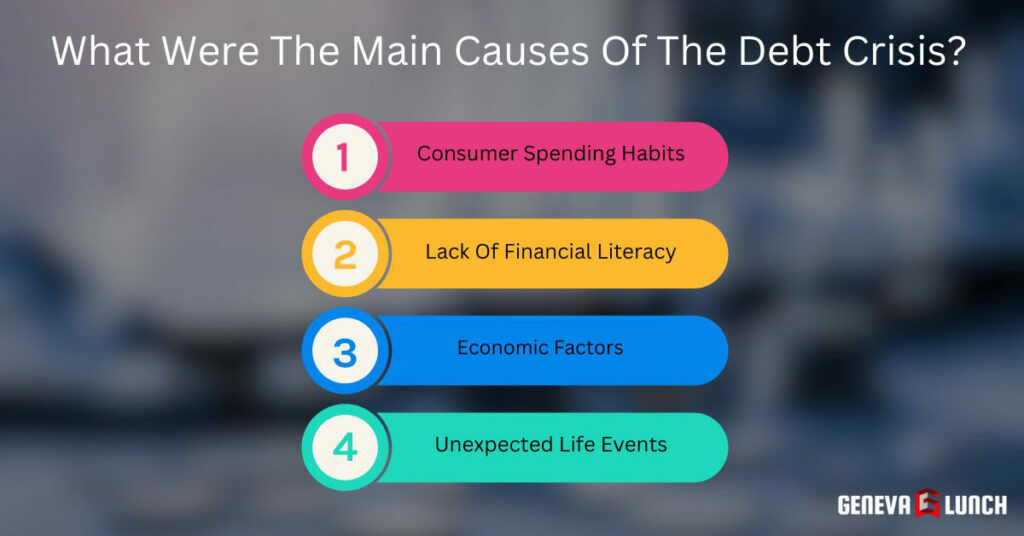
The debt crisis is often a result of several contributing factors that affect individuals’ financial stability and ability to repay debts. By understanding these key drivers behind the debt crisis, individuals and policymakers can better prepare and implement strategies to mitigate these risks and promote financial health. Here are some of the main causes:
Consumer Spending Habits
One major cause of personal debt is excessive spending relative to one’s income, often facilitated by the ease of credit card use. For example, if someone earns $3,000 monthly but consistently spends $3,500, relying on credit to bridge the gap, they accumulate debt quickly.
This debt grows due to interest and can spiral out of control, especially if the spending habit continues without adjustment.
Lack Of Financial Literacy
A significant number of people do not possess basic financial education, which includes understanding how to create and maintain a budget, how interest rates work, and the consequences of failing to manage debt. This lack of knowledge can lead to poor financial decisions, such as taking on high-interest loans without a plan for repayment.
For example, without understanding compound interest, a person might not realize that making only minimum payments on a high-interest credit card significantly increases the total amount paid over time.
Economic Factors
Broader economic issues such as recessions, inflation, or high unemployment rates also play a critical role in the debt crisis. These factors can reduce individuals’ ability to pay off debts due to decreased income or job loss.
For example, during an economic downturn, if someone loses their job, they may struggle to meet mortgage payments, leading to foreclosure or forced sale of assets, thereby exacerbating their financial crisis.
Unexpected Life Events
Life is unpredictable, and unexpected events like serious illnesses, family emergencies, or layoffs can drastically alter one’s financial landscape. Such events often result in sudden, significant expenses or loss of income, forcing individuals to rely on savings or, more commonly, to incur new debt.
For example, an unexpected medical bill of $20,000, when there is no insurance coverage, can push a financially stable individual into a debt spiral if they must resort to high-interest borrowing options to cover the cost.
Assessing Your Debt Situation
Effectively managing your finances starts with a clear understanding of your total debt. This assessment is crucial in developing a plan to reduce or manage debt effectively. Here’s how to thoroughly assess your overall debt situation to ensure you can create an effective financial plan.
Calculating Total Debt
Begin by summing all the debts you owe. This includes every form of debt from credit cards to loans and mortgages. Knowing the total helps you understand the scale of what you owe.
For example, if your debts include $4,000 on credit cards, a $15,000 car loan, and a $120,000 mortgage, your total debt would be $139,000. Having this figure allows you to set realistic repayment goals.
Identifying High-Interest Debt
Identify which of your debts have the highest interest rates, as these are the most costly over time. High-interest debts, such as some credit card balances, can grow rapidly, consuming more of your financial resources.
For example, if a credit card debt of $4,000 incurs 20% annual interest, it costs you much more to maintain compared to a student loan at 6% interest. Prioritizing these debts for repayment can save you a significant amount in the long run.
Understanding Debt-To-Income Ratio
Your debt-to-income ratio (DTI) is a key financial metric that lenders use to evaluate your ability to manage monthly payments and repay debts. Calculate your DTI by dividing your total monthly debt payments by your gross monthly income, then multiply by 100 to convert it to a percentage.
For example, if your monthly debts amount to $2,000 and your income is $5,000, your DTI would be 40%. A DTI higher than 40% is often seen as a risk by lenders and could impact your ability to obtain further credit.
Recognizing Warning Signs Of Overindebtedness
Be aware of the signs that indicate you may be carrying too much debt. These include difficulties in making minimum payments, borrowing from one credit source to pay another, and feeling stressed or overwhelmed by your financial situation. Regularly assessing your finances for these signs can help you take early action to mitigate more serious financial issues.
When your monthly budget is primarily going towards paying off debt and you are constantly worried about finances, it may be time to reconsider your debt management strategy or seek professional advice.
What Are The Strategies For Managing Debt?

Managing debt effectively is crucial for achieving financial stability and freedom. There are various strategies you can employ to keep your debt under control and gradually reduce it over time. Each strategy addresses different aspects of debt management, from budgeting to repayment approaches.
Budgeting Techniques
Effective budgeting is foundational in managing your finances. It is the first line of defense in managing your financial health. It ensures that every dollar you earn is allocated purposefully, helping you to prioritize debt repayment.
Zero-Based Budgeting
This technique requires you to allocate every dollar of your income to specific expenses, savings, or debt payments, resulting in zero unassigned funds at the end of the month.
For instance, if your monthly income is $3,000, you would distribute all $3,000 across your various financial obligations such as rent, utilities, groceries, savings, and debt repayment. This method ensures that no money is wasted and everything is accounted for, which can help in reducing debt faster.
50/30/20 Rule
This rule simplifies budgeting by dividing your income into three categories: 50% for necessities (like housing and food), 30% for wants (such as entertainment and dining out), and 20% for savings or paying off debts.
For example, on a $2,500 monthly income, you would allocate $1,250 for necessities, $750 for wants, and $500 towards debt repayment or savings. This method helps maintain a balance between spending and saving.
Envelope System
In this method, you use physical envelopes to allocate cash for different spending categories each month. Once the money in an envelope is spent, you cannot spend any more in that category until the next budget period begins.
For example, you may put $200 in the ‘Groceries’ envelope, $150 in the ‘Gas’ envelope, and $100 in the ‘Entertainment’ envelope at the start of the month. When you spend all $100 on entertainment in the first two weeks, you cannot spend on entertainment again until the next month.
This helps control overspending by making the consequences of emptying an envelope immediate and tangible.
Debt Repayment Methods
Once you have a budget in place, the next step is to choose a repayment method. Choose one that maximizes your payments and minimizes interest accumulation. It can greatly influence the speed and cost of your debt clearance.
Snowball Method
This method focuses on paying off debts from the smallest to the largest amount, regardless of the interest rate. This approach provides psychological wins that motivate you to keep paying off large debts.
For instance, if you pay off a small $500 medical bill first, you feel a sense of accomplishment. This encourages you to tackle the next debt of $2,000, and so on.
Avalanche Method
By contrast, the avalanche method prioritizes debts with the highest interest rates first, which saves money on interest payments over time. This method is efficient for reducing the amount you pay in interest.
For example, if you focus on paying down a credit card with a 20% interest rate before a student loan with a 6% rate, you reduce the amount of interest accumulating each month faster.
Debt Consolidation
Consolidating multiple debts into a single loan with a lower interest rate simplifies your payments and can reduce the amount you pay in interest.
For example, consolidating three credit cards with average interest rates of 18% into one consolidation loan at 12% not only reduces your monthly payments but also the total interest paid over the life of the loan.
Negotiating With Creditors
When you’re struggling to meet your debt payments, negotiating with your creditors can be a viable option. You can ask for lower interest rates, more favorable repayment terms, or even temporary relief from payments.
Transparent communication about your financial challenges can lead to adjustments that make your debt more manageable.
Seeking Professional Help
When managing debt on your own becomes too challenging or if you’re facing particularly complex financial issues, seek professional help. You can consider consulting a financial advisor for debt management. They can provide the guidance and resources needed to navigate the path to debt relief.
Credit Counseling
Credit counselors can be very helpful in offering guidance on debt management plans. They can help negotiate with creditors, and provide valuable budgeting advice.
This service typically includes a detailed evaluation of your financial situation to tailor advice and solutions to your specific needs.
Debt Settlement
This strategy involves negotiating with creditors to accept a one-time, lump-sum payment that is less than what you owe.
For example, if you owe $10,000, a debt settlement agency might negotiate to settle the account for $7,000, relieving you of the remaining debt.
Bankruptcy Considerations
Bankruptcy should be considered a last resort due to its significant impact on your credit history and future borrowing capabilities. It can lead to the discharge of certain debts but also leaves a lasting mark on your credit report.
Professional advice from a bankruptcy attorney is crucial to understand the implications and process involved.
Tips For Effective Debt Reduction
Reducing debt efficiently is essential for achieving financial stability. This process involves a dual approach: minimizing your current expenses and finding ways to increase your income. Below, you’ll find detailed strategies designed to help you lower your debt significantly over time.
Cutting Expenses
Cutting back on your spending is essential. It directly frees up more of your income to pay down debt. You can start by examining your spending patterns and identifying where you can make cuts.
Discretionary Vs. Non-Discretionary Spending
Understanding the difference between discretionary (non-essential) and non-discretionary (essential) spending can help you make smarter budgeting decisions. Non-discretionary expenses include housing and food, while discretionary expenses might include dining out or subscriptions.
For example, if you spend $300 a month on non-essential items, cutting this by half could save you $1,800 a year, which can be redirected towards paying off debt.
Lifestyle Adjustments
Making small changes in your lifestyle can significantly reduce your monthly expenses. For instance, opting for public transportation instead of driving, or cooking at home rather than eating out.
When normally you spend $400 a month on meals out and reduce this to $100, you save $300 monthly, adding up to $3,600 annually that can go towards debt.
Increasing Income
While decreasing expenses is vital, increasing your income is also important. It can make a substantial impact on your ability to reduce debt faster. Exploring additional income sources can give your budget a much-needed boost.
Side Hustles
Taking on additional work outside of your primary job can generate extra income to put towards your debt. This could be anything from freelance graphic design to driving for a ride-share service.
For example, if you earn an extra $500 a month from a side hustle, that’s an additional $6,000 a year to help pay down your debt.
Negotiating Salary Or Benefits
Consider discussing a higher salary or better benefits with your employer. It can increase your income without changing jobs.
Even a 5% salary increase on a $50,000 salary can mean an extra $2,500 a year, which can be directed towards reducing your debts.
Avoiding Accumulating Further Debt
A key part of debt reduction is to stop accruing more debt. This means resisting the urge to take on new loans or use credit cards for unnecessary purchases.
Staying committed to using cash or debit for transactions can ensure you do not add to your debt load.
Building An Emergency Fund
An emergency fund is crucial for avoiding new debt in the face of unexpected expenses, such as car repairs or medical bills. Aim to save at least three to six months’ worth of living expenses.
For instance, if your monthly expenses are $2,000, try to build a fund of $6,000 to $12,000. This fund acts as a financial buffer that can keep you from needing to borrow money when unexpected costs arise.
Maintaining Good Credit During Debt Management

Managing debt effectively is important, but maintaining a good credit score during this process is also crucial. A good credit score can affect your ability to borrow money in the future at favorable rates. Here’s how to manage your debt while keeping your credit score healthy.
Importance Of Credit Score
For those who’re aware of what is credit score, should also know that your credit score is a key factor lenders use to determine your creditworthiness. A high score can lead to better interest rates on loans and credit cards, potentially saving you money.
For example, a credit score above 700 might qualify you for a mortgage rate that is 1% lower than if your score were below 640, which could save you over $100,000 on a 30-year mortgage.
Monitoring Credit Reports
Regularly checking your credit reports helps you spot any errors that might harm your score. You can get a free credit report from each of the three major credit reporting agencies: Equifax, Experian, and TransUnion, once a year.
Monitoring ensures that your debt payments are being recorded correctly and allows you to correct inaccuracies promptly.
Impact Of Debt Management On Credit Score
Managing your debt can affect your credit score in different ways. For instance, consolidating your credit cards into one lower-interest loan will initially lower your score because it requires a hard credit inquiry.
However, as you pay down the debt, your score can improve because you reduce your credit utilization ratio and prove your ability to manage debt effectively.
Strategies For Rebuilding Credit
Rebuilding your credit during and after debt management involves several strategic actions. By following these strategies, you can maintain a good credit score while effectively managing your debt, setting yourself up for better financial health in the future. Here are the strategies to follow:
- Always pay on time: Late payments can severely damage your credit score. Setting up automated payments can help you avoid late payments.
- Keep balances low: Try to use less than 30% of your available credit limit on each account. For example, if you have a credit card with a $1,000 limit, try not to carry a balance higher than $300.
- Diversify your credit types: Having a mix of credit types, such as a credit card, a car loan, and a mortgage, can positively affect your score, provided they are all managed responsibly.
- Limit new credit inquiries: Too many hard inquiries in a short period can lower your credit score. Be selective about applying for new credit.
Long-Term Financial Planning Beyond Debt Management
Once you have a handle on managing your debt, it’s important to start thinking about your long-term financial health. This involves setting clear financial goals, creating a budget, investing for your future etc. Here’s how you can begin to build a secure financial future.
Setting Financial Goals
Start by defining clear, achievable financial goals. These might include saving for a house, preparing for retirement, or funding a child’s education.
Specific goals help guide your financial decisions and keep you motivated. For instance, if your goal is to save $50,000 for a down payment on a house in five years, you’ll need to save about $833 per month.
Creating A Sustainable Budget
Developing a budget that you can maintain in the long run is crucial for achieving your financial goals. This budget should account for all your income and expenses, while also allowing for savings and investments.
For example, if you earn $3,000 per month, you might allocate $1,500 to essentials, $600 to discretionary spending, and $900 to savings and investments.
Investing For The Future
Investing is an important part of building wealth over time. Consider diversifying your investments across different asset classes like stocks, bonds, and real estate to balance risk and return.
Starting small, such as investing 10% of your monthly income in a retirement account, can grow significantly due to compounding interest over decades.
Importance Of Financial Education

Educating yourself about finances is crucial for making wise financial decisions and enhancing your overall financial stability. As you improve your financial knowledge, you become better equipped to handle investments, savings, and even daily spending more effectively. Here’s why financial education is important:
- Informed Decision Making: Understanding financial concepts helps you make better choices about investments, loans, and managing debt.
- Risk Management: With financial education, you can assess investment risks more accurately and avoid common pitfalls that lead to financial loss.
- Long-Term Planning: Knowledge of financial planning aids in setting and achieving long-term goals, such as retirement planning and wealth accumulation.
By committing to continuous learning, you can ensure that your financial health extends far beyond just managing debt. It sets you up for a more secure and prosperous future.
Legal Aspects Of Debt Management
Navigating the legal aspects of debt management is crucial for making informed decisions. It can help protect your rights as you work to resolve your financial obligations. Understanding the rules and laws can empower you to make better choices and potentially ease the burden of debt.
Understanding Bankruptcy
Bankruptcy offers a legal solution for individuals and businesses overwhelmed by debt. It provides a pathway to reduce or eliminate certain obligations under the protection of the federal bankruptcy court. There are multiple types of bankruptcy, each designed for specific situations.
Types of Bankruptcy
There are different forms of bankruptcy, each suited to specific financial situations. Chapter 7 and Chapter 13 are the most common types.
- Chapter 7: This type involves liquidating assets to pay off debts. It’s often resolved within a few months, allowing for a fresh start with certain unsecured debts wiped clean.
- Chapter 13: This type allows individuals with regular income to develop a plan to repay all or part of their debts. Debtors propose a repayment plan to make installments to creditors over three to five years.
The Process Of Filing For Bankruptcy
The process begins by filing a petition in bankruptcy court. This petition must include detailed financial information such as assets, liabilities, income, and expenses.
Once filed, an automatic stay takes effect, stopping most creditors from pursuing further debt collection. In a Chapter 7 case, a trustee is appointed to oversee the asset liquidation and distribute the proceeds to creditors.
Long-term Implications Of Bankruptcy
Filing for bankruptcy can impact your credit report for up to 10 years, affecting your ability to obtain credit, secure housing, or even find employment.
Despite these consequences, bankruptcy can offer relief from overwhelming debt and a chance to rebuild financially.
Consumer Rights And Debt Collection
Knowing your rights when dealing with debt collectors is vital. It helps you protect yourself from unfair practices. It also ensures that debt collection efforts are conducted within the bounds of the law.
Fair Debt Collection Practices Act (FDCPA)
This law sets the standards for how debt collectors can interact with debtors. It prohibits any form of abuse, deception, or unfair practices.
For example, debt collectors are not allowed to harass you with repeated calls, falsely claim to be attorneys, or threaten legal action that is not actually being considered.
How To Deal with Debt Collectors
When dealing with debt collectors, it’s important to stay informed and calm. Always ask for a written notice of the debt, which they must provide within five days of their first contact with you. You should verify all the debt details (amount, creditor, etc.) to ensure accuracy.
Never ignore debt collectors, as this can lead to further actions, including lawsuits. Instead, communicate clearly and keep records of all interactions.
Legal Recourse In Debt Collection Disputes
When a debt collector violates your rights under the FDCPA, you have legal recourse. You can file a complaint with the Consumer Financial Protection Bureau (CFPB) or your state’s attorney general’s office. When needed, you can also pursue legal action against the collector.
When successful, you could receive damages, including the cost of legal fees. Additionally, you can report any abuses to the Federal Trade Commission.
FAQs
Why Is It Important To Manage Debt?
Managing debt is important because it helps maintain financial stability and avoid financial stress. By effectively managing debt, you can ensure timely payments, avoid accumulating excessive interest, and maintain a good credit score. This helps in securing future loans on favorable terms.
How Can I Avoid Going Into Debt Again In The Future?
To avoid going into debt in the future, create and stick to a realistic budget, spend within your means, and save regularly. Avoid using credit for unnecessary purchases and build an emergency fund. Regularly review your financial habits and adjust your budget as needed to prevent overspending.
Can I Improve My Credit Score While Paying Off Debt?
Yes, you can improve your credit score while paying off debt. Consistently making payments on time contributes positively to your payment history. Reducing your overall debt lowers credit utilization ratio, another key component of your score. Both actions help improve your credit score over time.
How To Create A Debt Management Plan?
To create a debt management plan, list all your debts, including interest rates and monthly payments. Prioritize debts with higher interest rates for faster repayment. Set a realistic budget that includes debt payments, and adjust spending to ensure you can meet these obligations.
When Is It A Good Idea To Seek Professional Help For Debt Management?
It’s a good idea to seek professional help for debt management if you feel overwhelmed by your debts or need guidance on restructuring your debts. You can choose a financial advisor or credit counselor who will provide personalized plans and help you manage your finances more effectively.
What Happens If I Can’t Pay My Debts?
When you can’t pay your debts, your creditors may increase penalties, and your account could go into default. This can lead to increased interest rates, collection efforts, and possibly legal action. It is important to communicate with creditors or consult a credit counselor as early as possible.
Conclusion
Effective debt management is key to achieving financial stability and freedom. By prioritizing high-interest debts, setting a structured budget, regularly reviewing your financial plan, utilizing automated payment systems, and seeking professional guidance when necessary, you can successfully navigate your way out of debt. Implementing these strategies will not only help you manage your current debts but also prevent future financial stress.