Derivatives: Types, How They Work, Benefits & Risks

In finance, there are many tools that help businesses and investors manage risks and make informed decisions. One of these important tools is called derivatives. Derivatives have become a key part of financial markets because they provide flexibility and protection against changing prices. So what exactly are derivatives?
Derivatives are financial contracts that get their value from an underlying asset, such as stocks, bonds, or currencies. They help investors manage risks or speculate on price changes. Common types include futures, options, swaps, and forwards. Their value changes with the price of the underlying asset.
In this guide, we’ll explore what derivatives are, how they work, the risks involved, and the advantages they offer. We’ll also discuss the different types of derivatives and their role in financial markets.
Key Takeaways
- Definition of Derivatives: Derivatives are financial contracts that get their value from an underlying asset’s price.
- Common Types of Derivatives: Popular derivatives include futures, options, swaps, and forwards, each with unique uses in finance.
- Purpose of Derivatives: Derivatives help investors reduce risk or profit from price movements in various markets.
- Derivatives and Risk Management: They are often used by businesses and investors to protect against changes in prices or rates.
- Leverage in Derivatives: Derivatives allow traders to control large assets with smaller investments, offering potential for higher returns.
What Are Derivatives?
Derivatives are financial contracts. The value of a derivative comes from another asset. This asset is called the underlying asset. Common underlying assets include stocks, bonds, and commodities like oil or gold. The derivatives can also be based on currencies or interest rates.
The price of a derivative depends on the value of the underlying asset. There are four main types of derivatives: futures, options, forwards, and swaps. For example, if oil is $100 per barrel, the price of a derivative linked to oil will depend on that $100 price. Derivatives are used to manage risk or to make profits from price changes.
Key Components Of Derivatives
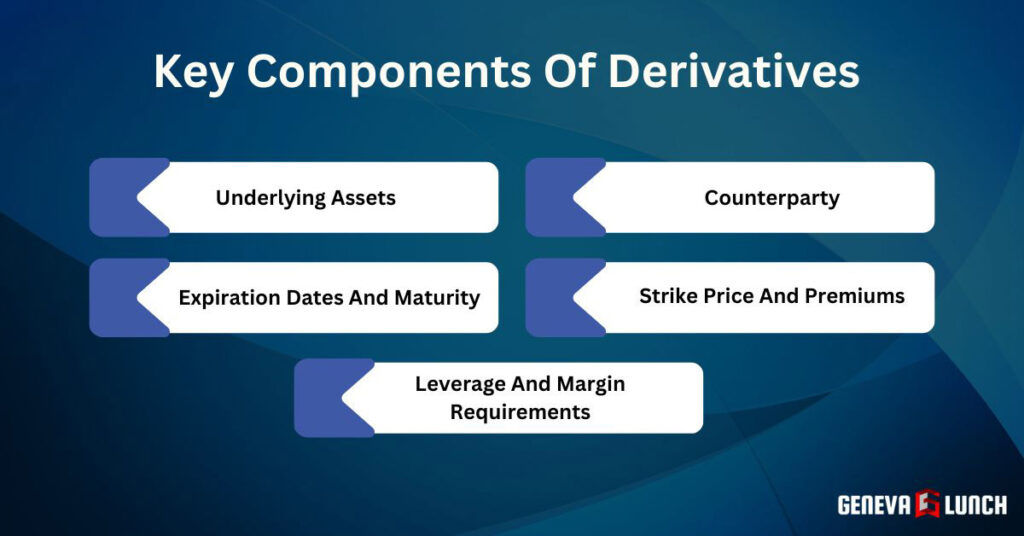
Derivatives have key parts that explain how they work. These parts affect the value and risks of a derivative. Each component is important to understand before using or trading derivatives. They include the underlying asset, the counterparty, expiration dates, strike price, premiums, leverage, and margin. Knowing these terms will help in understanding how these contracts are used in finance.
Underlying Assets
The underlying asset is the base for a derivative. It is the main thing that gives the derivative its value. Common examples of underlying assets are stocks, bonds, currencies, or commodities like oil or gold.
For example, if you have a derivative tied to the price of gold, the value of that derivative will go up or down based on gold’s price. Without the underlying asset, a derivative has no value. It depends fully on changes in the asset’s price.
Counterparty
The counterparty is the person or group on the other side of the derivative contract. In every derivative deal, two parties agree on the terms. The counterparty can be a bank, an investor, or a company.
Each party in the contract has certain rights and responsibilities. When one side does not follow the rules of the contract, it can create a risk for the other side. This is called “counterparty risk.” Counterparty risk is important because if the other party fails to deliver, you may lose money.
Expiration Dates And Maturity
Every derivative contract has an expiration date. This is the date when the contract ends. After this date, the contract is no longer valid. The time between when the contract is made and its expiration date is called its maturity.
For example, if you buy a derivative today with an expiration date six months from now, its maturity is six months. The expiration date is important because it affects the value of the contract. As the expiration date gets closer, the value may change based on how the underlying asset performs.
Strike Price And Premiums (For Options)
In options contracts, the strike price is the agreed price at which you can buy or sell the underlying asset. For example, if the strike price of a stock option is $50, you have the right to buy or sell the stock at $50, no matter what the actual market price is.
The premium is the cost you pay to own the option. It is like a fee. The higher the chance of the option being valuable, the higher the premium will be. The strike price and premiums are key details that affect whether the option is a good deal for the buyer.
Leverage And Margin Requirements
Leverage allows you to control a large amount of an asset with a smaller investment. For example, with leverage, you can control $10,000 worth of an asset by only putting down $1,000. This is helpful because it can increase your profits if the asset goes up in value.
However, it can also increase your losses if the value drops. Margin is the money you must put down to use leverage. Margin requirements are rules set by brokers to limit the amount of risk involved. Leverage and margin help people trade derivatives without needing large amounts of money upfront.
Types Of Derivatives
There are different types of derivatives used in finance. Each type has its own rules and purpose. The main types of derivatives are futures, options, swaps, forwards, and credit derivatives. Each of these helps people and businesses manage risk or make profits.
Futures Contracts
Futures contracts are agreements to buy or sell an asset at a future date for a set price. Both parties must follow the contract, no matter what happens to the price of the asset. For example, a farmer might use a futures contract to sell wheat at a fixed price, even if the market price changes later.
This helps the farmer know how much they will earn. Futures are traded on exchanges, and they are used for commodities like oil, wheat, and gold. Futures help protect against price changes, making them a useful tool for planning.
Options Contracts
Options contracts give the buyer the right, but not the obligation, to buy or sell an asset at a set price before a certain date. There are two types of options: call options and put options. A call option allows you to buy an asset, while a put option lets you sell it.
For example, if you have a call option for a stock at $100, you can buy the stock at that price, even if the market price goes up to $120. You must pay a premium to own the option, but you are not required to use it. Options provide flexibility for investors.
Swaps
Swaps are agreements between two parties to exchange cash flows or payments. The most common type of swap is an interest rate swap. In this swap, one party agrees to pay a fixed interest rate, while the other pays a floating rate. Swaps can also be used to exchange currencies or commodities.
For example, a company with a loan that has a floating interest rate might enter a swap to change it to a fixed rate. This helps the company know how much it will pay over time, reducing the risk of rising interest rates.
Forwards
Forwards are similar to futures contracts, but they are not traded on exchanges. They are private agreements between two parties. A forward contract sets the price to buy or sell an asset on a specific future date. Unlike futures, forwards are customizable.
This means the two parties can agree on the terms, such as the amount of the asset and the delivery date. For example, a company may use a forward contract to lock in the price of a currency for a future transaction. Forwards are useful for businesses that need to plan for future costs.
Credit Derivatives
Credit derivatives help manage the risk of a borrower not paying back a loan. The most common type is a credit default swap (CDS). In a CDS, one party agrees to pay the other if a borrower defaults on a loan.
For example, a bank might use a CDS to protect itself from losing money if a company fails to repay its debt. When the company defaults, the other party in the CDS will pay the bank. Credit derivatives are useful tools for managing credit risk in financial markets.
How Do Derivatives Work?

Derivatives work by getting their value from an underlying asset. The contract is based on the price of this asset. Derivatives are used for different reasons, like managing risk or making a profit. To understand how derivatives work, it’s important to know how pricing is decided, how the underlying asset affects the value, and what risks come with the counterparty.
Pricing Mechanisms
The price of a derivative is based on the price of the underlying asset. Several factors influence the price of a derivative. These include the current price of the asset, the time until the contract expires, and the level of risk.
For example, in a futures contract for oil, the price is set based on today’s oil price and how much time is left before the contract ends. The longer the time to expiration, the more the price may change. Derivatives can be more or less valuable depending on these factors.
Role Of Underlying Assets
The underlying asset is what gives a derivative its value. When the price of the underlying asset changes, the value of the derivative changes too. For example, in an options contract for a stock, the price of the stock is the key factor that affects the value of the option.
When the stock price goes up, a call option may become more valuable. When it goes down, a put option could be worth more. The underlying asset is always the main driver of a derivative’s value, and without it, the derivative has no worth.
Counterparty Risk
Counterparty risk is the chance that the other party in a derivative contract will not meet their obligations. This means one side of the deal may not follow through, causing the other side to lose money. For example, if two parties enter a forward contract, and one side cannot pay when the contract ends, the other party faces a loss.
This risk is higher in private contracts, like forwards, because they are not regulated by exchanges. Managing counterparty risk is important in derivative contracts to avoid unexpected losses.
Pricing Of Derivatives
The pricing of derivatives is important for both buyers and sellers. Different models and methods are used to calculate the price of a derivative. Accurate pricing helps investors know the value of their contracts. Some common methods for pricing derivatives are the Black-Scholes Model, the Binomial Option Pricing Model, Mark-to-Market valuation, and the Greeks in options pricing.
Black-Scholes Model
The Black-Scholes Model is a formula used to calculate the price of options. It uses several factors to find the price, like the current price of the asset, the time until the option expires, and the volatility of the asset’s price.
This model is very popular because it is simple and gives a clear price for an option. For example, the Black-Scholes Model might be used to calculate the value of a stock option based on the stock’s current price and how much time is left until the option expires.
Binomial Option Pricing Model
The Binomial Option Pricing Model is another way to find the price of an option. It looks at the possible future prices of the underlying asset at different points in time. The model breaks down time into small steps and calculates the price at each step.
This method helps show how the price of the option could change as the price of the asset moves up or down. It is a step-by-step process that helps investors understand how the value of the option may vary over time.
Mark-to-Market Valuation
Mark-to-Market Valuation is a method used to measure the current value of a derivative. It updates the value of the contract based on the market price of the underlying asset. For example, if you own a futures contract for oil and the price of oil goes up, the value of your contract will increase.
This method ensures that the value of the contract is always in line with the current market price. It is often used in financial markets to keep track of how much a contract is worth on any given day.
Greeks In Options Pricing
The Greeks are important tools used to understand how different factors affect the price of an option. The most common Greeks are Delta, Gamma, Theta, Vega, and Rho. Each Greek measures a different risk. For example, Delta shows how much the price of an option will change when the price of the underlying asset changes.
Theta shows how time affects the option’s price. These tools help traders manage the risks involved in options trading by showing how different factors like price and time can change the value of an option.
Applications Of Derivatives
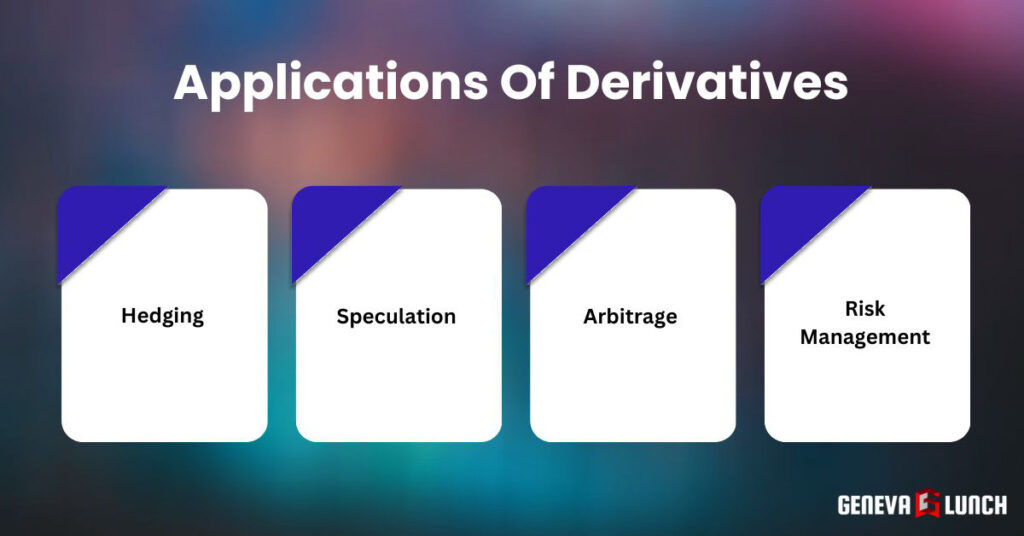
Derivatives are used for many purposes in finance. They help businesses and investors manage risks or make profits. The main uses of derivatives include hedging, speculation, arbitrage, and risk management. Each application has a specific goal. These tools are important in financial markets because they allow people to protect against price changes or take advantage of market movements.
Hedging
Hedging is when a person or business uses a derivative to protect against changes in prices. For example, a farmer might use a futures contract to lock in the price of wheat before the harvest. This way, even if the price of wheat falls later, the farmer will still get the agreed price.
Hedging reduces risk by setting a fixed price for an asset. Many companies use hedging to protect themselves from changes in prices, interest rates, or currencies. It is one of the most common uses of derivatives.
Speculation
Speculation is when investors use derivatives to try and make a profit from price changes. They do not own the underlying asset but bet on its future price. For example, a trader might buy an option for a stock, hoping the price will go up.
When the price does go up, the trader can make a profit. Speculation involves more risk because prices can go up or down. However, it can also lead to big rewards if the investor predicts the market correctly.
Arbitrage
Arbitrage is when traders use derivatives to make a profit from price differences in different markets. For example, if a stock is priced differently in two markets, a trader can buy the stock in the cheaper market and sell it in the more expensive one.
This difference in prices creates an opportunity to earn money. Arbitrage helps keep prices in line across markets because traders take advantage of these small differences. It is a way to make profits without taking on too much risk.
Risk Management
Risk management is a key reason why businesses use derivatives. Derivatives allow companies to reduce the risk of price changes, interest rate changes, or currency movements. For example, a company that buys goods from another country might use a currency swap to protect against changes in exchange rates.
By using derivatives, businesses can plan for the future without worrying about unexpected price changes. This helps companies stay stable and avoid large losses. Risk management is important for long-term success in business.
Risks Associated With Derivatives
Derivatives come with different risks. It is important to understand these risks before using or trading derivatives. Some of the main risks are market risk, credit risk, liquidity risk, leverage risk, and systemic risk. Each risk affects the value of a derivative or the chances of losing money. Knowing these risks helps investors and businesses make better decisions when using derivatives in financial markets.
Market Risk
Market risk is the risk that the price of the underlying asset will change. When the price moves in the wrong direction, the value of the derivative can drop. For example, if you own a futures contract for oil and the price of oil goes down, the value of your contract will also go down.
Market risk is common in all types of derivatives because prices of assets can go up or down based on economic factors. This makes market risk one of the biggest risks in derivatives trading.
Credit Risk
Credit risk is the chance that the other party in a derivative contract will not be able to meet their obligations. For example, if you enter a forward contract with another company, and they go bankrupt, they might not be able to pay you when the contract expires. This creates a loss for you.
Credit risk is higher in private contracts, like forwards, where there is no central exchange to guarantee the contract. Managing credit risk is important to avoid losing money in these situations.
Liquidity Risk
Liquidity risk is the risk that you may not be able to sell or buy a derivative easily. When there are not enough buyers or sellers in the market, it can be hard to close your position.
For example, if you own a derivative contract and no one wants to buy it, you might be stuck with it, even if its value is falling. Liquidity risk can make it harder to exit a trade quickly and can result in losses if the market is not active enough.
Leverage Risk
Leverage risk is the risk that comes from using borrowed money to trade derivatives. Leverage allows you to control a large position with a small amount of money, but it also increases your risk.
For example, if the price of the underlying asset moves against you, you can lose more money than you originally invested. Leverage can lead to big profits, but it can also lead to big losses. Managing leverage is important to avoid losing more than you can afford.
Systemic Risk
Systemic risk is the risk that problems in one part of the financial system will affect the entire system. For example, if a large bank fails because of bad derivative trades, it can cause other banks and markets to fail as well. This risk is especially high with complex derivatives that are tied to many parts of the financial system.
Systemic risk can lead to large financial crises, which affect not only investors but also the broader economy. Managing systemic risk is crucial to avoid major market failures.
Advantages Of Derivatives
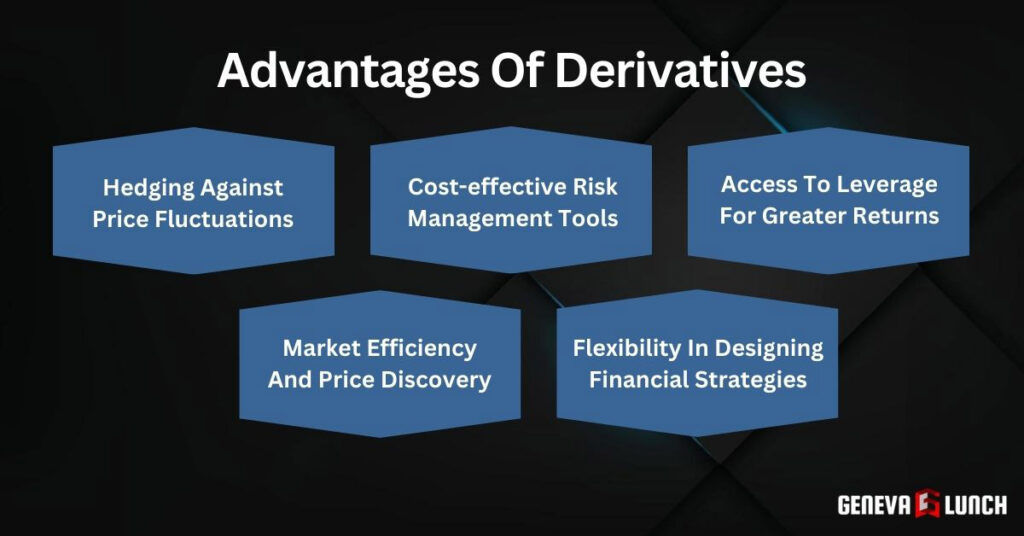
Derivatives offer many benefits in the world of finance. They help businesses and investors manage risks and improve profits. One of the biggest advantages of derivatives is their ability to protect against price changes. They also allow for greater flexibility in trading and investment strategies. Derivatives provide a cost-effective way to manage financial risks, and they help make markets more efficient. These benefits make derivatives a popular tool in global financial markets.
Hedging Against Price Fluctuations
One of the main advantages of derivatives is their ability to hedge against price changes. For example, if a company knows the price of oil might go up, it can use a futures contract to lock in the current price.
This protects the company from paying more in the future. Hedging is a key use of derivatives because it helps businesses and investors avoid large losses when prices change. This makes derivatives a valuable tool for planning and managing risk.
Cost-effective Risk Management Tools
Derivatives offer a cost-effective way to manage risk. Instead of buying large amounts of the underlying asset, companies can use derivatives to protect against price changes without having to invest as much money. For example, a company can use an option to control the price of a stock without having to buy the stock itself.
This saves money and reduces the amount of capital needed. Derivatives make it easier for businesses to protect themselves from risk without large upfront costs.
Access To Leverage For Greater Returns
Derivatives allow investors to use leverage, which means controlling a large position with a small amount of money. For example, by using leverage, an investor can control $10,000 worth of assets with only $1,000. This gives the chance for greater returns if the market moves in their favor.
However, it is important to remember that leverage also increases the risk of losses. Despite this, the access to leverage is one reason why derivatives are attractive to investors looking for higher profits.
Market Efficiency And Price Discovery
Derivatives help make markets more efficient. They allow traders to quickly react to changes in the market, which helps keep prices accurate. For example, if the price of oil is expected to rise, traders can use oil futures to adjust prices in the market.
This process is called price discovery, and it helps make sure that prices in the market reflect the true value of the assets. By using derivatives, markets can adjust to new information faster, making them more efficient overall.
Flexibility In Designing Financial Strategies
Derivatives give businesses and investors flexibility in designing their financial strategy. There are many different types of derivatives, like options, futures, and swaps, and each can be tailored to meet specific needs.
For example, an investor can use a combination of options and futures to create a strategy that protects against losses while allowing for potential gains. This flexibility makes derivatives a useful tool for managing risk and taking advantage of market opportunities.
Disadvantages Of Derivatives
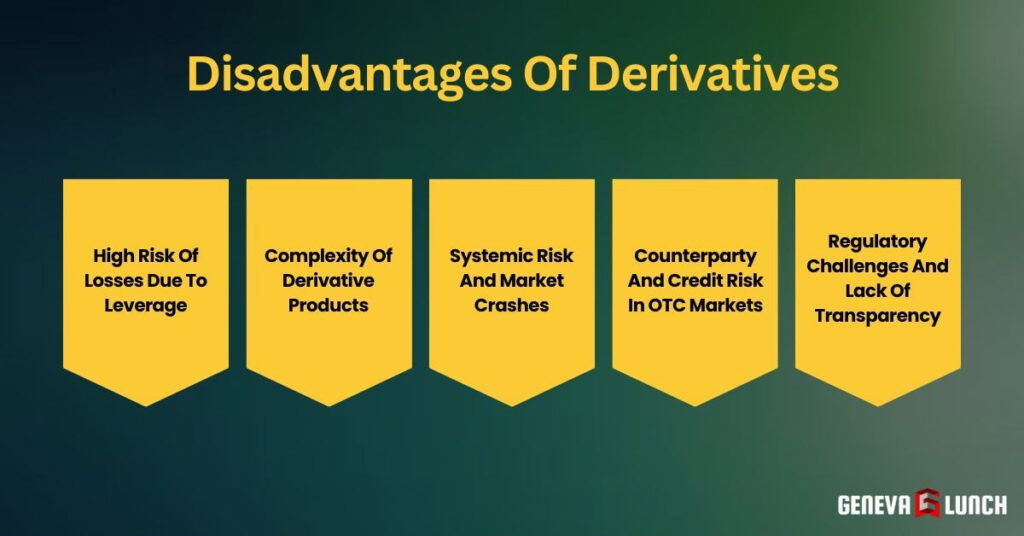
While derivatives offer many benefits, they also come with some disadvantages. These risks can lead to large losses if not managed carefully. Derivatives can be complex, and not all investors fully understand how they work. They also carry the risk of market crashes and problems between the parties involved. It is important to know the downsides before using derivatives in trading or business.
High Risk Of Losses Due To Leverage
Leverage can increase profits, but it also increases the risk of large losses. Since leverage allows investors to control large amounts of an asset with a small investment, even a small change in the price can result in big losses.
For example, if an investor uses $1,000 to control $10,000 in assets, a 10% drop in price could wipe out the entire investment. The risk of losing more money than initially invested is one of the biggest disadvantages of using derivatives.
Complexity Of Derivative Products
Derivatives are often very complex financial products. They have many components, and it can be difficult to fully understand how they work. For example, an options contract might have terms that are hard to follow for someone who is new to trading.
The complexity of derivatives means that investors need a deep understanding of the market and the product. Without this knowledge, it is easy to make mistakes that can lead to losses.
Systemic Risk And Market Crashes
Derivatives can contribute to systemic risk, which is the risk of the entire financial system being affected. For example, during the 2008 financial crisis, derivatives like credit default swaps played a major role in causing market crashes.
When a large company or bank fails because of bad derivative trades, it can affect other parts of the market. This can lead to widespread problems and even economic crises. Systemic risk is a serious concern in the world of derivatives.
Counterparty And Credit Risk In OTC Markets
Over-the-counter (OTC) derivatives are private contracts between two parties. In these markets, there is no central exchange to guarantee the contract. This creates counterparty risk, which is the chance that one party will not fulfill their side of the deal.
For example, if one party goes bankrupt, the other may not get paid. This credit risk makes OTC derivatives riskier than those traded on exchanges. It is important to understand who you are dealing with in OTC markets to avoid losing money.
Regulatory Challenges And Lack Of Transparency
Some derivatives markets are not well-regulated, which can lead to a lack of transparency. In some cases, it can be hard to know the true value of a derivative or the risks involved.
This is especially true in OTC markets, where trades are made privately between parties. The lack of clear regulations makes it harder for investors to trust the market. Regulatory challenges can create risks and make it more difficult to manage the safety of derivative trading.
FAQs
1. How To Trade Derivatives?
To trade derivatives, you need to open an account with a broker that offers derivative trading. You can choose between different types, like futures, options, or swaps. First, you need to decide on the underlying asset. Then you need to place your trade based on your view of the asset’s price movements.
2. Are Derivatives More Risky Than Stocks Or Bonds?
Yes, derivatives are usually more risky than stocks or bonds. This is because derivatives often involve leverage, which means you can lose more money than you invest. Also, the value of derivatives depends on the price of another asset, so they can be harder to predict.
3. Is An Equity Option A Derivative Investment?
Yes, an equity option is a type of derivative investment. It gives you the right, but not the obligation, to buy or sell a stock at a certain price before a specific date. The value of the option depends on the price of underlying stock. As it gets its value from the stock, it is considered a derivative.
4. Where Are Derivatives Sold?
Derivatives are sold in two main places: exchanges and over-the-counter (OTC) markets. On exchanges, like the Chicago Mercantile Exchange (CME), derivatives are traded publicly and have standard terms. In OTC markets, derivatives are traded privately between two parties and can have customized terms.
5. What Role Do Derivatives Play In Corporate Finance?
In corporate finance, derivatives help companies manage risk. Companies use derivatives to protect themselves from changes in prices, interest rates or exchange rates. This helps the companies plan for the future and also helps in avoiding any unexpected financial losses caused by the market changes.
Conclusion
Derivatives are powerful financial tools that help businesses and investors manage risks and take advantage of price changes. By understanding the different types, such as futures, options, and swaps, individuals can use derivatives to protect themselves from market uncertainties or increase their potential returns. With the right knowledge, derivatives can be an effective part of any financial strategy.