Financial Advisor Vs Robo Advisor (10 Key Differences)

When deciding how to handle your money, you may wonder if you should choose a financial or robo advisor. Each option has its benefits. Hence, what are the differences between a financial advisor vs robo advisor?
Both offer investment guidance, but a financial advisor provides personalized advice tailored to individual needs. Robo advisors offer automated, cost-effective solutions ideal for those with straightforward financial goals. Choose based on your financial complexity and personal preference.
Both options offer benefits, but the best choice depends on your needs and how complex your financial situation is. Let’s explore how each can help you grow your wealth.
Key Takeaways
- Personalized Guidance: Financial advisors provide bespoke advice tailored to individual financial goals and complex needs.
- Comprehensive Planning: Financial advisors offer strategic planning, including retirement, estate, and tax considerations.
- Cost Efficiency: Robo advisors deliver automated investment services at a lower cost than traditional financial advisors.
- Simplicity And Speed: Robo advisors quickly manage investments using algorithms, ideal for straightforward portfolios.
- Accessibility: Robo advisors are available 24/7, making it easy for investors to access their accounts and make adjustments.
What Does A Financial Advisor Do?

A financial advisor helps you manage money, plan for the future, and make smart financial decisions. They look at your complete financial picture and give personalized advice. Here are 6 key areas where financial advisors help:
Estate Planning
Estate planning involves making decisions about how your assets will be handled when you pass away. A financial advisor helps create a plan to protect your wealth and ensure your wishes are followed. They can help you set up wills, trusts, and beneficiary designations to minimize taxes and legal issues for your heirs.
Risk Management
Managing risk means protecting your finances from unexpected events like illness, accidents, or loss of income. Financial advisors help you identify potential risks and recommend insurance or investment strategies to protect you and your family. This may include health insurance, life insurance, or disability coverage.
Investment Management
Financial advisors help you build and manage an investment portfolio that matches your goals and risk tolerance. They advise on what to invest, when to buy or sell, and how to balance risk and returns. Advisors also monitor your portfolio, adjusting based on market changes or life events.
Retirement Planning
Planning for retirement is a major part of financial advising. Advisors help you figure out how much money you need to retire and how to save for it. They create a strategy that might include 401(k) plans, IRAs, and other retirement accounts, ensuring you stay on track for a comfortable retirement.
Education Planning
Education planning is about setting aside money for college. A financial advisor helps you understand options like 529 plans and other saving strategies. They work with you to save enough to give your children or grandchildren the best start without leaving them in debt.
Financial Planning
Financial planning pulls everything together. A financial advisor creates a full plan based on your life goals. They look at your income, debts, savings, and spending to advise on reaching your financial goals, whether it’s buying a home, saving for college, or retiring comfortably.
What Does A Robo Advisor Do?
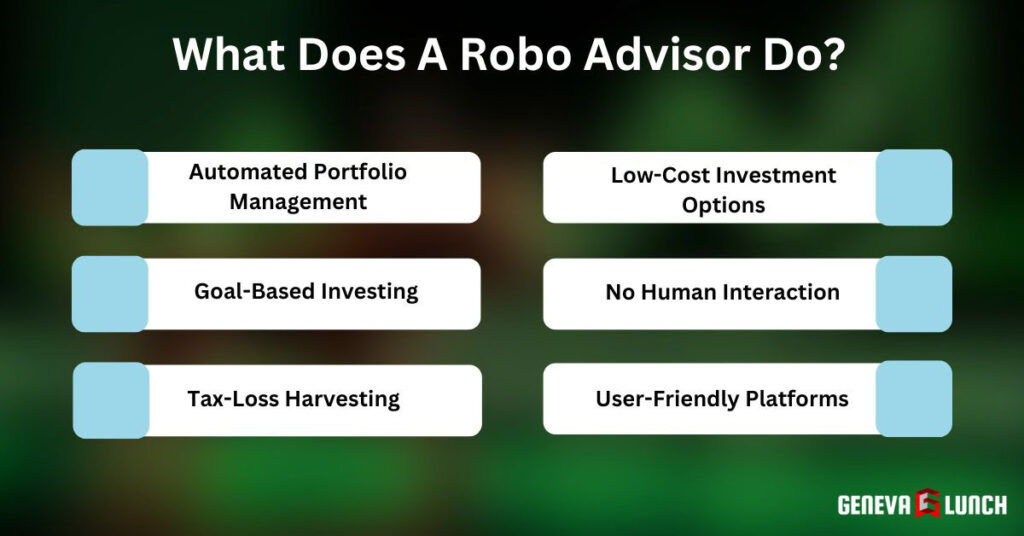
A robo advisor is a digital platform that manages your money using computer algorithms. Unlike a human financial advisor, a robo advisor uses data and technology to make investment choices.
Automated Portfolio Management
Robo advisors create and keep your investment portfolio on track. They use algorithms to pick investments that match your goals and how much risk you want to take. The robo advisor adjusts your investments, buying or selling stocks, to keep everything balanced.
Low-Cost Investment Options
One big advantage of robo advisors is they charge less than human financial advisors. They offer services at a low fee because they use technology instead of expensive human labor. This makes it easier for more people to start investing, even with a small amount of money.
Goal-Based Investing
Robo advisors focus on helping you meet specific financial goals. Whether you’re saving for a house, retirement, or college, tell the robo advisor your target, and it designs a plan to get you there. It selects investments that fit your timeline and risk level, adjusting them as you approach your goal.
No Human Interaction
Robo advisors operate without human help. This means you don’t get to talk to someone for financial advice. While this could be a drawback for some, it’s perfect for investors who prefer a hands-off approach. You rely on the system to manage your money based on the rules it follows.
Tax-Loss Harvesting
Robo advisors can also help you save money on taxes. They use a strategy called tax-loss harvesting, which involves selling investments that are losing money to offset the taxes on gains from other investments. This can help reduce your tax liability, boosting your overall returns.
User-Friendly Platforms
Robo advisors are known for their easy-to-use interfaces. These platforms make it simple to set up an account and start investing. They often come with tools and visual aids to help you understand your investments and track your progress toward your financial goals.
Financial Advisor Vs. Robo Advisor: Key Differences
Choosing between a financial advisor and a robo advisor depends on your needs and preferences for managing finances. Financial advisors provide personalized advice and services, while robo advisors offer automated, algorithm-driven investment management. Here’s a comparison to help you understand their key differences:
| Feature | Financial Advisor | Robo Advisor |
| Scope of Services | It offers many services, including estate planning, retirement planning, and more. | Focuses mainly on investment management. |
| Client Relationships | Builds personal relationships through direct contact and meetings. | Interaction is primarily digital, with limited human contact. |
| Compensation Structure | Charges fees based on assets under management, hourly rates, or fixed costs. | Usually, it charges a lower percentage of assets under management. |
| Regulatory Oversight | Subject to comprehensive regulatory oversight by bodies like the SEC. | It is also regulated, but the focus is more on data security and algorithmic trading. |
| Decision-Making Authority | Clients may delegate decision-making authority or collaborate on decisions. | Clients delegate all decision-making to the automated systems. |
| Educational Requirements | Typically required to have financial certifications and degrees. | Operates on algorithms developed by financial and software experts. |
| Investment Strategy | Can tailor strategies to the client’s unique financial situation and preferences. | Uses predefined algorithms to manage investments based on the client’s risk profile. |
| Ongoing Support | Provides ongoing personalized support and can adapt strategies over time. | Offers limited support, mostly automated or through customer service centers. |
| Customization | High level of customization in portfolio management and financial planning. | Limited customization based on selected investment models. |
| Fiduciary Responsibility | Often has a fiduciary duty to act in the client’s best interest. | They may not always have fiduciary responsibilities but focus on efficient portfolio management. |
Financial Advisor Vs. Robo Advisor: Similarities

Both financial advisors and robo advisors aim to help you with your money. They both offer investment guidance. They follow the rules set by monetary authorities. This ensures they operate fairly and legally.
Client-Centered Services
Whether you choose a financial advisor or a robo advisor, the services you receive focus on your needs. Financial advisors meet with you to understand your financial goals and help plan your financial future.
Robo advisors use your online information to suggest the best investments for you. Both aim to offer solutions that fit your life and goals.
Regulatory Compliance
Financial advisors and robo advisors must follow strict rules. These rules are made by groups that oversee the financial market.
They ensure that both types of advisors act in the best interest of their clients and operate transparently. This means they must be honest about their services and any fees they charge.
Ethical Standards
High ethical standards are critical for both financial advisors and robo advisors. They must act in your best interest and offer advice based on your financial situation. They are not allowed to suggest investments that benefit them more than you. Trust is a big part of their job.
Investment Guidance
Both types of advisors offer guidance on financial investment to help your money grow. Financial advisors engage directly with you to identify the best investments that match your life, needs, and risk tolerance.
Robo-advisors follow a similar path but leverage computer programs to analyze your data and recommend investments tailored to your financial goals.
Holistic Planning
Holistic planning considers all parts of your financial life. Financial advisors help plan your financial future, including savings, investments, insurance, and retirement planning.
Robo advisors offer a more focused approach, typically centering on investments but still considering your overall financial goals. Both methods aim to help you achieve financial stability and growth.
When To Choose A Financial Advisor?

Choosing a financial advisor is best when you need expert advice tailored to your unique financial situation. They work closely with you to understand your financial goals and create strategies that help you meet them. Here’s when you should consider hiring a financial advisor:
Complex Financial Situations
When your financial life has many moving parts, a financial advisor can help you understand it. They handle complex cases involving multiple income streams, large investments, or planning for your future needs.
For example, if you own a business or have various assets, a financial advisor can help you manage them effectively.
Debt Management
Managing debt is crucial for financial health. A financial advisor for debt management can offer strategies to reduce or eliminate debt. They can suggest ways to consolidate loans or adjust your budget to handle your debts better. This guidance is especially helpful if you have high-interest debts or need help to balance multiple repayments.
Wealth Management
Wealth management is essential for those with significant assets. A financial advisor provides services that help you grow your wealth, protect it, and plan its distribution in the future. They can advise on investments, estate planning, and even charitable giving, ensuring that your wealth aligns with your long-term visions and values.
Education Funding
Planning how to pay for education, whether it’s for you or your children, can be challenging.
Financial advisors develop savings plans, like 529 plans, and other investment strategies to fund educational expenses. They help ensure you can afford these costs without sacrificing other financial goals.
Tax Planning
Taxes can take a big chunk out of your earnings and savings. A financial advisor can show you how to plan and save on taxes. They keep up with the latest tax laws and can suggest ways to minimize liabilities through deductions, tax-efficient investments, and timing of income and purchases.
Investment Planning
Investing is a powerful way to grow your money, but it can be complex. A financial advisor helps you understand different investment options and their associated risks.
They create a personalized investment plan based on your risk tolerance and financial goals. This plan can include stocks, bonds, mutual funds, or other investment vehicles suited to your needs.
When To Choose A Robo Advisor?
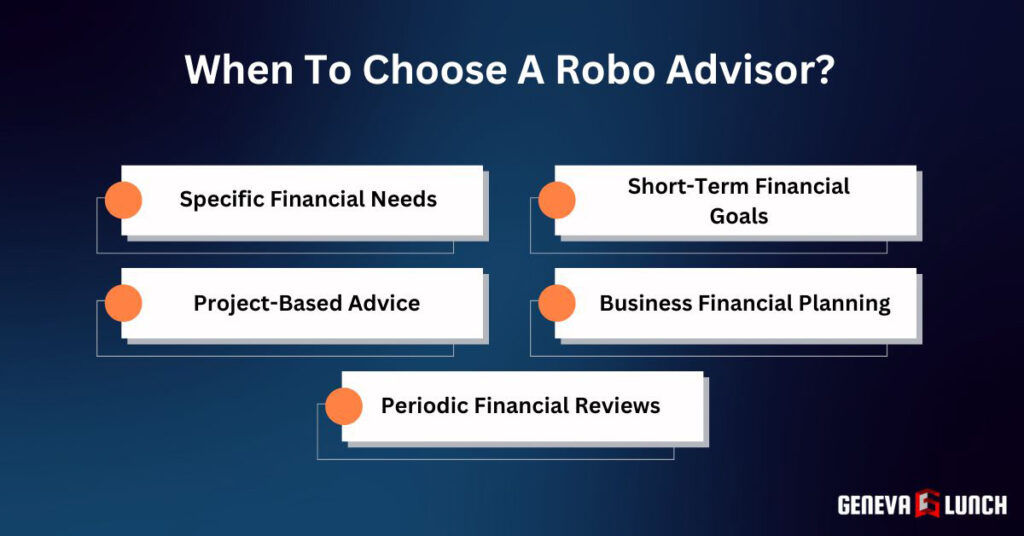
Choosing a robo advisor is smart when you need quick, straightforward advice at a low cost. These digital platforms use computers to manage your investments. They are best for those with simple financial needs or new investors.
Specific Financial Needs
A robo advisor could be a great choice if your financial needs are simple. They are good for saving for a goal or investing a small amount. These advisors can quickly set up a plan based on your input.
They manage your investments with proven rules and algorithms. This keeps you on track without needing frequent check-ins.
Short-Term Financial Goals
For goals you want to reach soon, like saving for a vacation or a big purchase within a few years, robo advisors can help. They excel at setting up portfolios that aim for short-term gains.
Their automated systems adjust your investments to meet your timeline. They are an efficient tool for short-term planning.
Project-Based Advice
When you need advice for a specific project, such as saving for a wedding or starting a large home improvement, robo advisors can offer guidance. Robo advisors have clear, limited goals. Their algorithms can direct your funds to meet these goals without needing ongoing advice.
Business Financial Planning
Small business owners who need straightforward financial planning can benefit from robo advisors. These services can manage business-related investment accounts, help set aside money for business expansion, or manage cash reserves efficiently without the complexities of a personalized financial planner.
Periodic Financial Reviews
Robo advisors are ideal for periodic, not continuous, financial reviews. Many platforms offer tools that allow you to check the progress of your investments at any time. This feature suits those who want a hands-off approach. They still want occasional updates to ensure everything is on track.
Can You Use Both?
Yes, you can use both a financial advisor and a robo advisor. This combination helps you manage your money well, combining the strengths of both types of advisors.
Complementary Roles
Financial advisors and robo advisors can work together very well. A financial advisor talks to you to understand your needs and make a plan that fits your life. They help with big money decisions and explain things you might not know much about.
On the other hand, a robo advisor takes care of your investments every day. It uses computers to decide the best way to manage your money. This setup means you get custom advice and smart, quick investment handling at once.
Layered Protection
Using both kinds of advisors also adds layered protection to your finances. The financial advisor looks at the big picture and can steer you away from risky choices. They help you plan for long-term goals like retirement or buying a house.
Meanwhile, the robo advisor works to protect and grow your investments. It reacts fast to market changes, so your investments are constantly watched and adjusted, keeping your money safer.
Diverse Expertise
With both a financial advisor and a robo advisor, you benefit from diverse expertise. The financial advisor knows much about different financial areas like taxes, estate planning, and insurance. They bring a human touch and can understand complex situations.
The robo advisor brings speed and handles data well. It ensures that your portfolio is balanced and fits your risk level. Together, they cover all aspects of managing your money, ensuring that you have the best advice and tools working for you.
FAQs
Is A Financial Advisor Better Than A Robo Advisor?
Choosing between a financial advisor and a robo-advisor depends on your needs. A financial advisor offers personalized guidance, which is ideal for complex financial situations. While, robo-advisors provide automated, cost-effective investment management suitable for straightforward portfolios.
What Should I Consider When Choosing Between A Financial Advisor And A Robo Advisor?
When choosing between a financial advisor and a robo advisor, consider your financial goals, need for personalized advice, investment complexity, and cost preferences. Financial advisors offer tailored guidance, while robo advisors provide cost-effective, automated investment services.
How Do I Know If A Financial Advisor Or Robo Advisor Is Right For Me?
Evaluate your financial goals and service preferences. A financial advisor is ideal if you need personalized, comprehensive advice and have complex financial situations. Conversely, if you prefer affordable, automated investment management with lower fees, a robo advisor may better suit your needs.
Can A Financial Advisor Also Be A Robo Advisor?
Yes, a financial advisor can also be a robo advisor. Robo advisors use algorithms to manage investments automatically. Some financial advisors offer robo advisory services, combining personal guidance with automated management to provide clients with human expertise and efficient technology.
How Do Financial Advisors And Robo Advisors Charge For Their Services?
Financial advisors typically charge fees based on a percentage of assets managed, hourly rates, or flat fees for personalized advice and comprehensive planning. In contrast, robo advisors usually charge lower fees as a percentage of assets, offering automated investment management at reduced costs.
Final Word
Choosing between a financial advisor and a robo advisor depends on your needs. A financial advisor is a good choice if you value personalized advice and have a complex economic situation. They guide you through big decisions and plan for your future.
When you prefer a more hands-off approach or have more straightforward needs, a robo advisor can be a great option. They handle your investments using innovative technology and usually cost less.
Consider what you need from your financial services to make the best choice for your money.