Return On Investment (ROI): Maximizing Business Returns
Every business wants to grow and earn more money. Return on Investment, or ROI, helps you see how well your money works.
Return On Investment (ROI) effectively measures how profitable an investment is by comparing its gains to its costs. It helps investors determine the efficiency of their investments and make informed financial decisions. Calculating ROI involves dividing net profit by total investment costs.
With ROI, you can turn your ideas into real success. Start maximizing your business returns today with easy and straightforward strategies.
Key Takeaways
- ROI Calculation: Determine ROI by dividing net profit by the initial cost, providing a clear financial performance indicator.
- Investment Comparison: ROI helps compare the efficiency of different investments, guiding more informed financial decisions.
- Performance Metric: Use ROI to assess the effectiveness of business strategies and operational changes over time.
- Risk Assessment: Incorporate ROI to evaluate potential risks and returns, enhancing strategic investment planning.
- Long-term Planning: ROI is crucial for long-term financial planning, helping businesses allocate resources effectively.
What Is Return On Investment (ROI)?
Return on Investment, or ROI, is a way to measure how well a business is doing with the money it spends. Think of it like this: ROI tells you how good you were at doing that if you use your own money to make more money. It helps business owners see if the money they put into a project, like buying new equipment or advertising, helped them make more money. It’s a simple number that shows if an investment was worth it.
How To Calculate ROI?
Calculating ROI is very easy. To calculate Return on Investment (ROI), follow these simple steps:
- Subtract the Final Value from the Initial Value: First, find out how much the investment is worth at the end (final value) and subtract the amount you initially paid for it (initial value).
- Divide by the Initial Value: Take the result from step one and divide it by the initial value of the investment. This calculates how much you gained relative to your starting point.
- Multiply by 100 to Get a Percentage: To turn that figure into a percentage, multiply it by 100. This percentage is your ROI.
Here’s the formula: ROI=(Final Value−Initial ValueInitial Value)×100\text{ROI} = \left(\frac{\text{Final Value} – \text{Initial Value}}{\text{Initial Value}}\right) \times 100 ROI=(Initial ValueFinal Value−Initial Value)×100
For example, if you bought stock for $100 and sold it for $150, your ROI would be: ROI=(150−100100)×100=50%\text{ROI} = \left(\frac{150 – 100}{100}\right) \times 100 = 50\%ROI=(100150−100)×100=50%
This calculation gives you a clear idea of how effective your investment has been in terms of generating returns.
What Factors Influence ROI?
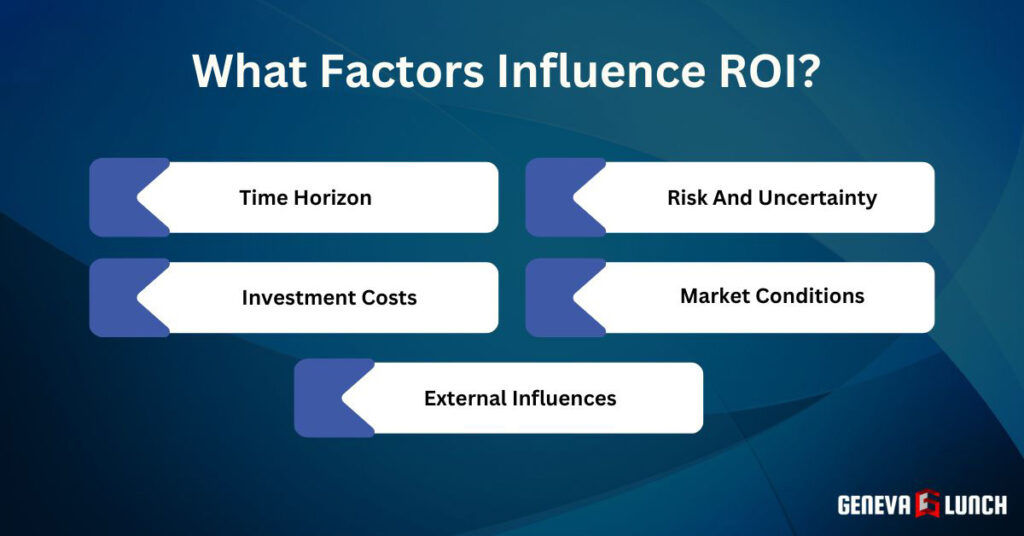
ROI measures how well a company turns investments into profits. This simple yet powerful tool can guide businesses in making profitable decisions. Many factors can affect ROI, including the investment’s timing and market conditions. Understanding these elements enables enterprises to achieve maximum returns and develop strategic plans.
Time Horizon
The time horizon refers to when an investment is made and the returns are realized. Short-term investments show quick profits but involve higher risk. On the other hand, long-term investments usually grow steadily. They benefit from compounded growth and a better market. To boost ROI, businesses must align their investment horizons with their goals.
Risk And Uncertainty
Risk and uncertainty are inherent in any investment. Higher risks often offer the potential for higher returns but can also lead to significant losses. Businesses must assess the risk level they can tolerate. They must also stay agile and ready to adapt strategies as market conditions or external factors change.
Investment Costs
The initial and ongoing costs associated with an investment significantly influence its ROI. Lower costs usually mean it is easier to achieve a positive ROI.
Businesses must consider direct costs, like the purchase price, and indirect costs, like maintenance and operating costs. Effective cost management can substantially improve investment returns.
Market Conditions
Financial markets and market conditions significantly affect ROI. The economy’s performance, industry growth, and customer preferences can change an investment’s profits.
For example, investing in technology can bring high returns during a tech boom but earn less during a downturn. Businesses must watch financial markets and adjust their investment strategies to achieve the best ROI.
External Influences
Changes in regulations, politics, and the economy can impact ROI. Regulations might increase costs or open new opportunities. Political and economic stability can encourage investment by providing a predictable environment.
Companies must stay informed about external factors and use this knowledge in their investment decisions. This will help protect and improve their ROI.
Benefits Of Using ROI
Return on Investment (ROI) is a powerful tool in business. It measures how much money you make from an investment compared to your spending. Companies use ROI to decide how to spend their money and see if their choices work well.
Applicable Across Multiple Investments
ROI works for all types of investments. Whether a company spends money on new technology, marketing campaigns, or real estate, ROI can show what brings in the most profit. This helps companies decide where to invest, regardless of industry or project size.
Helps Compare Different Opportunities
ROI is key in comparing different business choices. It compares the results of various investments, showing which options bring more money and which might not be worth it. Companies look at ROI to pick the best projects that promise higher returns.
Supports Financial Decision-Making
ROI guides leaders in making smart business choices. It offers a clear number showing whether an investment made money. This helps managers back up their decisions with solid data. Knowing the ROI, they can plan better and make choices that boost business growth.
Tracks Investment Performance Over Time
ROI is not just a one-time check. It can track how investments perform over time. Businesses use ROI to see if a project’s benefits grow or shrink. This tracking helps businesses adjust their plans to keep getting good investment returns.
Limitations Of ROI

While Return on Investment (ROI) is a valuable tool for measuring the efficiency of an investment, it has its limitations. These drawbacks can affect how you interpret ROI figures and make financial decisions.
Ignores Time Value Of Money
ROI does not consider the time value of money. This means it treats a dollar earned today like one earned years later.
However, money today is worth more than the same amount in the future because of its potential earning capacity. Consider this to avoid misleading ROI calculations, especially for long-term projects.
Can Be Misleading For Long-Term Investments
For long-term investments, ROI can be misleading. It calculates the total return without considering how long it takes to achieve these returns. Investments that yield high returns over a longer period seem less attractive than those that yield quick returns but may not be as profitable in the long run.
Does Not Account For Risk
ROI does not include risk factors. It only looks at the gains from investments relative to cost without considering the uncertainty of those returns. Different investments come with varying levels of risk, and a higher ROI might be due to higher risk, which is not apparent from the ROI figure alone.
Inconsistent Cost Definitions
The calculation of ROI can vary depending on how costs are defined. Different businesses may include or exclude certain costs, which affects the ROI calculation. This inconsistency can make it difficult to accurately compare ROI across different investments or companies.
Ignores Non-Monetary Benefits
ROI focuses strictly on monetary returns and ignores other benefits that do not directly translate into cash but are valuable to the business.
These can include improvements in employee satisfaction, brand reputation, or customer loyalty. Although not quantified in ROI calculations, these benefits can significantly impact a business’s long-term success.
ROI In Different Contexts
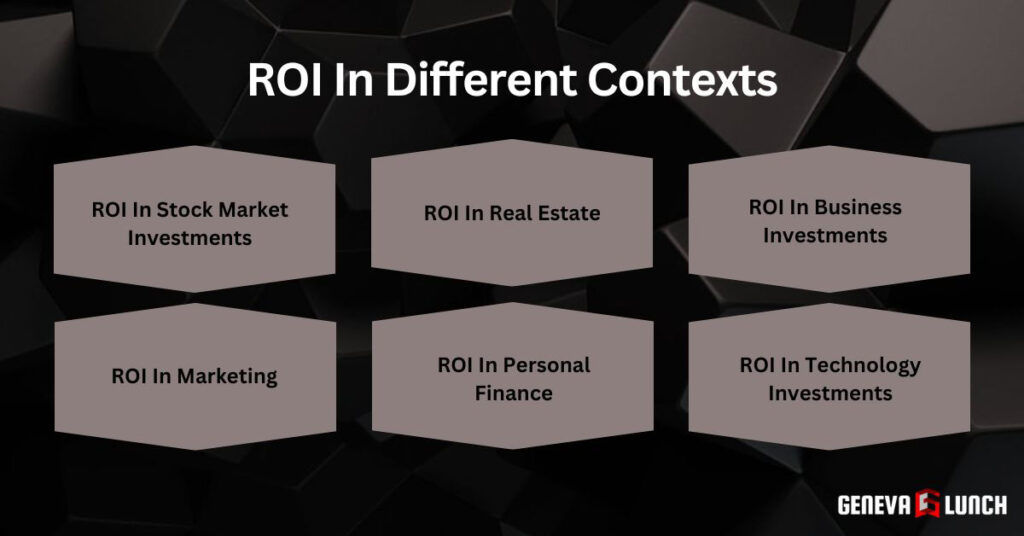
Return on Investment (ROI) is a versatile tool used across various areas to measure the success of an investment. It helps people and businesses decide where to invest by showing what they can expect to get back.
ROI In Stock Market Investments
In the stock market, ROI helps investors understand how well their stock purchases have performed. It considers the gain or loss on the stock relative to the initial investment cost. Investors use ROI to compare stocks’ performance or evaluate their portfolio’s effectiveness over time.
ROI In Real Estate
For real estate investments, ROI calculates the return from properties, considering rental income, price appreciation, and costs such as maintenance and taxes. A high ROI typically indicates that the property generates significant income or has increased substantially in value, making it a profitable investment.
ROI In Business Investments
Businesses use ROI to judge the profitability of their investments in projects, acquisitions, or new equipment. This measurement helps companies decide where to allocate resources to maximize profits. An investment with a high ROI shows it has generated significant value relative to its cost.
ROI In Marketing
Marketing ROI is crucial for assessing the effectiveness of advertising campaigns. It measures the additional sales generated by a campaign against its cost. This helps marketers optimize spending, focusing on strategies that yield the highest returns and adjusting or abandoning lower-performing initiatives.
ROI In Personal Finance
In personal finance, ROI can apply to various investments, such as stocks, bonds, or personal education. It helps individuals assess how well their personal decisions are paying off financially, guiding them on where to invest their money for the best personal or financial growth returns.
ROI In Technology Investments
Companies also calculate ROI to evaluate technology investments like new software or hardware upgrades. The ROI helps them see if the technology increases efficiency, reduces costs, or improves service or product quality enough to justify the expense. This is critical as tech investments can be substantial and risky.
How To Improve ROI
Improving Return on Investment (ROI) is a key goal for businesses. A higher ROI means you’re making more money for every dollar spent. Let’s explore some ways to do that.
Reducing Investment Costs
One of the simplest ways to improve ROI is to spend less. Lowering the costs of your investments, like using cheaper materials or finding more efficient methods, will leave more room for profit. This doesn’t mean cutting corners but finding ways to be smart with your spending.
Increasing Revenue
Another way to boost ROI is to bring in more money. This can be done by raising prices, offering new products, or reaching more customers. When your revenue grows without spending much more, your ROI will improve. Small changes in marketing or sales strategies can lead to big increases in income.
Extending The Time Horizon
You might see better returns if you give your investment more time to grow. Some investments take longer to show their total value. By being patient and letting them mature, you can improve your ROI. This is especially important for long-term projects like real estate or new business ventures.
Diversifying Investments
Spreading your money across different areas can also help improve ROI. This strategy, called diversification, reduces the chance of big losses. When one investment doesn’t work out, others may perform well. Balancing risk across many investments makes you more likely to see stable returns.
Risk Management
Effective risk management is essential for boosting ROI. While high-risk investments may offer higher returns, they also carry a greater risk of losses. Use strong risk management strategies to protect your returns.
Choose safer investments and keep contingency plans. This careful approach minimizes potential losses and stabilizes and enhances your ROI over the long term.
Common ROI Mistakes To Avoid

While ROI is a valuable tool, it’s easy to make mistakes when calculating or using it. These mistakes can lead to poor decisions. Below are common ROI mistakes to avoid.
Overestimating Future Cash Flows
One common mistake is assuming that future earnings will always be high. It’s easy to get excited about the potential profit, but overestimating cash flows can make you look better than it is. This can lead to disappointment if actual returns fall short.
Ignoring Hidden Costs
It’s easy to forget about the extra costs that need to be clarified immediately. These can be maintenance costs, upgrades, or even more money spent on marketing. When people only look at the clear costs, like purchase price, they miss part of the picture. Always add these hidden costs to get a true sense of your investment costs.
Misusing ROI In Short-Term Investments
Using ROI to judge short-term investments can be misleading. This method works best for longer-term projects where returns happen over time.
For short-term investments, ROI might not show the extra costs or changes that can happen quickly, like market swings or unexpected expenses. So, using different tools along with ROI can give a better picture for short-term decisions.
Focusing Solely On ROI
Another mistake is using ROI as the only decision-making tool. While ROI is important, it doesn’t show the full picture. It’s important to also consider risk, market trends, and how an investment fits into long-term goals. Focusing only on ROI can lead to missed opportunities or poor choices.
Not Adjusting For Inflation And Market Conditions
Always remember the economy and prices change. What seems like a good return now might not hold up if inflation rises or market conditions get tough. Always update your ROI calculations to reflect current economic situations. This helps you understand how your investments perform against the backdrop of the broader economy.
FAQs
1. What ROI Is A Good Investment?
A good ROI depends on the investment type and your risk tolerance, but generally, a 7-10% annual return is considered favorable. Higher ROIs may involve more risk, while lower returns offer greater stability. Assess your financial goals and market conditions to determine the best investment ROI.
2. Can ROI Be Negative?
Yes, ROI can be negative. This happens when an investment’s costs exceed its returns, causing a loss. A negative return on investment means underperformance. It prompts investors to reassess their strategies or seek better investments. They want to cut losses and boost profits for better growth.
3. How Does ROI Differ Across Industries?
ROI varies by industry due to capital intensity, growth, and risk. For example, tech and healthcare often have high ROIs due to innovation and demand. In contrast, utilities and real estate may provide stable but lower returns. These differences help investors tailor strategies to specific sectors.
4. What Is A Realistic ROI For Startups?
Startups typically aim for a realistic ROI of 20% to 40% within the first few years. However, actual returns can vary widely based on industry, market conditions, business model, and execution. Investors may expect higher returns to compensate for the higher risk associated with startups.
5. Can ROI Be Used For Social Or Environmental Projects?
Yes, ROI can be used for social or environmental projects to measure the benefits relative to costs. This approach helps organizations evaluate the efficiency and impact of their initiatives, ensuring resources are utilized effectively for the desired social or environmental outcomes.
Final Word
Mastering ROI means your business makes more from each dollar spent. It’s not just about cutting costs—it’s about smart choices that pay off. Every decision you make can lead to greater profits and success.
Focusing on effective strategies and monitoring ROI sets your business up for a brighter, more profitable future. Think of ROI as your financial roadmap: It guides you to invest wisely and grow your business. Start today, and see how far your efforts can take you!