Financial Investment: Types, Strategies & Risk Management
Investing your money wisely is important if you want to see it grow. Financial investments take many forms, such as stocks, bonds, and real estate. Each type offers different benefits and risks.
Financial investment involves allocating funds to assets to generate returns. Key strategies include diversification, regular market analysis, and risk assessment to achieve growth and mitigate losses. Effective management and knowledge of markets are essential for successful financial investing.
Whether you’re starting out or looking to improve your investment skills, learning these basics can help you build a stronger financial future.
Key Takeaways
- Diverse Investment Types: Explore stocks, bonds, real estate, and mutual funds, each offering different benefits and suitable for various financial goals.
- Strategic Investment Planning: Effective strategies like diversification, dollar-cost averaging, and market timing can optimize returns and minimize risks.
- Risk Assessment Crucial: Understand individual risk tolerance and potential investment volatilities to tailor strategies that align with personal financial objectives.
- Regular Portfolio Review: Periodic assessment of your investment portfolio ensures alignment with your evolving financial goals and market conditions.
- Professional Guidance Recommended: Consulting with financial advisors can optimize investment choices, ensuring sophisticated strategies are tailored to current economic trends.
What Is Financial Investment?
Financial investment is when you put your money into things that can earn more money over time. This can be buying shares in a company, investing in gold, or even saving money in a bank account that earns interest.
The goal is to grow your money so that you have more in the future. When you invest, you choose where to put your money based on how much you hope to earn and how much risk you’re willing to take.
Different types of investments have different levels of risk and potential for earning money.
Financial investment is allocating money with the expectation of future returns. It can involve a variety of assets and strategies, with the ultimate goal of growing wealth over time. It’s putting your money to work for you, not just letting it sit in a savings account.
Here are 3 key characteristics of financial investments:

- Involves Risk: Savings accounts have guaranteed returns. But, investments have varying degrees of risk. The chance of higher returns also comes with the risk of losing some or all of your investment.
- Time Horizon: Different investments are suited for different timeframes. Short-term investments are good for near-term goals, as you’ll need the money in a few years. Long-term investments are for building wealth over decades.
- Return on Investment (ROI): This is the profit or gain your investment generates. It can take various forms, such as interest on bonds, stock dividends, or real estate value growth.
There are many financial investments. Each has a risk-reward profile and liquidity (ease of converting to cash). Some common examples include:
- Stocks: Ownership shares in companies that can appreciate and pay dividends.
- Bonds: Loans you make to governments or corporations, offering a fixed interest rate in return.
- Mutual Funds: Professionals manage these portfolios. They pool funds from many investors and invest in a variety of assets.
- Exchange-Traded Funds (ETFs): Like mutual funds, they trade on stock exchanges like individual stocks.
- Real Estate: Owning a property that can generate rental income or appreciation.
What Is The Purpose Of Financial Investment?
Financial investment involves putting money into stocks, bonds, or real estate, hoping that the money will grow over time. The main goal is to make more money in the future.
People invest to increase their wealth and have more money for retirement, buying a house, or starting a business.
When you invest, you try to make your money work for you. Instead of just saving money in a bank, investing allows you to use your money to earn more money. This can help you reach your financial goals faster and more efficiently.
Investig is also a way to protect your money from losing value due to inflation. Inflation makes things more expensive over time, meaning money not invested might buy less.
Investing wisely allows you to keep up with or even outpace inflation, ensuring your finances stay strong.
People invest for a variety of reasons, but 4 of the most common goals include:
- Growing Wealth: The primary objective of most investments is to accumulate wealth over time. Invest wisely. You can beat inflation and reach your long-term goals. These goals include retirement or a child’s education.
- Generating Income: Some investments, like bonds and dividend stocks, can bring a steady income stream. This income can supplement your salary or serve as a source of retirement income.
- Preserving Capital: Some investments aim for growth. Others aim to protect your money’s purchasing power. This might involve lower-risk investments, like government bonds. They offer a guaranteed return of your principal.
- Meeting Financial Goals: Investments can be a powerful tool for achieving specific financial objectives. Strategic investing can help you save for a house down payment, fund a dream vacation, or build a retirement nest egg.
Understand your financial goals, risk tolerance, and time horizon. Then, select the strategies and vehicles to help you reach those goals.
Types Of Financial Investments
When we talk about financial investments, we mean putting money into things that can earn more money over time. There are many ways to invest, such as stocks, bonds, and real estate. Each type has its benefits and risks.
1. Stocks
Stocks represent fractional ownership in a company. Stocks are a popular way to invest. When you buy stocks, you buy a small part of a company. When the company does well, you can make money. When it doesn’t, you may lose money.
What Are Stocks?
Stocks, also known as equities, are a type of investment that represents fractional ownership in a company. When you buy a stock, you buy a small piece of that company. Stocks are a fundamental component of many investment portfolios.
They offer the potential for high returns but also carry inherent risks. The stock market can be volatile, and there’s always the possibility that a company’s value could decline.
Types Of Stocks
There are 2 primary categories of stocks: common and preferred.
- Common Stock: The most widely held type of stock grants shareholders voting rights on company decisions. Shareholders also benefit from possible capital appreciation and receive dividends, a portion of the company’s profit.
- Preferred Stock: Preferred stockholders generally lack voting rights. But, they have a higher claim on company dividends than common stockholders. If the company closes, preferred stockholders are entitled to be paid before common stockholders. They get their investment back first.
How To Invest In Stocks?
There are several ways to invest in stocks such as opening a brokerage account, investing through online platforms, individual stock picking, mutual funds, and ETFs.
- Opening a brokerage account: A brokerage account lets you buy and sell stocks. You do this through a licensed intermediary.
- Investing through online platforms: Many online platforms offer free stock trading, making it accessible to more investors.
- Individual Stock Picking: Researching and buying shares of specific companies directly through a brokerage account.
- Mutual Funds: Investing in a pool of stocks managed by a professional fund manager.
- Mutual funds and ETFs: These investment vehicles pool money from multiple investors and invest in a basket of stocks, offering diversification and potentially lower fees.
2. Bonds
Bonds are IOUs issued by companies or governments. When you buy a bond, you loan money to the issuer. In exchange, you get a fixed interest rate for a set period.
Upon maturity, you receive the principal amount you invested back. Bonds offer stable returns and are more predictable than stocks. However, they usually have lower potential returns.
What Are Bonds?
Bonds are debts. They represent loans from investors to borrowers, like corporations or governments. The borrower promises to repay the principal amount borrowed (face value). They will also pay interest at regular intervals until the bond matures.
Types Of Bonds
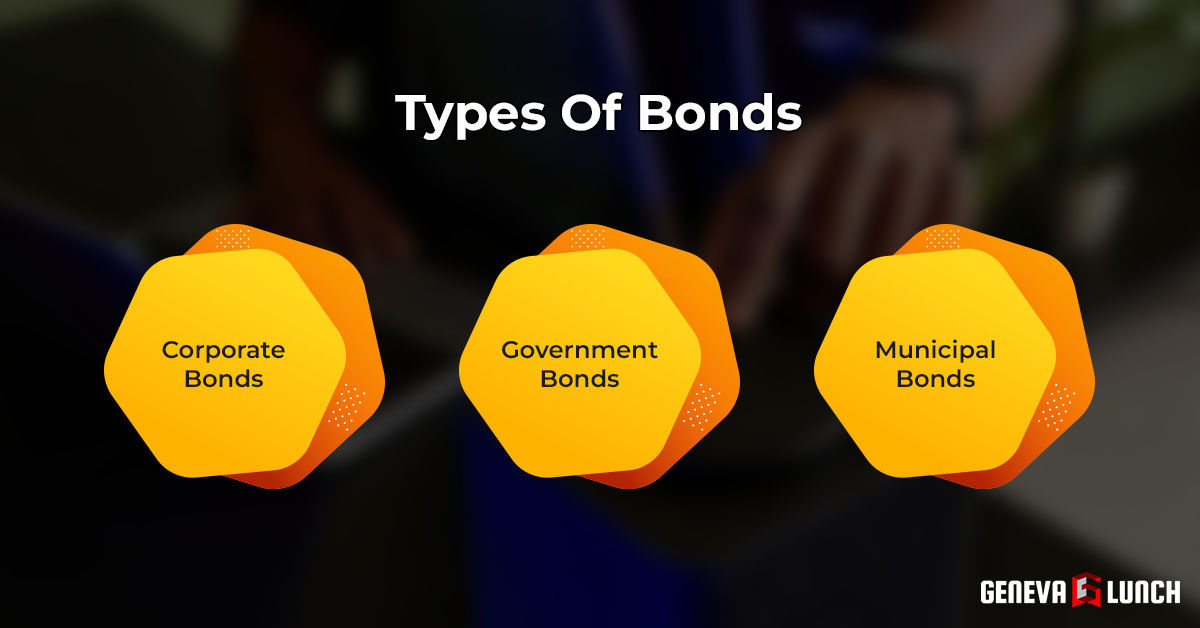
There are mainly 3 types of bonds: corporate bonds, government bonds, and municipal bonds. Here’s the detail –
- Corporate Bonds: Issued by corporations to raise capital for various purposes. They usually offer higher interest rates than government bonds. But, they have a higher credit risk. This risk is caused by the issuer defaulting on the loan.
- Government Bonds: These are issued by federal, state, or local governments. They are generally considered the safest type of bond due to governments’ low credit risk. They typically offer lower interest rates than corporate bonds.
- Municipal Bonds: Issued by municipalities to finance public projects like schools, roads, and hospitals. Interest on municipal bonds may be exempt from federal taxes. Depending on the specific bond, it may also be exempt from state and local taxes.
Risks And Benefits Of Investing In Bonds
Investing in bonds has risks and benefits as well. The following are the details –
Benefits
- Regular Income: Bonds provide steady income through regular coupon payments.
- Lower Volatility: Bonds have less price change than stocks. This makes them a stable investment.
- Diversification: Bonds can help diversify your portfolio and mitigate overall risk.
Risks
- Interest Rate Risk: Interest rates are rising, making existing bonds less attractive. This could cause their price to fall.
- Credit Risk: The risk of the issuer defaulting on the loan, resulting in a potential loss of principal.
- Inflation Risk: Bond returns may not beat inflation. This would cause a loss of purchasing power over time.
3. Mutual Funds
Mutual funds offer a convenient and diversified way to invest in a basket of securities.
What Are Mutual Funds?
Mutual funds are investment vehicles. They pool money from multiple investors and invest it in various assets, such as stocks, bonds, or both. A pro fund manager oversees the fund. They make investment choices for the shareholders. Mutual funds offer several advantages, especially for new investors.
Types Of Mutual Funds
Let’s talk about the types of mutual funds. There are different types of mutual funds available. The top 4 types of mutual funds are equity funds, bond funds, hybrid funds, index funds.
- Equity Funds: Primarily invest in stocks, aiming for capital appreciation through stock price growth and potential dividend income. These funds generally carry higher risk and volatility compared to bond funds.
- Bond Funds: Invest mainly in bonds. They offer steady income through coupon payments. Bond funds are less volatile than equity funds. But they also offer lower returns.
- Hybrid Funds (Balanced Funds): Invest in a mix of stocks and bonds, seeking a balance between income and growth. The stock-to-bond ratio in the fund varies. It depends on the fund’s goal.
- Index Funds: This passively tracks a particular market index, like the S&P 500. These funds aim to copy the index by holding the same securities in the same proportion as their weight in the index. Index funds generally have lower fees compared to actively managed mutual funds.
Advantages And Disadvantages Of Mutual Funds
Mutual funds have advantages as well as disadvantages. Knowing them is important. Let’s explore the advantages and disadvantages of mutual funds.
Advantages
- Diversification: Mutual funds provide instant diversification across various holdings, reducing overall portfolio risk.
- Professional Management: A qualified fund manager handles investment decisions. This eliminates the need for individual security selection.
- Affordability: Mutual funds allow you to invest in assets with relatively little money.
- Liquidity: Mutual funds can be easily bought and sold on most trading days.
Disadvantages
- Management Fees: Mutual funds charge fees to cover operational costs and the fund manager’s salary. These fees can eat into your returns.
- Lack of Control: Investors have limited control over the securities held within the fund.
- Potential for Underperformance: Managed mutual funds may not outperform the overall market.
4. ETFs (Exchange-Traded Funds)
ETFs are a popular investment. Like mutual funds, they are pools of money invested in many securities, offering the diversification of mutual funds and the benefit of stock-like trading.
But they are traded on stock exchanges. They can be bought and sold throughout the trading day at market prices.
What Are ETFs?
ETFs are investment funds that hold assets like stocks, commodities, or bonds. They are listed on exchanges, and their shares are traded much like stocks. This means investors can buy and sell ETF shares from others on the market. They do this through the exchange. They can do this, not just from the fund itself.
Differences Between ETFs And Mutual Funds
Here are a few quick differences between ETFs and mutual funds. Let’s take a look at them.
| Feature | ETFs | Mutual Funds |
| Trading | Traded throughout the day like stocks | Traded only at the end of the trading day |
| Price | Market price determined by supply and demand | Net asset value (NAV) of the underlying holdings |
| Fees | May have lower expense ratios due to passive management | |
| Management | Often passively managed, tracking an underlying index | Can be actively or passively managed |
| Flexibility | Can be bought and sold on the exchange throughout the day | Less flexible, can only be bought or sold at the end of the day |
Benefits Of Investing In ETFs

Investing in ETFs (Exchange-Traded Funds) offers several advantages for both novice and experienced investors. Here are 5 of the key benefits:
- Flexibility: You can buy and sell ETFs at intraday prices, which gives you more control over the price of shares.
- Lower Costs: Many ETFs have lower annual fees than mutual funds. This can save investors a lot of money over time.
- Transparency: ETFs often show their holdings daily. Mutual funds generally disclose their portfolios every quarter or month.
- Diversification: Like mutual funds. ETFs let you invest in a broad portfolio of assets. They can also cover specific sectors, regions, or strategies. They offer a simple way to diversify.
- Accessibility: ETFs are available to anyone with a brokerage account. They make it easy for individual investors to access diverse assets. Investors can do this without having to buy and manage a large portfolio.
5. Real Estate
Real estate investment entails purchasing, owning, and managing property to generate revenue. Investors can earn passive income and benefit from potential capital growth by renting or selling these properties.
Consulting a financial advisor for real estate can enhance these strategies, making it a favored choice for those seeking to safeguard against inflation and diversify their investment portfolios.
What Is Real Estate Investment?
Real estate investment involves buying property to make money. You can do this by renting, leasing, or price appreciation. This long-term investment requires a lot of capital and can be affected by economic factors, like market trends and interest rates.
Types Of Real Estate Investment
Real estate investment comes in different types. Let’s explore 3 types of real estate investment.
- REITs (Real Estate Investment Trusts): REITs are companies that own or finance income-producing real estate across a range of property sectors. They offer investors regular income, diversification, and long-term growth.
- Residential: This involves properties such as houses, apartments, and townhouses. Investors make money by renting out properties and profiting from any rise in their value.
- Commercial: Commercial real estate includes office buildings, shopping malls, and industrial properties. The income here is generally higher, derived from longer lease agreements.
Pros And Cons Of Real Estate Investment
Real estate investment can be a lucrative path to building wealth and generating income, but it also comes with its own set of challenges. Here’s a breakdown of the pros and cons to consider:
Pros
- Steady Income: Rental properties can provide a steady income stream from tenants.
- Appreciation Potential: Real estate values tend to rise over time, which provides the potential for capital gain.
- Tax Advantages: Owning real estate has many tax benefits. These include deductions for mortgage interest, property taxes, and depreciation.
- Inflation Hedge: Real estate values and rents typically rise with inflation. This makes it a good hedge against the falling value of currency.
Cons
- Capital Intensive: Starting a real estate investment requires a lot of capital. You need it for the full purchase or a down payment.
- Liquidity: Unlike stocks or bonds, real estate is not liquid. Selling properties can take a long time and be costly.
- Management Overhead: Real estate can only be demanding if you hire a property management company. Maintenance and management require much time and effort.
- Market Risk: Like all investments, real estate has market risks. These include economic downturns, which can cut property values and rents.
6. Commodities
Commodities are basic goods used in trade. They are interchangeable with other goods of the same type. These are typically used as inputs in producing other goods or services. Investing in commodities can diversify an investment portfolio. Their market values often move independently of stocks and bonds.
What Are Commodities?
Commodities are raw materials, primary farm products that can be bought and sold. They are typically standardized and traded in bulk on regulated commodities exchanges. Commodities are vital to the world economy. They are the basic parts of complex goods and services.
Types Of Commodities
Let’s talk about 3 types of commodities of financial investment which are metals, energy, and agriculture.
- Metals: This category includes precious metals. It has gold, silver, and platinum. People use them as a hedge against inflation or currency devaluation. It also includes industrial metals like copper, aluminum, and steel. They are vital for making things.
- Energy: This includes oil, natural gas, coal, and uranium. Energy commodities are crucial for powering industries. They are also heavily influenced by geopolitical and environmental policies.
- Agriculture: This includes food crops like wheat, corn, and soybeans and livestock such as cattle and hogs. Agricultural commodities can be very volatile due to factors like weather, disease, and government policies.
How To Invest In Commodities?
There are several ways to invest in commodities, each with its own advantages and risks. Here’s a breakdown of the most common methods:
- Commodity Futures: A popular way to invest in commodities is through futures contracts. They are agreements to buy or sell a specific quantity of a commodity at a set price on a future date. Futures are standardized and traded on exchanges. They give investors leverage but are risky.
- Commodity ETFs and Mutual Funds: Invest in commodities or futures contracts. They provide an easier way for investors to access commodity prices. They do this without trading futures directly.
- Physical Commodities: Another method is to invest directly in physical commodities. This means buying gold bars or coins. However, it involves storage and insurance costs.
- Stocks of Companies in Commodity-Related Industries: Another way to invest in commodities is to invest in the stocks of companies that produce or trade in commodities, such as mining or agricultural firms.
7. Cryptocurrency
Unlike traditional currencies, cryptocurrency is digital. It is a virtual currency that uses cryptography for security. Cryptocurrency operates on decentralized networks based on blockchain technology. It uses a distributed ledger enforced by a diverse network of computers.
What Is Cryptocurrency?
Cryptocurrencies are digital assets meant to be a medium of exchange. Records of individual coin ownership are stored in a ledger, a computerized database that uses strong cryptography.
This secures transaction records, controls coin creation, and verifies coin transfers. It does not rely on central authorities. These are like governments or banks. They uphold or maintain value.
Popular Cryptocurrencies
The 5 most popular cryptocurrencies are Bitcoin (BTC), Ethereum (ETH), Ripple (XRP), Litecoin (LTC), Cardano (ADA).

- Bitcoin (BTC): It is the first cryptocurrency. Many people use it and see it as secure.
- Ethereum (ETH): Not just a cryptocurrency, it’s also a platform for building decentralized applications (dApps).
- Ripple (XRP): Known for its digital payment protocol more than its cryptocurrency.
- Litecoin (LTC): Designed to produce faster transaction times than Bitcoin.
- Cardano (ADA): Focuses on a research-driven approach to platform development.
Risks And Potential Rewards
The world of investing revolves around the delicate dance between risk and reward. Understanding these two opposing forces is crucial for making informed investment decisions.
Risks
- Volatility: Cryptocurrencies can have big price swings. This happens due to sentiment and speculation in the market.
- Regulatory Risk: The uncertain regulatory environment can significantly impact price and availability.
- Security Risks: Cryptocurrencies are safe but not immune to hackers and breaches, which can cause big losses.
Potential Rewards
- High Return Potential: Prices have risen. So, some investors have made fast and large returns from cryptocurrency.
- Decentralization: Cryptocurrencies are decentralized. This provides security because they are not tied to any country. They are not subject to government manipulation or interference.
- Innovation and Accessibility: Investing in cryptocurrencies means investing in blockchain technology, which is increasingly used across many industries.
8. Certificates Of Deposit (CDs)
A Certificate of Deposit (CD) is a savings account on steroids. You deposit a set amount of money for a fixed term, usually a few months to several years. The bank offers a guaranteed interest rate in return for locking away your money.
It’s usually higher than what you’d get with a regular savings account. The key thing to remember with CDs is that penalties for withdrawing early can be steep. So, make sure your chosen term aligns with your financial goals.
9. Money Market Accounts
Like CDs, money market accounts offer a higher yield than traditional savings accounts. However, they provide more flexibility. Money market accounts allow a few monthly withdrawals and transfers, often by check or debit card.
This makes them a good option for parking your emergency fund. They also work to save for a short-term goal. For such goals, you might need occasional access to your cash.
10. Options
Options contracts grant you the right. But, they do not force you to buy or sell a security. You can do so at a certain price by a specific date. They can be complex investments.
They are used for various strategies, from making income to hedging other holdings. Options are risky. They are recommended for experienced investors. These investors are comfortable with the potential for big losses.
11. Annuities
An annuity is an insurance product designed to provide income in retirement. You can pay a lump sum upfront or make regular contributions over time. When you retire, you can choose how to receive your saved money.
You can get it as a guaranteed income for life. Annuities offer features like tax advantages and death benefits but can also come with high fees and surrender charges.
12. Retirement Accounts
Retirement accounts are special investments. They are designed to help you save for your later years. These accounts often have tax benefits. They allow your contributions to grow without taxes or even tax-free. Common types of retirement accounts include:
- 401(k): Offered by many employers, this account allows salary deductions to be invested before taxes. Contributions have limits, and withdrawals before retirement typically incur penalties.
- IRA (Individual Retirement Account): These accounts can be opened independently and offer more investment flexibility. There are various IRA types with different contribution limits and tax implications.
Financial Investment Strategies
Investing your money can lead to growth. You can choose from many strategies depending on your goals and risk tolerance. Here’s a detailed look at some popular investment strategies including value investing, growth investing, income investing, dividend investing, and momentum investing.
Value Investing
Value investing is about finding and buying stocks. They appear underpriced compared to their real value. Value investors follow this strategy: They look for companies whose stock prices don’t fully reflect their worth.
They invest in these stocks and hold onto them until the market sees their true value. This can lead to big returns. This strategy requires patience. You need a good grasp of financial statements and a willingness to invest long-term.
Growth Investing
Growth investing targets companies. They show potential for above-average growth, even if their stocks are already expensive. The bet is that these companies will keep making more profit and gaining market share.
This will cause their stock prices to rise. This strategy suits risk-takers. They are willing to take more risk for the chance of higher returns and are less concerned about high stock prices.
Income Investing
Income investing focuses on generating a steady income from investments. It’s popular among those who need regular income, like retirees. This strategy involves investing in bonds and dividend-paying stocks.
It also includes real estate investment trusts (REITs) and other assets that produce income. The goal is to make a portfolio that pays out reliably. You should do this without needing to sell the assets.
Dividend Investing
Dividend investing is a specific form of income investing that focuses on buying stocks of companies that pay high dividends. These companies are often well-established.
They consistently give earnings to shareholders. Dividend investing is attractive because it pays regular cash. You might also benefit from the stock’s going up.
Momentum Investing
Momentum investing is based on following market trends. Investors using this strategy buy stocks that are trending upward and sell them when they start to decline.
This requires constant monitoring of market movements. It is based on the belief that stocks that are rising or falling will keep doing so soon. It’s suited for those who can handle the high risks. They must make quick decisions, as this strategy demands.
Financial Investment Analysis
Financial investment analysis is the cornerstone of making sound investment decisions. It’s the process of evaluating potential investments to understand their risks and potential rewards and align them with your financial goals. Here’s a breakdown of the key elements involved:
Fundamental Analysis
Fundamental analysis is like being a detective. It involves looking closely at companies to decide if their stock is good. You look at many things to figure out if the company is strong.
1. Financial Statements Analysis
This is where you start. You look at the company’s financial reports, which tell you how much money the company is making and spending. It’s like checking whether someone is good at saving money or spends too much.
2. Ratio Analysis
Next, you use special math called ratios to compare numbers in the financial statements. These ratios help you see how well the company manages its money. It’s like comparing scores to see who is the best in class.
3. Economic Analysis
Here, you look at the big picture. How is the economy doing? Is it a good time to invest? You look at things like jobs, prices, and how much people are spending.
4. Industry Analysis
Now, you think about the industry the company is in. Is it a growing industry? Are there big problems? It’s like seeing if the ground is good for planting your seed.
5. Company Valuation Techniques
Finally, you figure out how much the company is worth. There are many ways to do this. It’s a bit like deciding how much to pay for a car based on what it offers. You want to pay a fair price, not too much.
Technical Analysis
Technical analysis helps investors predict what might happen to prices in the future by looking at past market data like prices and volume. People who use technical analysis look at charts and use different tools to make good choices about buying or selling stocks.
1. Chart Patterns
Chart patterns are shapes within a price chart that help predict future price movements. Common patterns include triangles, rectangles, and head-and-shoulders. These shapes can tell if prices are likely to go up or down.
2. Technical Indicators
Technical indicators are calculations based on stock price and volume. They help investors decide when to buy or sell. Examples include the Relative Strength Index (RSI) and the Moving Average Convergence Divergence (MACD). These tools can show if a stock is overbought or oversold.
3. Trends Analysis
Trend analysis involves examining the direction in which prices are moving. If prices are moving up, it’s an uptrend. If they are moving down, it’s a downtrend. Knowing the trend helps investors follow the “trend is your friend” strategy.
4. Support and Resistance Levels
Support and resistance levels are specific prices where a stock repeatedly stops falling or rising. The support level is where a price often stops falling, and resistance is where it often stops rising. These levels can help investors find good spots to enter or exit trades.
5. Moving Averages
Moving averages smooth out price data by creating a single flowing line, making it easier to see the trend. Investors use moving averages like the 50-day or 200-day moving average to spot trend directions and potential price reversals.
Investment Vehicles And Platforms
Investing money wisely means knowing where and how to do it. Different types of investment vehicles and platforms can help you grow your money. Let’s explore common ways through brokerage accounts and how they can suit your investment goals.
Brokerage Accounts
A brokerage account lets you buy and sell investments like stocks, bonds, and mutual funds. There are several brokerage accounts such as full-service brokerage, discount brokerage, online brokerage, etc. Each brokerage account offers different services at various costs.
1. Full-Service Brokerage
Full-service brokerages provide detailed advice and personalized services. They help with investment choices, retirement planning, and tax advice. This type is good for people who want expert guidance and are willing to pay higher fees.
2. Discount Brokerage
Discount brokerages offer fewer services but at a lower cost. They allow you to buy and sell investments without advice. This type is good for those who know about investing and prefer to save on fees.
3. Online Brokerage
Online brokerages operate on the Internet and usually offer tools for managing your investments digitally. These platforms are easy to use and offer quick market access, making them ideal for active traders.
4. Robo-Advisors
Robo-advisors use algorithms to manage your investments based on risk tolerance and goals. They require less money to start, and fees are low. Robo-advisors are a great choice for beginners and those who prefer a hands-off investment approach.
5. Direct Investing Platforms
Direct investing platforms allow you to buy stocks directly from companies without a broker. This cuts costs and gives you direct control over your investments. It’s suitable for those who want to invest directly in companies they believe in.
Investment Apps
Investment apps such as mobile trading apps, investment tracking apps, robo advisor apps, micro-investing apps make managing your money from your phone or computer easy. They can help you trade, track, and learn about investing.
1. Mobile Trading Apps
Mobile trading apps let you buy and sell stocks, bonds, and other investments. They give you the power to manage your portfolio anytime, anywhere. These apps often come with tools to help you make smart decisions.
2. Investment Tracking Apps
Investment tracking apps help you monitor your investments. They can show whether you’re making or losing money and show your investment growth over time.
3. Robo-Advisor Apps
Robo-advisor apps use computers to manage your investments. They make investing simple. You answer some questions, and the app picks the best investments for you based on your answers.
4. Micro-Investing Apps
Micro-investing apps let you invest small amounts of money regularly. Even if you only have a few dollars, these apps help you start investing. It’s a great way to grow your money over time.
5. Financial Education Apps
Financial education apps teach you about investing and managing money. They provide lessons and tools to help you become a smarter investor. These apps are good for both beginners and experienced investors.
What Are The Risk Management Strategies In Investing?

Investing money has risks, but smart strategies can help you manage them. This means you have a plan to handle the market’s ups and downs. Here, we’ll discuss ways to control risk while aiming for good investment returns.
Concepts Of Risk and Return
Risk and return are fundamental concepts in investing. Risk refers to the potential of losing some or all of your investment. In contrast, return is the gain you earn from your investments.
Typically, higher risks are associated with higher potential returns. Understanding the link between risk and return is key. It helps you make informed investment choices.
Investors need to evaluate their risk tolerance. They must see how much risk they can handle. Then, they should seek investments that match this level.
Diversification Strategies
Diversification is a strategy that spreads investments across different types of assets and sectors, reducing risk. The idea is simple: concentrate only some of your resources in one area.
For instance, your bonds or real estate may still do well if the stock market falls. They will offset losses. Diversification reduces the impact of poor performance in any single investment.
Asset Allocation Techniques
Asset allocation involves dividing your investment portfolio among different types of assets, such as stocks, bonds, and cash. The process depends largely on your risk tolerance, investment horizon, and financial goals. Allocate your assets strategically.
You can balance risk and return to fit your finances. Regularly adjust your asset allocation in response to market changes or life events. This is a key part of the strategy to keep a desired level of risk.
Hedging Strategies
Hedging involves using financial instruments to offset potential losses in investments. It’s like an insurance policy for your portfolio. For example, if you own stocks, you can use options as a hedge.
Options let you sell your stocks at a set price, limiting potential losses if the stock market falls. Hedging can be complex and typically requires sophisticated knowledge of financial markets.
Risk Assessment Tools
Risk assessment tools are critical for evaluating the risk associated with potential investments. These tools analyze historical data, market trends, and economic indicators to assess the level of risk.
They can also simulate market scenarios and show how they might affect your portfolio. By using these tools, investors can understand the risks. This will help them make confident decisions about where to invest.
Tax Considerations In Financial Investment
Managing taxes is a critical financial investment aspect. It can greatly impact your returns. You need to understand how different investments are taxed and use strategies to cut taxes. This can make your investments more efficient. Here are key areas to consider for tax-efficient investing.
Tax-Efficient Investing Strategies
Tax-efficient investing involves choosing investments with favorable tax treatments. For example, municipal bonds are often tax-exempt at the federal level.
They are also sometimes tax-exempt at the state level, making them attractive to investors in higher tax brackets. The goal is to maximize after-tax returns, which is done by choosing and holding investments that create low tax bills.
Capital Gains Tax
Capital gains tax applies to the profit from the sale of an investment held for more than a year. Long-term capital gains are taxed at a lower rate than short-term gains.
Short-term gains are from investments held for less than a year and taxed at ordinary income rates. Knowing when to sell investments can help manage capital gains taxes well.
Dividend Tax
Dividends received from investments are subject to dividend taxes. The rate depends on whether the dividends are qualified or non-qualified.
Qualified dividends are taxed at low long-term capital gains tax rates, while non-qualified dividends are taxed at high ordinary income rates. Choosing stocks that pay qualified dividends can reduce your tax burden.
Tax-Advantaged Accounts
Investing through tax-advantaged accounts like 401(k)s, IRAs, and Roth IRAs can significantly reduce your tax bill.
Adding to 401(k)s and IRAs may cut your taxable income for the year they are made. But, money from Roth accounts is tax-free in retirement. Utilizing these accounts is essential for long-term tax planning.
Tax-Loss Harvesting
Tax-loss harvesting involves selling investments at a loss to offset gains made elsewhere in your portfolio.
This strategy can cut your taxable income. It uses losses to counter gains. It’s helpful to lower your total tax and change your portfolio. You can do this without incurring high taxes.
Planning And Building An Investment Portfolio
Building a successful investment portfolio requires careful planning and execution. The foundation of any good portfolio starts with clearly understanding your financial goals. Once you know your goal, you can choose the right investments and create a strategy.
Setting Financial Goals
The first step in planning your investment portfolio is to set your financial goals. Think about what you want to achieve with your money.
Do you want to save for a new house, your retirement, or your child’s education? Knowing your goals helps you decide how to invest your money.
Short-Term Vs. Long-Term Goals
You need to understand the difference between short-term and long-term goals. This understanding is crucial for allocating assets in your portfolio. Short-term goals require more liquidity and prioritize capital preservation. Long-term goals can take more risk, but they also have the chance for higher returns.
Setting Realistic Expectations
Setting realistic expectations for your investments is essential. While high returns are desirable, understanding the inherent risks involved is crucial. Investments with higher growth potential also carry a higher degree of risk. Aim to balance risk and reward that align with your goals and risk tolerance.
Building A Balanced Portfolio
A balanced portfolio has a mix of assets that can grow in value and protect you from big losses. This mix often includes stocks, bonds, and cash.
The right balance depends on your age, goals, and how much risk you can handle. A balanced portfolio helps you stay on track during market ups and downs.
Allocation Strategies
Allocation strategies involve deciding how much money to put in different investments. For example, young people might invest more in stocks because they have time to ride out market swings.
Older people might choose more bonds and cash to lower their risk as they get closer to needing their money.
Rebalancing Techniques
Rebalancing means adjusting your portfolio to keep it in line with your goals. If stocks do well and make up too much of your portfolio, you might sell some stocks and buy more bonds or cash.
This returns your portfolio to your original plan and keeps your risk level in check. Rebalancing at least once a year is a good rule to follow.
Using Technology In Investing
Technology makes investing easy and accessible for everyone. It helps people make better decisions and manage their investments efficiently.
Robo-Advisors
Robo-advisors are tools that use algorithms to manage your investments. You set your goals and risk tolerance, and they do the rest. They pick and manage your investments for you, making adjustments as needed.
Investment Apps And Platforms
Investment apps and platforms let you buy and sell investments. You can use them from your phone or computer. These tools often provide educational resources to help you learn as you go. They make investing easy and convenient. You can do everything from buying to monitoring.
FAQs
What Is The Importance Of Diversification In A Financial Investment Portfolio?
Diversification is essential in managing risk and enhancing potential returns in a financial investment portfolio. Spreading investments across various asset classes, industries, and geographies minimizes the impact of poor performance in any area, leading to more stable and consistent growth.
What Are Some Common Investment Fees I Should Be Aware Of?
Common investment fees include management fees, performance fees, and expense ratios for mutual funds and ETFs. Be aware of transaction fees for buying and selling and potential front-end or back-end load fees depending on the investment vehicle. These fees can significantly impact overall returns.
What Are Some Red Flags To Watch Out For When Considering An Investment?
Investors need to be aware of fees like management fees, performance fees, fund expense ratios, and transaction fees for asset trading. Mutual funds may also have load fees. Consulting with financial advisors is essential to managing these costs efficiently and enhancing returns effectively.
How Much Risk Can I Afford To Take With My Investments?
The level of risk you can afford in investments depends on your financial goals, age, income stability, and risk tolerance. Younger investors often handle more risk for higher growth, while those nearing retirement generally seek safer, more stable investments to protect their capital.
What Are The Key Differences Between Stocks And Bonds?
The risk you can afford in investments depends on your financial goals, age, and income stability. Stocks offer potential for higher returns but with more volatility, whereas bonds provide steady income and are generally safer. Balancing the two helps manage risk and maximize returns.
How Does Geopolitical Risk Factor Into Investment Decision-Making?
Geopolitical risks are crucial in investment decisions as they can disrupt global markets and affect economic forecasts. Investors assess these risks to modify their strategies, potentially shifting investments to safer assets or markets less likely to be impacted by political instability.
What Are Some Strategies For Managing My Investment Portfolio Over Time?
Strategies to manage your investment portfolio include regular rebalancing, strategic diversification, and monitoring for performance and risk. Additionally, adapting to market shifts and personal financial changes is crucial to maintaining the health and growth of your investments over time.
Final Words
Investing your money wisely is key to growing it. Different types of investments, like stocks, bonds, and real estate, can help. It’s important to choose a mix that fits your risk comfort. Using good strategies helps you manage risks and aim for better returns.
Always keep learning about how to handle your investments better. This way, you can make smarter choices and achieve your financial goals. Remember, the right mix and smart strategies are crucial to investment success.