Price-To-Earnings Ratio (P/E Ratio): Types & How It Calculate
The Price-to-Earnings Ratio, or P/E Ratio, is a special tool for determining whether a stock is a good buy.
The Price-to-Earnings Ratio (P/E Ratio) measures a company’s current share price relative to its per-share earnings. It provides insight into market expectations and the stock’s valuation. A higher P/E suggests higher future earnings expectations. Use it to compare industry peers or market averages.
Let’s dive in and find out what makes a good P/E Ratio and how you can use this number to pick the best slices of the stock market!
Key Takeaways
- Understanding Value: A low P/E ratio may indicate an undervalued company, offering a potentially lucrative investment opportunity.
- Growth Potential: High P/E ratios often suggest higher investor growth expectations, signaling anticipated future earnings.
- Industry Comparison: Comparing P/E ratios within the same industry can highlight more or less attractive investment options.
- Market Sentiment: Fluctuating P/E ratios reflect changing market sentiments and economic conditions affecting stock evaluations.
- Risk Assessment: A high P/E ratio indicates an overvalued stock, presenting higher investment risks.
What Is The Price-To-Earnings (P/E) Ratio?
The Price-to-Earnings (P/E) Ratio tells us what the market will pay for each dollar of a company’s earnings. It’s like a price tag for earnings. To find the P/E ratio, divide the company’s stock price by its earnings per share.
For example, if a company’s stock costs $30 and earns $2 per share, you do this math: $30 divided by $2 equals a P/E ratio of 15. This means investors pay $15 for every $1 of earnings.
The P/E ratio helps investors decide whether a stock costs too much or is a good deal based on earnings. When the P/E ratio is high, the stock is expensive, but when it’s low, it can be a bargain.
Types Of P/E Ratios
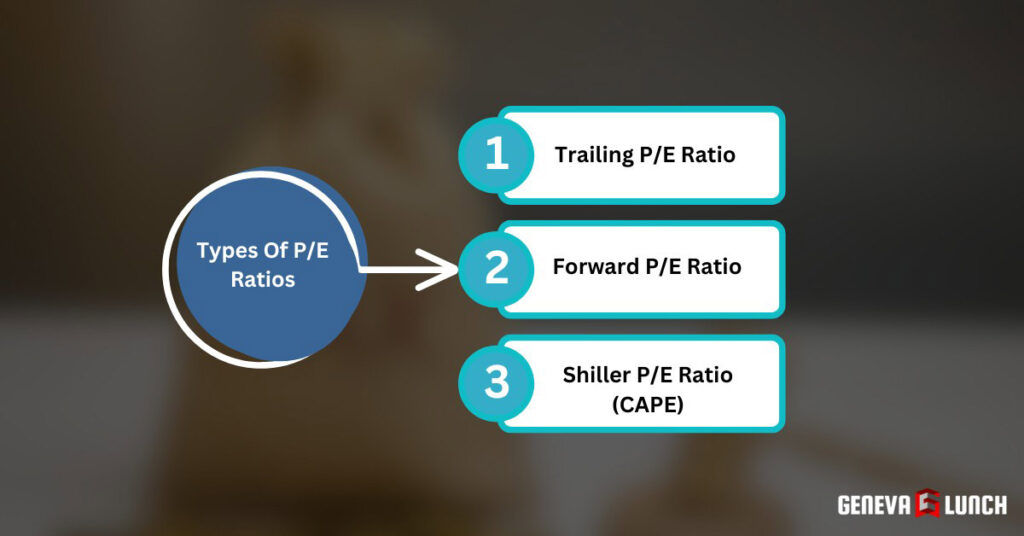
The price-to-earnings ratio, or P/E ratio, helps us understand how much we pay for each dollar a company earns. Different types of P/E ratios give us unique information about a company’s past, present, or future money-making ability.
Trailing P/E Ratio
The trailing P/E ratio is the most common type used by investors. It is calculated by dividing the current stock price by the total EPS earned by the company over the past 12 months.
The trailing P/E ratio shows how much investors will pay for a dollar of the company’s earnings based on its past performance. It is grounded in historical data, making it a reliable measure of a company’s current valuation.
Forward P/E Ratio
The forward P/E ratio looks ahead. It uses expected future earnings per share for the next year to tell us what investors think will happen. They use predictions to guess future earnings. A lower forward P/E means the company is expected to make more money, making it a good deal today.
Shiller P/E Ratio (CAPE)
The Shiller P/E ratio, or CAPE, stands for cyclically adjusted price-to-earnings. This ratio looks at earnings from the past ten years and adjusts them for inflation. Using a longer period smooths out short-term ups and downs, this ratio helps investors get a big-picture view of the stock’s value compared to its long-term earning power.
How Is The P/E Ratio Calculated?
The P/E ratio, or price-to-earnings ratio, is calculated by dividing the current market price of a company’s stock by its earnings per share (EPS). Here’s how you can do it:
Find the Current Stock Price: This is the price at which the stock is currently trading on the stock market.
Determine the Earnings Per Share (EPS): EPS can be either for the past 12 months (trailing EPS) or for the forecasted next 12 months (forward EPS).
- Trailing EPS is calculated by dividing the company’s total earnings over the past year by the number of outstanding shares.
- Forward EPS is an estimate of the company’s expected earnings in the next year, divided by the number of outstanding shares.
Divide the Current Stock Price by the EPS:
P/E Ratio= EPS/Current Stock Price
This ratio tells you how much investors are willing to pay for each dollar of earnings, giving a sense of the stock’s market value relative to its earnings power.
Significance Of The P/E Ratio

The P/E Ratio tells us how much money people are willing to pay for a company’s stock compared to its earnings. This number is crucial in corporate finance because it helps investors understand a company’s value.
Indicator Of Valuation
The P/E ratio shows whether a stock is a good value or not. A low P/E ratio could mean the stock is cheap, which is a chance to buy a good stock at a low price. But we need to be careful. Sometimes, a low P/E ratio can mean the company has problems.
Measure Of Market Expectations
The P/E ratio also tells us what investors think will happen with the company. A high P/E ratio means people expect the company to grow and make more money. They are willing to pay more now because they think the stock will be worth much more later.
Tool For Comparing Companies
We can use the P/E ratio to compare different companies. This helps to see which company would be a better deal. By looking at the P/E ratios of companies in the same industry, we can choose which stock is the best to buy.
Insight Into Growth Potential
The P/E ratio gives clues about a company’s growth potential. A higher P/E ratio often means a company is expected to grow faster than others. It shows investors believe in the company’s future and are excited about its potential.
How Do You Interpret The P/E Ratio?
The Price-to-Earnings (P/E) ratio helps you understand how much you pay for each dollar of a company’s earnings. It’s a simple way to see if a stock is expensive or cheap compared to its earnings.
High P/E Ratio Implications
A high P/E ratio can mean a company’s stock costs more per dollar of current earnings. Investors may pay more because they believe the company will grow a lot. However, high P/E ratios also mean more risk. The stock price could drop if the company does not grow as expected.
Low P/E Ratio Implications
A low P/E ratio means the stock is a good deal. You pay less for each dollar of earnings. This can happen when companies are not expected to grow much. A low P/E can sometimes be a sign of a strong buy if the market has missed the stock’s true value.
Industry Benchmarks
Each industry has its typical P/E ratio range. Technology companies often have higher P/E ratios because they grow fast. Utility companies have lower P/E ratios as they grow slowly. Knowing these benchmarks helps you judge if a P/E ratio is too high or low.
Comparing P/E Ratios Within Industries
When you compare P/E ratios within the same industry, you can spot which companies would be better deals. Look for companies with lower P/E ratios but good growth plans. This can lead you to smart investments that others may overlook.
Historical P/E Ratio Trends
Looking at P/E ratios over time can show you trends. A rising P/E ratio means a company or market is getting more popular. When the P/E ratio is falling, it could mean the market expects the company to earn less in the future. Watching these trends helps you decide when to buy or sell stocks.
What Factors Influence The P/E Ratio?

The P/E ratio, or Price-To-Earnings ratio, is a tool that helps people see how much they pay for $1 of a company’s earnings. Several factors can change this ratio. Here are 5 factors to consider –
Company Growth Rates
When a company grows fast, its P/E ratio usually goes up. This happens because investors think the company will make more money in the future, so they are willing to pay more now. A company that grows slowly may have a lower P/E ratio because investors do not expect big changes in earnings.
Economic Conditions
The economy greatly affects the P/E ratio. When the economy is strong, companies often earn more money, and people feel good about investing, which can raise the P/E ratio. However, if the economy is doing poorly, P/E ratios may decrease because companies earn less and people are scared to invest.
Market Sentiment
How people feel about the market can also affect the P/E ratio. When optimistic investors think the market will do well, they may pay more for stocks, raising the P/E ratios. They pay less once worried or unsure, making the P/E ratios fall.
Interest Rates
Interest rates have a big impact on the P/E ratio. When rates are low, people can borrow money cheaply, so they invest more in stocks, pushing P/E ratios higher. When rates are high, it costs more to borrow money, making people invest less and lowering the P/E ratios.
Company’s Earnings Quality
The quality of a company’s earnings is also important. When a company makes money stably and reliably, its P/E ratio can increase because investors trust it more. However, if a company’s earnings are not steady, its P/E ratio may be lower because investors see it as a riskier choice.
What Are The Limitations Of The P/E Ratio?
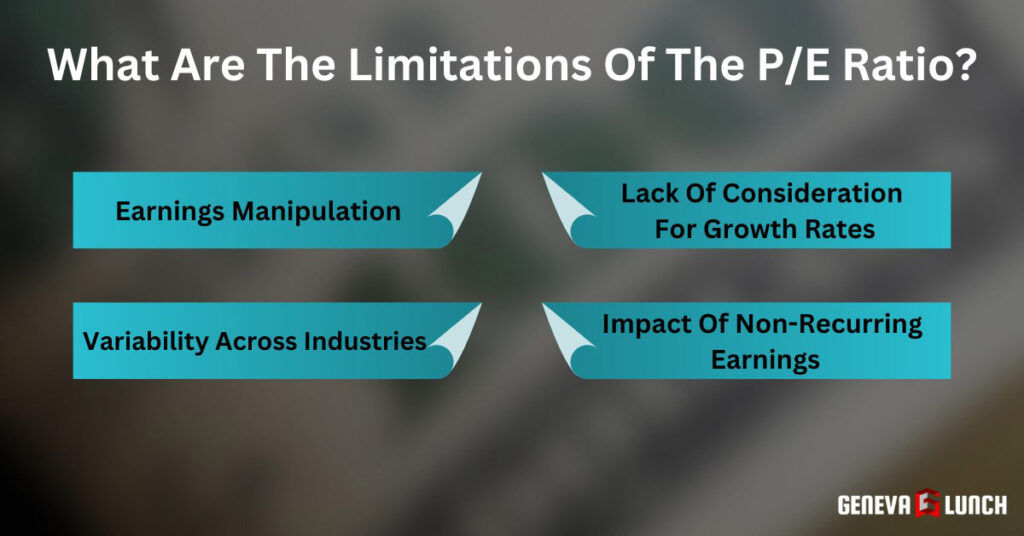
The P/E ratio is a popular tool investors use to value a company’s stock. It shows how much you pay for every dollar of a company’s earnings. However, this ratio has some limits. It doesn’t tell the whole story about a company’s health or future.
Earnings Manipulation
Sometimes, companies change how they report earnings to make things look better than they are, which can make the P/E ratio misleading.
For example, a company may delay certain expenses or rush some income to make profits appear higher. This tricks investors into thinking the company is more profitable, affecting the P/E ratio.
Lack Of Consideration For Growth Rates
The P/E ratio does not consider how fast a company is growing. Two companies may have the same P/E ratio, but one grows faster. The faster-growing company could be a better buy, but you wouldn’t know just by looking at the P/E ratio.
Variability Across Industries
Different industries have different typical P/E ratios. Tech companies often have higher P/E ratios due to fast growth expectations. In contrast, utility companies usually have lower P/E ratios because they grow slowly. Comparing P/E ratios across different industries may not give accurate insights.
Impact Of Non-Recurring Earnings
Sometimes, a company’s earnings include unusual profits or losses that won’t happen again. These are called non-recurring earnings. They can come from selling a business unit or a one-time tax benefit. These earnings can distort the P/E ratio. A high P/E ratio can make a company look overvalued when it’s just a one-time gain boosting the earnings.
Practical Applications Of The P/E Ratio
The P/E ratio helps investors decide how much to pay for a stock based on its current earnings. This ratio is very useful for making smart choices in the stock market.
Stock Selection
When choosing stocks, the P/E ratio can show which companies are priced well. A lower P/E ratio means a stock is cheap compared to its earnings, making it a good choice. But, investors need to look at more than just the P/E ratio to make a good decision.
Market Timing
The P/E ratio can help investors decide when to buy or sell stocks. When the market’s P/E ratio is high, it means stocks are too expensive. A low ratio could mean it’s a good time to buy. Timing the market can be tricky, but the P/E ratio gives useful hints.
Portfolio Management
Managing a portfolio means choosing the right mix of stocks. The P/E ratio helps investors understand which stocks make their portfolios too risky or safe. There are different types of portfolios, such as growth, income, and balance. Each type has a different goal and risk level; the P/E ratio helps manage these risks.
Identifying Overvalued And Undervalued Stocks
The P/E ratio is key to finding stocks that cost too much or too little. Stocks with a high P/E ratio may be overvalued, and those with a low P/E ratio can be undervalued. This information helps investors pick stocks that are likely to do well in the future.
What Strategies Can You Use With The P/E Ratio?

The P/E ratio helps investors pick stocks. You can use this number to determine if a stock is a good deal, growing fast, or better than others. Here are 4 ways to use the P/E ratio:
Value Investing
Value investing means buying stocks that cost less than they are worth. You look for stocks with low P/E ratios. A low P/E ratio can mean the stock is cheap compared to the company’s earnings. Value investors buy these stocks because they think the price will increase later.
Growth Investing
Growth investing focuses on companies expected to grow faster than others. These stocks usually have high P/E ratios, which means people think the company will make more money in the future. Investors pay more for these stocks now, hoping to earn more as the company grows.
Comparative Analysis
Comparative analysis means comparing the P/E ratios of different stocks. You look at companies in the same industry and see how their P/E ratios stack up. This helps you find out which companies would be better investments. When one company’s P/E ratio is much lower than others, it can be a good deal.
Sector Rotation Strategies
Sector rotation strategies involve moving money between market sectors based on P/E ratios. Investors might invest more money in sectors with lower P/E ratios and less in those with higher P/E ratios. They do this to get the best returns as different sectors grow or shrink.
Frequently Asked Questions (FAQs)
How Do Stock Buybacks Affect The P/E Ratio?
Stock buybacks reduce the number of outstanding shares, often leading to a higher P/E ratio if earnings remain constant. This effect can make a stock appear more expensive relative to its earnings, signaling increased investor confidence or strategic corporate maneuvers to enhance shareholder value.
Can The P/E Ratio Predict Future Stock Performance?
While the P/E ratio is commonly used to evaluate stock attractiveness, it is not a standalone predictor of future stock performance. For a more comprehensive analysis, it should be paired with other financial indicators to assess potential growth, market conditions, and company fundamentals.
Can The P/E Ratio Be Used For Non-Equity Investments?
The P/E ratio is typically reserved for equity investments, which evaluate the price of a company’s stock relative to its earnings per share. Alternative metrics such as yield or price-to-book ratios offer more relevant financial insights for non-equity investments like bonds or commodities.
How Reliable Is The P/E Ratio In Volatile Markets?
The P/E ratio can be less reliable in volatile markets as it may not accurately reflect future earnings potential. Rapid price changes can distort the ratio, making it challenging to gauge true investment value. Combining it with other financial metrics is advisable for a fuller analysis.
What Does A Negative P/E Ratio Indicate?
A negative P/E ratio indicates that a company is currently unprofitable, with less than zero earnings. This can suggest financial challenges or a period of significant investments. Investors often view negative P/E ratios as risky, potentially signaling future growth or ongoing struggles.
Why Might Two Companies In The Same Industry Have Different P/E Ratios?
Two companies in the same industry may have different P/E ratios due to variations in growth expectations, profitability, risk levels, and market sentiment. Factors like management efficiency, competitive advantages, and financial stability significantly influence their respective P/E ratios.
Final Word
The P/E ratio helps us understand how much we pay for each dollar of a company’s earnings. It shows if a stock costs more or less compared to its earnings.
When the P/E ratio is high, people expect the company to grow earnings quickly. A low P/E ratio can mean the stock is cheap or the company faces problems. This number is useful in finances because it helps investors make smart choices.
Always compare the P/E ratio to other facts to decide if a stock is a good buy. This will help you manage your finances better and make wise investment decisions.