Bear Market: Causes, Opportunities & Mistakes to Avoid

When the stock market drops significantly, we call it a “Bear Market.” This means stocks are worth less than before and can continue for a while.
A bear market occurs when stock prices fall by 20% or more from recent highs, typically signaling widespread pessimism and negative investor sentiment. Understanding this market condition helps investors make informed decisions about buying, selling, or holding their investments during such periods.
Let’s explore the critical aspects of a bear market and how it can impact your investment decisions.
Key Takeaways
- Short-Selling Opportunities: In a bear market, short-sellers profit by betting against the market, anticipating further declines in stock prices.
- Value Buys: Astute investors can acquire undervalued stocks during a bear market, potentially yielding significant returns as markets recover.
- Long-Term Planning: Investors can use bear markets to plan long-term investments, buying high-quality stocks at lower prices.
- Economic Indicators: A bear market can signal economic shifts, providing insight into future market and economic conditions.
- Potential for Market Recovery: Historically, bear markets are followed by recoveries, where the markets regain and potentially exceed previous highs.
What Is A Bear Market?
A bear market is a term used in finance to describe a significant market decline. It occurs when stock prices fall by 20% or more from recent highs and continue to drop over a sustained period.
This downturn isn’t just a brief dip; it’s a substantial and prolonged period where securities keep losing value. The decline affects many stocks and can last several months to years.
Bear markets are usually triggered by a loss of investor confidence, which can be caused by various economic factors, such as recessions, crises, or financial distress.
Why Is The Bear Market Important?

Bear markets are crucial for many reasons. They mark the natural cycle of financial markets. This cycle alternates with bull markets, where prices rise.
Understanding and identifying bear markets is essential for investors and financial professionals to adjust their financial strategies effectively. These strategies help minimize losses and capitalize on the lower stock prices that bear markets often present.
- Risk Assessment: Bear markets test the financial system’s resilience and an investor’s risk tolerance. They challenge investors to stay calm. They must make smart choices despite falling portfolio values.
- Investment Opportunities: For some investors, bear markets offer opportunities. Prices of stocks become lower, making this a potential time to buy quality stocks at a discount. These opportunities can lead to significant gains when the market eventually recovers.
- Economic Indicators: Bear markets often reflect broader economic trends and signal a weakening economy. As a result, they prompt governments and central banks to make policies. The goal is to stabilize the economy and avoid deep recessions.
- Market Correction: Sometimes, bear markets help correct overvalued stock prices. The market can return to a more sustainable growth path by adjusting these prices to more realistic levels.
Overall, bear markets can be challenging. But they are a vital part of the financial markets. They provide checks and balances that can lead to healthier, stable markets in the long term.
Main Characteristics Of A Bear Market
A bear market is a period of sustained decline in investment prices. While there can be temporary dips in any market, a bear market is characterized by specific conditions that signal a broader downturn. Let’s delve into the 5 key characteristics of a bear market:
Prolonged Decline
The most prominent feature of a bear market is a prolonged decline in asset prices. This is typically defined as a drop of 20% or more from a recent peak, sustained over at least two months. This extended period of downward movement distinguishes a bear market from a short-term correction.
Pessimistic Sentiment
Bear markets are fueled by negative investor sentiment. As prices fall, investors lose confidence in the market’s ability to recover quickly.
This pessimism can become a self-fulfilling prophecy. Investors sell to avoid more losses, driving prices even lower. Fear and panic can dominate the market, leading to irrational investment decisions.
Economic Slowdown
Bear markets often coincide with or even foreshadow a slowdown in the overall economy. Reduced economic activity can lead to lower corporate profits, which can cause stock prices to decline. Rising unemployment and tighter credit can hurt investor confidence and worsen the bear market.
Decreased Trading Volume
As pessimism sets in, trading activity decreases in a bear market. Investors become hesitant to buy into a declining market, and those holding onto stocks may be reluctant to sell at a loss.
This decrease in volume can create a lack of liquidity, making it difficult for investors to enter or exit the market at their desired prices.
Falling Investor Confidence
A hallmark of a bear market is the erosion of investor confidence. Before, hopeful investors may become risk-averse.
They will withdraw their money from stocks to safer investments like bonds or cash. This change in investor behavior drives down stock prices and strengthens the overall bearish feeling.
Causes Of Bear Markets

Bear markets don’t materialize out of thin air. Several underlying factors can trigger a sustained decline in investment prices. Here’s a closer look at 4 significant causes of bear markets:
1. Economic Recession
A bear market is often a companion to a recession, a period of significant decline in economic activity. During a recession, consumer spending weakens, businesses experience lower profits, and unemployment rises. This downturn is hurting the economy.
It has led to lower corporate earnings, which can cause stock prices to drop. Recessions can also create a domino effect. Falling stock prices hurt consumer confidence and slow economic recovery.
2. High Inflation
Inflation refers to a rise in the general price level of goods and services over time. While moderate inflation is usually manageable, high inflation can harm the stock market.
When inflation is high, the purchasing power of future earnings decreases, leading to lower stock prices. Investors hesitate to pay the same price for stocks expected to earn less.
3. Interest Rate Hikes
Central banks use interest rates as a tool to manage the economy. They may raise interest rates to slow down borrowing and spending when inflation is high. While this can help control inflation, it can also negatively affect the stock market.
Higher interest rates raise businesses’ borrowing costs, stifling investment and growth. This, in turn, can lead to lower corporate profits and declining stock prices.
4. Political Instability
Political instability can create uncertainty and risk aversion among domestic and international investors. Wars, terrorist attacks, and big scandals can scare investors, leading them to sell stocks and move money into safer havens, like gold or treasuries.
This sudden shift in investor behavior can trigger a decline in stock prices and potentially lead to a bear market.
5. Global Events
Global events, such as wars, pandemics, and natural disasters, can significantly affect stock prices and lead to a bear market.
Wars
When a war starts, it creates a lot of uncertainty. Investors worry about the future and can sell their stocks. This selling can cause stock prices to fall a lot.
Pandemics
A pandemic can slow down the whole world. Many businesses have to close or slow down, and people buy less. This drop in business can lower stock prices.
Natural disasters
Natural disasters like hurricanes or earthquakes can destroy property and halt businesses. This damage can cause significant financial loss and lower stock prices.
Historical Context Of Bear Markets
Bear markets are a recurring feature of the financial landscape. While they can be unsettling, understanding their historical context can provide valuable perspective. Here, we’ll explore some significant bear markets and the lessons they offer.
Overview Of Major Bear Markets
Several bear markets have left a significant mark on the financial world throughout history. Let’s delve into four notable examples including the Great Depression, the Dot-Com Bubble, and the COVID-19 Pandemic:
The Great Depression (1929)
This historic bear market, triggered by the 1929 stock market crash, remains the worst in U.S. history. Prices fell by over 80%. Many factors caused this, including too much speculation, buying on margin, and a lack of regulation.
These factors led to a total meltdown of investor confidence. The Great Depression is a stark reminder of the dangers of unchecked market excitement.
The Dot-Com Bubble (2000)
The late 1990s saw a surge in tech stocks. Many had inflated valuations due to the rapid rise of internet companies. When the bubble burst in 2000, the Nasdaq Composite Index plummeted over 80%. This bear market showed that investing should be based on fundamentals. It’s not about hype.
The Global Financial Crisis (2008)
This crisis originated in the U.S. housing market with the collapse of subprime mortgages. The failure of big banks caused a global recession and a severe bear market. It showed how the financial system is interconnected and the dangers of taking too much risk.
The COVID-19 Pandemic (2020)
The unprecedented global pandemic caused a swift and sharp decline in stock prices in early 2020. The bear market was short. But, it showed how markets are vulnerable to surprises.
Lessons Learned From Past Bear Markets
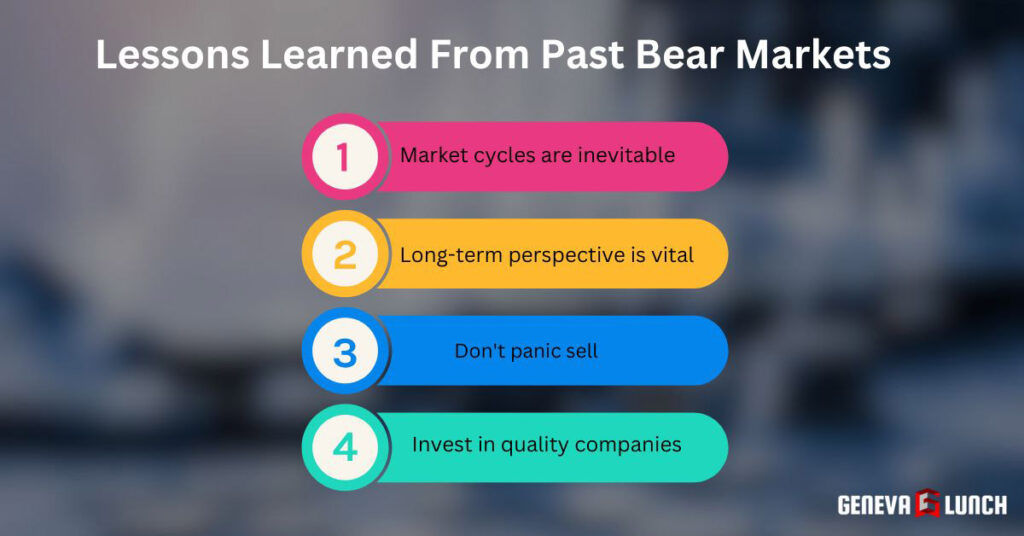
While each bear market has its unique characteristics, valuable lessons can be gleaned from history:
- Market cycles are inevitable: Boom and bust cycles are a natural part of the investment landscape. Bear markets are a reminder. Growth is always followed by decline.
- Long-term perspective is vital: Long-term investment helps weather market volatility. Investors with a diverse portfolio can weather bear markets. They can also gain from the eventual recovery.
- Don’t panic sell: Fear and panic can lead to irrational investment decisions during a bear market. It’s crucial to stick to your investment strategy and avoid knee-jerk reactions.
- Invest in quality companies: Focus on companies with strong fundamentals and solid track records. These companies provide stability during turbulent times.
Phases Of A Bear Market
A bear market doesn’t unfold all at once. It typically progresses through several distinct phases, each with its characteristics. Understanding these phases can help investors navigate a bear market and make informed decisions.
Initial Decline
The initial decline marks the beginning of a bear market. This phase can be subtle, with stock prices experiencing a gradual downward trend.
Investors may initially dismiss it as a short-term correction, overlooking the potential for a more extended decline. However, some early warning signs are present. These signs include decreasing investor confidence or harmful economic data.
Reflexive Bounce
As prices fall, some investors see an opportunity to buy at a discount, triggering a temporary price increase.
This reflexive bounce can be fueled by bargain hunters or short-term traders hoping to capitalize on a quick turnaround. But, this rise is usually short. Then, economic or market worries cause more selling.
Fundamental Downturn
The core of a bear market is the fundamental downtrend. During this phase, economic factors, negative news events, or a loss of investor confidence take hold, causing a sustained decline in stock prices.
This is the longest and most volatile stage of a bear market, with significant price swings and emotional selling.
Bottoming Phase
The bottoming phase signifies the end of the decline and the potential beginning of a market recovery. It often has decreasing volatility and more trading.
Long-term investors see it as oversold and hunt for bargains. Finding the exact bottom takes a lot of work. However, signs like stable prices and good data can suggest a turnaround.
Impact Of Bear Markets
A bear market occurs when stock prices fall significantly over time. This kind of market can change how investors act and grow the economy.
How Does A Bear Market Affect Investors?
A bear market occurs when stock prices fall significantly over a long time. This kind of market can make investors worry. When prices go down, many think they will lose money.
Some may sell their stocks to prevent further losses. Others wait and see, hoping the prices will go back up.
Psychological Impact
A bear market can make investors feel stressed or scared. Watching the value of stocks go down can be challenging. Some people may panic and make quick decisions. This stress can affect other parts of their lives, too.
Financial Losses
During a bear market, many investors see their money shrink. When they sell their stocks at low prices, they lock in their losses, turning paper losses into actual money losses.
Investors who need money during a bear market may have to sell at the wrong time, which can lead to significant financial problems.
On Companies
When a bear market occurs, companies can face hard times. People may spend less because they are worried, and companies sell less and make less money. Some companies even have to stop hiring new people or cut jobs.
Stock Prices
During bear markets, stock prices fall. This means that if you own stock in a company, it may be worth less than before. This price drop can happen quickly and affect many stocks simultaneously.
Corporate Earnings
Bear markets can lower corporate earnings. When people buy less, companies earn less money. This can be tough for businesses, tiny ones. Companies need to find ways to save money or find new ways to make money.
How Does A Bear Market Affect The Economy?
In a bear market, stocks lose value. Many people see their investments shrink, which can make them spend less money. Businesses may earn less and slow down their growth plans. This chain reaction can weaken the whole economy.
Recession
A bear market can lead to a recession. A recession happens when the economy stops growing for a long time. During a bear market, if people and companies spend less, the economy does not grow. This can start a recession.
Unemployment Rates
When there is a bear market, companies can make less money. When they earn less, they may need to cut costs. Often, they do this by letting go of workers. So, during bear markets, more people lose their jobs. This increases unemployment rates.
Strategies For Surviving A Bear Market

In a bear market, stock prices drop, and the mood can feel gloomy. But there are ways to get through these challenging times. Let’s explore how to protect your money and find new opportunities to grow it.
Portfolio Diversification
One smart move is to spread your investments across different types. This way, when one kind does poorly, others can do well. When talking about types of portfolios, you can choose from growth, income, or a mix of both, which helps balance the risks.
Asset Allocation
Asset allocation means deciding how much of your money goes into stocks, bonds, or other investments.
Risk Management
Managing risk means not putting all your eggs in one basket. It’s essential to know how much risk you can take. When the market drops, you should be okay and able to wait for a better time.
You can limit how much money you want to risk and ensure you can handle any losses without significant problems.
Defensive Investing
Defensive investing means being careful with your money. When the market is bad, you buy stocks that usually do not lose much value. These are often in companies that sell things we always need, like food and electricity.
Blue-Chip Stocks
Blue-chip stocks are shares in big, strong companies that have been around for a long time. They are known for being safe even when the market is not doing well, and these companies usually make money even in hard times.
Dividend Stocks
Dividend stocks are shares in companies that pay you money regularly. Owning these can be a smart move in a bear market. The extra money from dividends can help, especially when the prices of stocks are falling.
Bonds and Fixed-Income Securities
Bonds and fixed-income securities are loans you give to companies or the government. In return, they pay you back with interest. They are safer than stocks because they promise to pay you back when the market is down.
Long-Term Investment Approaches
Investing for the long term helps you ride out the ups and downs of the market. With smart financial investment planning, you don’t have to worry about prices going up or down daily. Instead, you look at your investments as something that will grow over many years.
Buy And Hold Strategy
The buy-and-hold strategy is simple. You buy and keep stocks for a long time, not sell them when the market drops. Over time, the market usually goes up, which means your investments can grow if you are patient and keep your stocks during the bear market.
Dollar-Cost Averaging
Dollar-cost averaging means you invest a set amount of money at regular times. For example, you can buy $100 worth of stocks every month, no matter the price.
When prices are low, you get more shares for your money. This can be an excellent way to build up your investment over time without trying to guess when the market will go up or down.
Opportunities In Bear Markets
While bear markets can be daunting, they also present potential opportunities for savvy investors. Here, we explore some strategies to consider during a market downturn:
Identifying Undervalued Stocks
Bear markets can create buying opportunities for quality stocks that have been oversold. Investors can buy valuable assets at low prices. They should focus on companies with solid fundamentals.
These companies have a history of profit and a lasting competitive advantage. Conducting thorough research and employing valuation techniques can help identify such undervalued stocks.
Investing In Safe-Haven Assets
During uncertain times, investors seek safe-haven assets. These assets tend to hold or gain value when the stock market falls. Here are two prominent examples:
Gold And Precious Metals
Gold has always been a safe-haven asset, seen as a store of value in turbulent times. Other precious metals, such as silver and platinum, can also offer similar benefits.
Treasury Bonds
Issued by the U.S. government, Treasury bonds are considered relatively risk-free investments. They offer steady income from interest payments. They can stabilize a portfolio in a bear market.
Benefits Of Rebalancing Your Portfolio
A bear market can disrupt your portfolio’s asset allocation. Rebalancing involves adjusting your portfolio. You do this to bring it in line with your target allocation.
This may involve selling assets that performed better than expected, like stocks, and buying more of those that performed worse, like bonds. Rebalancing helps maintain your desired level of risk and can be a strategic move during a bear market.
Common Mistakes To Avoid During A Bear Market
Many investors make decisions that can hurt their portfolios during a bear market. Here are some common errors you should try to avoid. This advice includes insights from financial advisors who understand these challenges well.
Panic Selling
Panic selling, fueled by fear and the need to avoid further losses, is a detrimental strategy during a bear market.
Selling your investments at a low point locks in those losses and prevents you from participating in the eventual recovery. Sticking to your investment plan and maintaining a long-term perspective is crucial.
Overreacting To Market Volatility
Market volatility, with sharp price swings and periods of uncertainty, is a hallmark of bear markets.
However, constantly reacting to these fluctuations can lead to poor investment decisions. Focus on the long term of your investments. Avoid short-term emotions. This is key.
Ignoring Fundamentals
While market sentiment can play a role in a bear market, it’s essential to maintain sight of your investments’ underlying fundamentals. Focus on companies with strong finances.
They also need a solid track record and a lasting competitive edge. These companies are in a better position to weather the storm. They will emerge stronger when the market recovers.
Chasing Performance
The temptation to chase past performance, hoping to recoup losses quickly, can be strong during a bear market. However, this often leads to investing in risky or trendy assets without proper research.
Stay true to your investment strategy and avoid chasing short-term gains that could lead to even bigger losses.
Recovery And Post-Bear Market Strategies

Bear markets can be scary. But they are always followed by recovery. Here, we’ll explore strategies to navigate the post-bear market. They can help you take advantage of the upswing.
Signs Of Market Recovery
When a bear market ends, you can see signs that things are improving. Stock prices start to rise steadily, not just for a day or two, but for a longer time.
Also, people feel more confident about spending money, and companies report better profits. More jobs are available, and fewer people say they are worried about money.
Adjusting Investment Strategies
After a bear market, it’s smart to review your investment plan again. Lower prices offer new opportunities to make money. Consider buying stocks that performed well during tough times. It’s also an excellent time to mix different types of investments to keep your money safe.
Reassessing Risk Tolerance
It’s essential to know how much risk you can handle. After a bear market, you can take less risk. This is a good time to decide what makes you feel safe. You can choose safer investments if you get worried during big market drops.
Rebuilding Your Portfolio
To rebuild your portfolio, buy stocks likely to grow over time. Look for strong companies with good management. Also, consider adding bonds or other safe assets to balance your investments. This helps protect your money from future market drops.
Learning From The Bear Market Experience
A bear market can be a valuable learning experience. Reflect on your investment decisions during the downturn and identify areas for improvement.
Understanding market cycles and using sound investment principles can help you refine your investment strategy and make more informed choices in the future. You can also better navigate bear and bull markets.
FAQs
What Is The Cause Of The Bear Market?
The cause of the bear market typically involves widespread pessimism and negative investor sentiment. Factors include economic downturns, geopolitical crises, or excessive valuations in the stock market. These elements lead to prolonged downward trends in stock prices, affecting various sectors.
How Often Do Bear Markets Occur?
Bear markets typically occur every 3.6 years on average, but this can vary based on economic conditions. These downturns, defined by a 20% drop from recent highs, reflect periods of economic uncertainty and investor pessimism. Understanding these cycles is crucial for strategic investment planning.
What Is The Longest Bear Market In History?
The longest bear market in history occurred during the Great Depression, lasting from 1929 to 1932. This prolonged downturn in the stock market saw a devastating decline of nearly 90%. It marked a critical period of economic hardship worldwide, profoundly impacting financial markets and investors.
Is Bear Market Good Or Bad?
Bear markets are typically viewed as challenging for investors, as stock prices decline by 20% or more from recent highs, often signaling economic downturns. However, they can offer opportunities to buy quality stocks at lower prices, setting the stage for future gains when the market rebounds.
Who Benefits From A Bear Market?
In a bear market, savvy investors who practice short-selling often benefit. By betting against market trends, these investors can profit when stock prices fall. Additionally, value investors can capitalize by purchasing undervalued stocks during the downturn, setting the stage for future gains.
Is It Good To Buy In A Bear Market?
Buying in a bear market can be a strategic move for long-term investors. While it involves risks, purchasing stocks at lower prices may offer high potential returns as markets recover. This approach best suits those with a solid understanding of market trends and risk tolerance.
What Should You Do If A Bear Market Begins?
When a bear market begins, consider diversifying your portfolio to mitigate risk. Prioritize stable, dividend-paying stocks and consider buying opportunities in undervalued sectors. Avoid panic selling; review your investment strategy to ensure it aligns with your long-term financial goals.
Can You Make Money During A Bear Market?
Yes, you can make money during a bear market by employing strategies like short-selling, where investors profit from declining stock prices. Additionally, bear markets offer the chance to buy high-quality stocks at lower prices, setting the stage for future gains when the market rebounds.
Final Words
In a bear market, stock prices fall for a long time. This happens when many people sell their stocks, worried they may lose money. But it’s not all bad. Smart investors can buy stocks for low prices and make money later.
Everyone should watch the market closely and make wise choices. A bear market doesn’t last forever. Stocks usually start to go up again after some time. Remember, even when the market is down, you can still plan for your future.