Behavioral Finance: Biases, Theory, Models & Decision Making

Financial decisions aren’t always made on numbers alone; emotions and psychological factors often play a significant role. Understanding why people make decisions that may seem irrational is crucial in the world of finance. This is where behavioral finance comes in. But what is behavioral finance, exactly?
Behavioral finance is a field that examines how psychological factors influence financial decisions. It explores why individuals often make irrational choices that conflict with economic theory. This study helps understand and predict patterns in investor behavior and market dynamics.
In this article, we’ll explore the key aspects of behavioral finance. We’ll also cover the common biases, theoretical models, and decision-making processes.
Key Takeaways
- Essence of Behavioral Finance: Behavioral finance studies the psychological impacts on financial decision-making and market behavior
- Explanation of Market Anomalies: It provides insights into why markets might behave irrationally or unpredictably.
- Improvement of Financial Practices: Helps in crafting strategies that account for human biases, enhancing investment outcomes.
- Enhancement of Risk Management: Guides investors and firms in managing risks by understanding emotional responses.
- Optimization of Investor Behavior: Behavioral finance aims to improve investor behavior through awareness and mitigation of psychological biases.
What Is Behavioral Finance?
Behavioral finance studies how psychology affects financial decisions. It shows that people do not always act rationally when it comes to money. Instead, emotions and biases influence their choices. This field looks at why people may buy high and sell low, contrary to traditional financial advice.
Behavioral finance also explores how social pressures and personal beliefs impact investment decisions. It uses real-life scenarios to explain financial behavior, helping us understand why people often repeat the same financial mistakes. This understanding can lead to better financial planning and investing strategies.
Why Is Behavioral Finance Important?
Behavioral finance is important because it helps us understand why people make financial decisions that might not always be rational. It looks at how emotions and psychology affect how you manage your finances, including investing and saving. This field shows that fear, greed, and other feelings can drive financial markets.
Here are the key points to consider regarding the importance of behavioral finance:
- Emotion’s Role: Shows how fear and greed can drive market dynamics.
- Improved Decision Making: Aids in recognizing and avoiding typical financial errors.
- Policy Influence: Guides the development of financial policies that consider human behavior.
Understanding behavioral finance enhances our ability to craft strategies that mitigate emotional impacts. It promotes better financial health across both personal and wider economic environments.
Key Concepts In Behavioral Finance
Behavioral finance explores several concepts that explain why individuals often make irrational financial decisions. These concepts focus on psychological biases and heuristics that can lead to suboptimal financial behavior. Below, we break down some of the key biases and heuristics that play a significant role in financial decision-making.
What Are The Biases In Behavioral Finance?

Biases in behavioral finance are tendencies or habits that can lead people to make irrational decisions about money. These biases often stem from our emotions or cognitive errors. Here are some common biases:
Overconfidence
Overconfidence bias occurs when people have too much confidence in their own abilities, leading them to take greater risks in their financial decisions.
For example, a person may think they can time the stock market perfectly, causing them to buy stocks at high prices and sell them at low prices, which can result in significant losses.
Anchoring
Anchoring happens when individuals rely too heavily on the first piece of information they receive. In finance, this may mean basing investment decisions on initial price levels rather than current data.
For instance, if a stock was once priced at $100 and drops to $80, a person may still think it’s worth $100 and make a poor investment decision.
Loss Aversion
Loss aversion refers to people’s tendency to prefer avoiding losses rather than acquiring equivalent gains. For example, someone may avoid selling a losing stock to prevent realizing a loss, even if it’s financially sensible to sell.
People often feel the pain of losing $50 more strongly than the pleasure of gaining $50.
Confirmation Bias
Confirmation bias leads people to favor information that confirms their existing beliefs. In finance, an investor might focus only on news that suggests a stock will rise and ignore news that suggests otherwise.
This can lead to biased decision-making and financial loss.
Mental Accounting
Mental accounting involves treating money differently depending on its source or intended use. For example, someone may treat $1,000 from a tax refund differently from $1,000 earned from work, perhaps spending the refund more freely.
This can lead to inefficient financial management as it affects how people save, spend, and invest their money.
What Is A Behavioral Heuristic?
Behavioral heuristics are simple, mental shortcuts we use to make decisions quickly. These heuristics can be helpful, but they often lead to errors in judgment, particularly in complex situations like financial investing. Here are some of the most influential heuristics in behavioral finance:
Availability Heuristic
The availability heuristic is when people judge the likelihood of an event based on how easily examples come to mind. For instance, after hearing about stock market crashes, individuals may overestimate the risk of investing.
This can influence decisions, such as avoiding stocks, even though they can be beneficial long-term investments.
Representativeness Heuristic
Representativeness heuristic occurs when people incorrectly judge the probability of an event by comparing it to an existing prototype in their minds.
For example, someone may assume a good company is always a good investment, while ignoring the underlying financial metrics.
Anchoring and Adjustment
Anchoring and adjustment heuristic is when individuals use an initial value as a starting point, then adjust it to make a decision. However, the adjustments are typically insufficient.
For instance, if a stock starts the day at $150 and drops to $130, an investor may think it’s a bargain without considering why it dropped.
Prospect Theory
Prospect theory explains how people decide between alternatives that involve risk, where the probabilities of outcomes are uncertain. The theory suggests that people value gains and losses differently, leading to decisions that deviate from standard logic.
For example, people often reject a sure gain in favor of a gamble with lower expected value if they see a chance to avoid a loss. This can explain why investors hold onto losing stocks too long, hoping to break even.
Emotions And Financial Decision Making
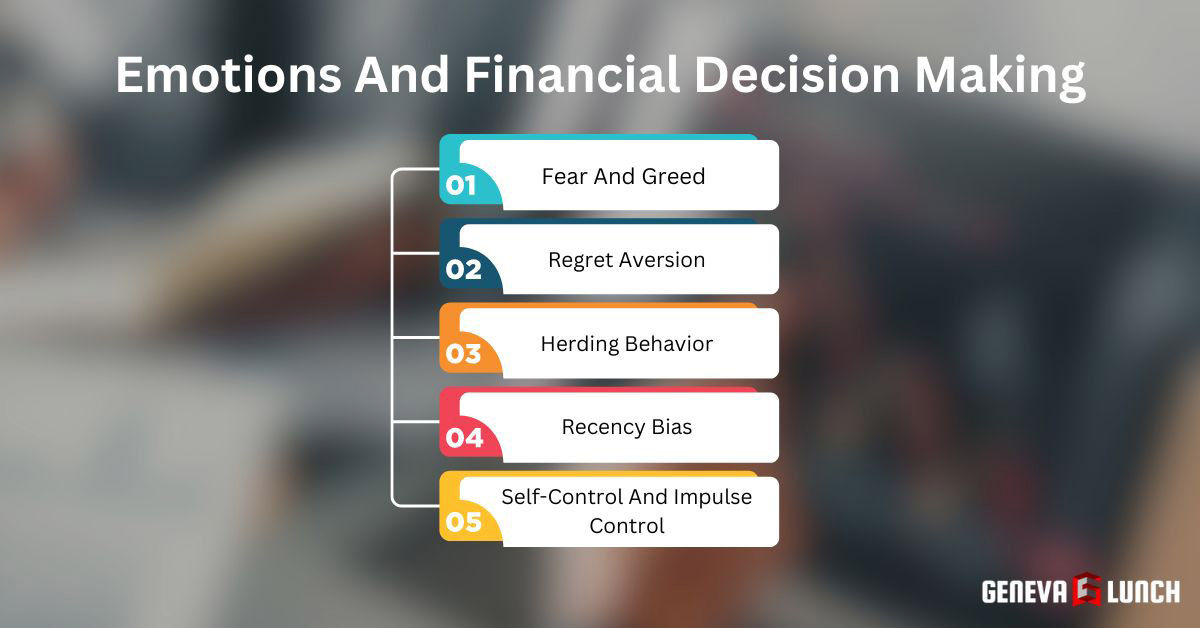
Emotions play a significant role in how people make financial decisions. Often, our feelings can lead us to act in ways that may not be in our best financial interest. Here are some common emotional factors that impact financial decisions:
Fear And Greed
Fear and greed are powerful emotions that influence financial decisions. Fear can lead to selling assets too quickly when their prices drop, while greed can cause buying more when prices are high, hoping they will go even higher.
For instance, during a market crash, fear can drive an investor to sell stocks at a 30% loss, missing out on potential recovery.
Regret Aversion
Regret aversion is the desire to avoid the feeling of regret after making a decision. It affects financial decisions by making individuals hesitant to make choices that could lead to a loss.
For example, an investor can avoid investing in a new technology company because they fear it might fail, despite potential high returns.
Herding Behavior
Herding behavior occurs when individuals follow the actions of a larger group, regardless of their own beliefs or the underlying information. In finance, this can lead to stock market bubbles or crashes.
For instance, if many people start buying a particular stock, others may follow, causing its price to inflate unnaturally.
Recency Bias
Recency bias is the tendency to weigh recent events more heavily than earlier events. In financial decision-making, this might lead someone to expect the continuing performance of a stock based on its recent success.
For example, if a stock has risen 10% in the past month, an investor may assume it will keep rising.
Self-Control And Impulse Control
Self-control and impulse control are crucial in managing finances effectively. Lack of impulse control can lead to excessive spending or risky investments on a whim.
For instance, an individual may spend $200 on a spontaneous shopping spree instead of saving for future financial goals, thereby jeopardizing their budget and savings plan.
Behavioral Finance And Investing
Behavioral finance helps us see why people make certain investment choices and how to make better ones. It studies the way personal biases impact investing and suggests ways to reduce these effects. This section explores some common errors investors make due to these biases and outlines strategies to help minimize these errors.
Common Pitfalls In Investment Decisions
Investors often fall into traps due to common behavioral biases that affect decision-making. Recognizing these pitfalls can greatly enhance investment outcomes. Here are some frequent investment errors driven by psychological biases:
Herd Behavior
Herd behavior describes when investors copy others instead of analyzing information themselves. This can lead to inflated stock prices or severe crashes.
For instance, if a large number of investors decide to buy a specific stock because everyone else is buying, the stock’s price may initially skyrocket. However, it might plummet later when these investors decide to sell off their shares all at once.
Home Bias
Home bias is when investors mostly choose companies from their own country instead of considering those from other countries. This behavior can decrease diversification and increase investment risk.
Research shows that investors often keep over 70% of their portfolios in domestic stocks, which can lead to higher losses during domestic market downturns.
Familiarity Bias
Familiarity bias happens when investors prefer to invest in markets or companies they know well, even if better opportunities exist elsewhere.
This can be seen when employees invest a large part of their savings in the stock of the company where they work, overlooking the importance of spreading their investments across different sectors or regions.
Strategies To Mitigate Behavioral Biases
To combat the influence of behavioral biases, several effective strategies can be applied. These strategies are designed to counteract the psychological tendencies that often lead to poor investment decisions.
Diversification
Diversification is a key strategy to reduce risks by spreading investments across various asset types, industries, and geographic locations. Diversification helps lessen the blow of a poor performance by any single investment.
For example, if one stock declines, others in different sectors or regions may not, which can help stabilize overall portfolio performance.
Contrarian Strategies
Contrarian strategies are used by investors who choose to go against the current market trends. They buy stocks when most are selling and sell when others are buying.
This method can exploit market overreactions and result in profitable opportunities, especially when market trends reverse.
Use Of Financial Advisors
Employing financial advisors can provide a buffer against personal investment biases. Advisors offer experienced insights and can guide investors towards more balanced decisions.
They help investors maintain discipline in their investment strategies and avoid common mistakes like panic selling or excessively speculative investing.
Behavioral Portfolio Management
Behavioral portfolio management integrates traditional investment strategies with insights into investor behavior. This approach helps create portfolios that align with both financial goals and emotional well-being, considering personal risk tolerance and emotional responses to market changes. Key elements include:
- Personalized Risk Tolerance: Tailoring portfolios to match individual comfort with risk.
- Goal-Oriented Investment: Choosing investments based on personal financial goals.
- Behavioral Coaching: Advising investors to maintain strategy during market volatility, helping avoid impulsive decisions.
This method aims to maximize returns while minimizing emotional stress.
Behavioral Finance In Practice
Behavioral finance offers practical ways to apply psychological insights to manage money better, both in investment management and personal finance. These applications help individuals and institutions make more informed decisions, taking into account human behavior and its effect on financial outcomes.
Applications In Investment Management

In the realm of investment management, behavioral finance is used to enhance portfolio design and decision-making. By understanding and anticipating common biases, financial professionals can structure investments effectively. Here’s how some key concepts are applied:
Behavioral Portfolio Theory
Behavioral Portfolio Theory suggests that investors use layers of assets to address different goals and risks.
For example, one might keep bonds for safety and stocks for growth, treating each “layer” as a separate mini-portfolio. This theory explains why some investors may keep high-risk assets even if overall they seem risk-averse.
Behavioral Alpha
Behavioral Alpha is about earning extra returns by exploiting behavioral biases in the market.
For instance, a fund manager may identify stocks undervalued due to investors’ overreactions to bad news and invest in them before their prices rebound, gaining an advantage over less insightful competitors.
Adaptive Market Hypothesis
The Adaptive Market Hypothesis combines principles from economic theory with behavioral finance. It suggests that market efficiency isn’t constant but evolves as participants adapt to changes.
For example, during a financial crisis, markets may become less efficient as panic and herd behavior increase, providing opportunities for informed investors to profit.
What Is Behavioral Finance In Personal Finance?
Behavioral finance in personal finance examines how individual financial behaviors are influenced by psychological factors. It provides insights into why people make the financial decisions they do. Here’s how these insights are applied:
Savings And Spending Patterns
Behavioral finance studies how psychological factors affect saving and spending. It shows that people may spend a windfall more freely than regular income- a concept known as mental accounting.
For instance, someone may use a $1,000 bonus on luxury items they wouldn’t normally buy, rather than saving it.
Debt Management And Behavioral Biases
Debt management often struggles against biases like the tendency to underestimate future expenses. This can lead to overuse of credit and high debt loads.
For example, people may take on a new credit card offer thinking they will pay off the balance quickly, but end up only paying the minimum each month, accruing large amounts of interest.
Retirement Planning And Behavioral Pitfalls
Behavioral finance identifies issues like short-term thinking, which can disrupt retirement planning. Many fail to save adequately for retirement because they focus on immediate financial needs rather than future ones.
For example, only 36% of Americans think they’re on track with their retirement savings, often because they prioritize current spending over future savings.
Behavioral Finance And Technology
Behavioral finance and technology intersect to greatly enhance how financial services are provided and decisions are made. Technology helps in identifying and overcoming biases in financial behaviors through innovative tools and data analysis. This section explores the role of technology in behavioral finance, as well as the impact of big data on financial decision-making.
Role Of Technology In Behavioral Finance
Artificial intelligence (AI) and machine learning are reshaping behavioral finance. It analyzes vast amounts of data to detect patterns that humans may overlook.
Use Of AI And Machine Learning
Artificial intelligence (AI) and machine learning are reshaping behavioral finance by analyzing vast amounts of data to detect patterns that humans may overlook. These technologies help predict irrational financial behaviors driven by emotions and enable more rational decision-making. Key impacts of AI and machine learning in behavioral finance include:
- Pattern Detection: AI systems can quickly identify trends and anomalies in financial markets, which helps investors make informed decisions.
- Emotion Recognition: Machine learning algorithms analyze data to determine when decisions are likely influenced by emotions rather than logic.
- Decision Support Tools: AI assists in developing applications that guide users toward more systematic and disciplined investing, potentially increasing returns while minimizing risks.
By integrating AI and machine learning, financial tools are becoming more adept at helping investors overcome biases and execute more effective financial strategies.
Behavioral FinTech Innovations
Behavioral FinTech refers to technological innovations that incorporate behavioral finance principles to improve personal finance management. Innovations such as apps that analyze spending habits and suggest budget improvements or investment adjustments are becoming common.
For instance, some apps nudge users to save more by showing how small savings can accumulate over time based on user-specific spending data.
Big Data And Behavioral Analysis
Big data is crucial in financial services. It provides detailed insights into how people behave financially and helps companies improve their services. This massive amount of data, when properly analyzed, can reveal trends and patterns that are not visible through traditional analysis methods.
How Big Data Shapes Financial Services
Big data fundamentally changes financial services by enabling tailored offerings and enhanced understanding of consumer behavior. Financial institutions analyze vast amounts of data to improve decision-making and service personalization.
Key ways big data shapes financial services include:
- Customization of Services: Companies personalize products like loans and credit cards based on customer data insights.
- Risk Assessment: Detailed historical data helps in accurately evaluating client risks.
- Customer Retention: Analysis of transaction patterns aids in developing strategies to keep clients.
This approach allows financial services to operate more efficiently and respond better to customer needs.
Predictive Models And Consumer Behavior
Predictive models in behavioral finance use big data to forecast future behaviors and trends. These models analyze past consumer actions to predict how they may behave in similar situations in the future.
For instance, banks may use predictive models to determine who might default on a loan, by analyzing past payment histories and purchasing behaviors, thereby reducing risk and improving decision-making in lending.
Behavioral Finance Tools And Techniques
Behavioral finance tools and techniques offer valuable insights into how psychological factors affect financial decisions. This section delves into both the theoretical models that help us understand financial behavior and the practical tools used to analyze and influence investor behavior.
What Is A Behavioral Model In Finance?
Behavioral models in finance help explain why people make financial decisions that don’t always align with traditional economic theories. These models incorporate psychological aspects into financial decision-making.
Prospect Theory Model
The Prospect Theory Model explains how people value gains and losses differently, leading them to make decisions that can seem irrational.
For example, individuals may avoid risks that could lead to a gain but accept risks to avoid a certain loss. This model shows that losing $100 feels more painful than the joy of gaining $100.
Mental Accounting Framework
The Mental Accounting Framework suggests that people categorize and treat money differently based on its source or intended use.
For instance, someone may treat $1,000 from a tax refund less cautiously than $1,000 earned from months of work. This can lead to differing spending and saving behaviors.
Behavioral Asset Pricing Model
The Behavioral Asset Pricing Model incorporates psychology to understand how assets are valued and priced in the market.
It considers factors like investor sentiment, market trends, and overreactions to news events, which traditional models may overlook. For example, this model can explain why stock prices might soar irrationally during a tech boom.
Tools For Analyzing Investor Behavior
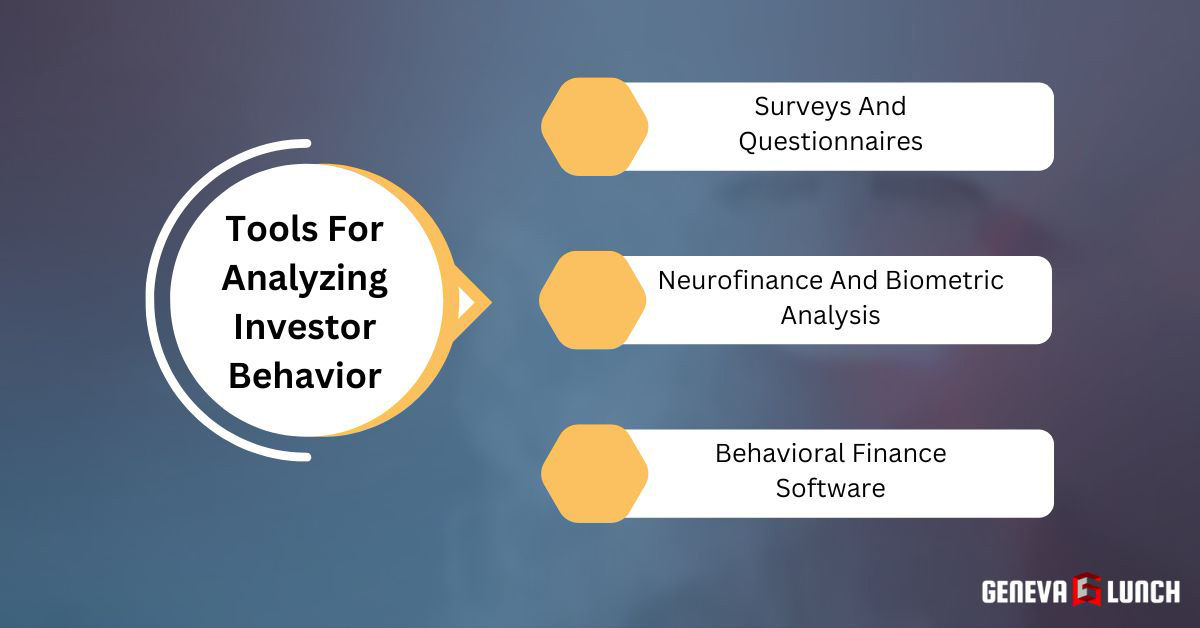
Practical tools and techniques are used to study and understand investor behavior. They provide insights that can improve financial advising and portfolio management.
Surveys And Questionnaires
Surveys and questionnaires are simple yet effective tools for gathering data about investor attitudes and behaviors. They can reveal patterns such as risk aversion or a preference for certain types of investments, helping advisors tailor their advice.
For instance, a questionnaire may show that 70% of respondents prefer real estate over stocks due to perceived stability.
Neurofinance And Biometric Analysis
Neurofinance and biometric analysis use technology to study how the brain and body react during financial decision-making.
For example, using eye-tracking technology or heart rate monitors can reveal how stressed or excited individuals are when making investment choices, helping to understand their risk tolerance better.
Behavioral Finance Software
Behavioral finance software utilizes algorithms and data analysis to predict and analyze investor behavior. This software can, for example, track an investor’s tendency to sell during market downturns, providing insights that can help in developing strategies to counteract panic selling or other irrational behaviors.
These tools and techniques provide a richer understanding of the financial market by considering the human elements that influence financial decisions.
FAQs
What Role Do Heuristics Play In Behavioral Finance?
Heuristics in behavioral finance are mental shortcuts that help people make quick decisions without deep analysis. However, these shortcuts can lead to errors in judgment. It may cause someone to overestimate the risk of an investment based on recent news stories, rather than on long-term data.
What Are Some Common Biases Identified In Behavioral Finance?
Common biases in behavioral finance are overconfidence, loss aversion, and confirmation bias. Overconfidence leads individuals to overestimate their knowledge. Loss aversion makes losses feel more severe than gains. Confirmation bias causes people to focus on information that supports their beliefs.
How Does Overconfidence Lead To Bad Investment Decisions?
Overconfidence can lead to bad financial investment decisions by making investors believe they can predict market moves better than they actually can. This might lead them to trade too frequently, take on too much risk, or hold onto losing investments too long, expecting a turnaround.
Can The Fear Of Missing Out (FOMO) Impact My Financial Planning?
Yes, the fear of missing out (FOMO) can significantly impact financial planning. It can drive impulsive decisions, like investing in a trending stock without proper research. This might lead to poorly timed investments and increased risk, detracting from a well-considered financial strategy.
How Can I Avoid Herd Mentality When Making Investment Choices?
To avoid herd mentality in investment choices, focus on your individual financial goals and risk tolerance. Do your research or consult with a professional rather than following popular trends. This helps maintain a rational approach to investing, independent of crowd-driven market sentiments.
Does Mental Accounting Affect How I Budget And Spend Money?
Yes, mental accounting affects how you budget and spend by causing you to treat money differently based on its source or intended use. For example, you may be more likely to splurge with a holiday bonus than with regular salary. Recognizing this bias can help make more rational spending decisions.
Can Behavioral Finance Principles Be Used To Design More Effective Investment Strategies?
Yes, behavioral finance principles can be used to design more effective investment strategies by accounting for human emotions and biases. Strategies can be tailored to manage psychological factors, such as overconfidence and loss aversion, ensuring that decisions are more data-driven.
How Can Behavioral Finance Help Improve Personal Finance Management?
Behavioral finance can improve personal finance management by making you aware of your biases, like spending biases and the tendency to underestimate future needs. This can help you plan better for long-term goals, manage debt wisely, and save more effectively, leading to better financial management.
Final Words
Behavioral finance offers invaluable insights into how psychological factors shape financial decisions and market behavior. By understanding the biases and emotional influences that drive these decisions, individuals and companies can make more informed, rational choices. Embracing the principles of behavioral finance not only helps mitigate risks but also enhances overall financial strategy and performance.